Tracking Voter Shifts in Financial Anxiety
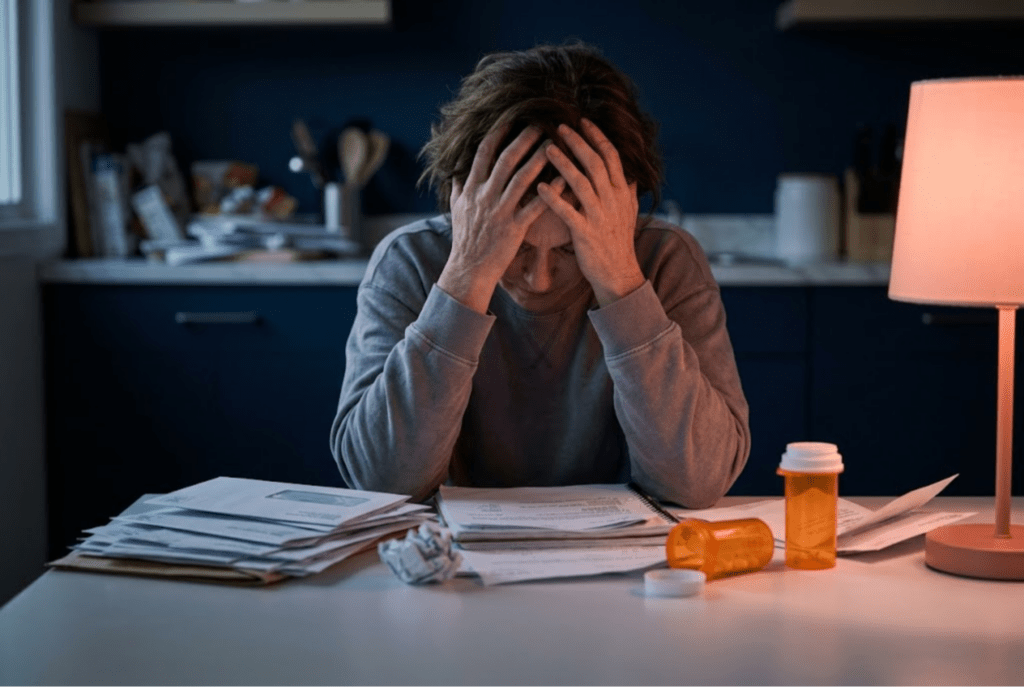
A Change Research national survey of 1,714 registered voters, conducted June 10 to 17, 2026, finds that majorities report pessimism about the economy, everyday prices, and their own financial outlook. Change Research has tracked these questions monthly since January 2026, and the June figures represent the most pessimistic readings on nearly every measure across that period. Voters cite compounding financial pressures, from fuel and groceries to housing and healthcare, in their responses to both multiple choice questions and an open-ended question about what it would take for them to feel more financially secure.
Recession Perceptions
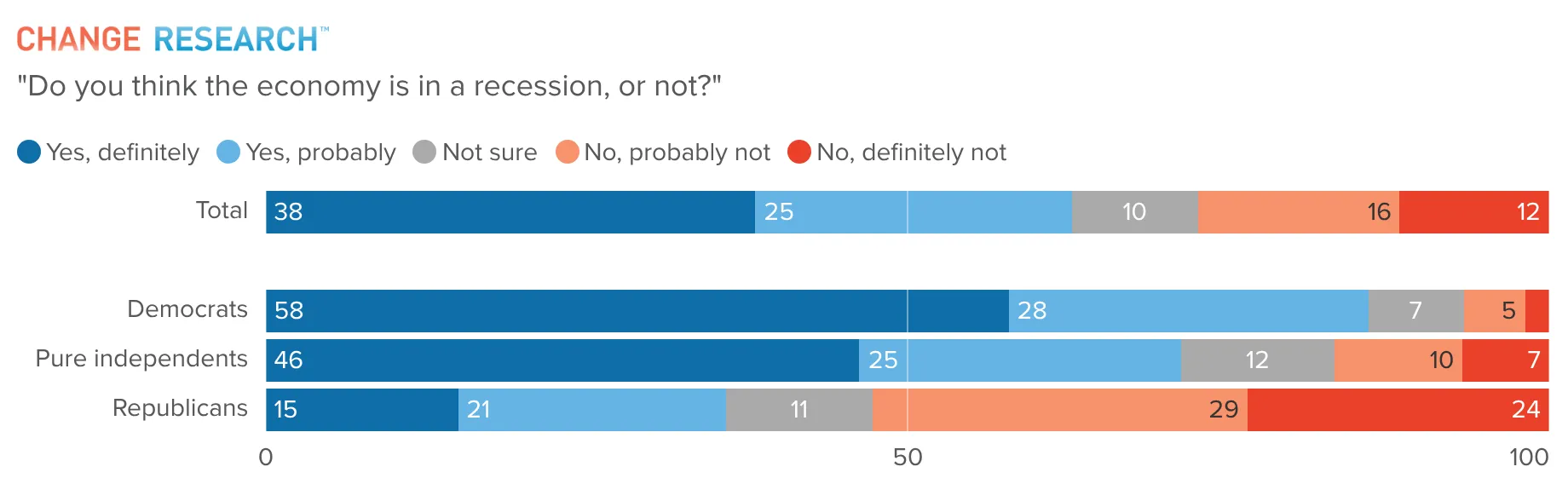
Sixty-three percent of voters say they believe the economy is in a recession (contrary to the economic definition): 38% say there is definitely a recession, and 25% say probably. Sixteen percent say probably not, and 12% say definitely not. That figure has risen across every monthly survey since January (before the Iran conflict), when 46% of voters said the economy was in recession.
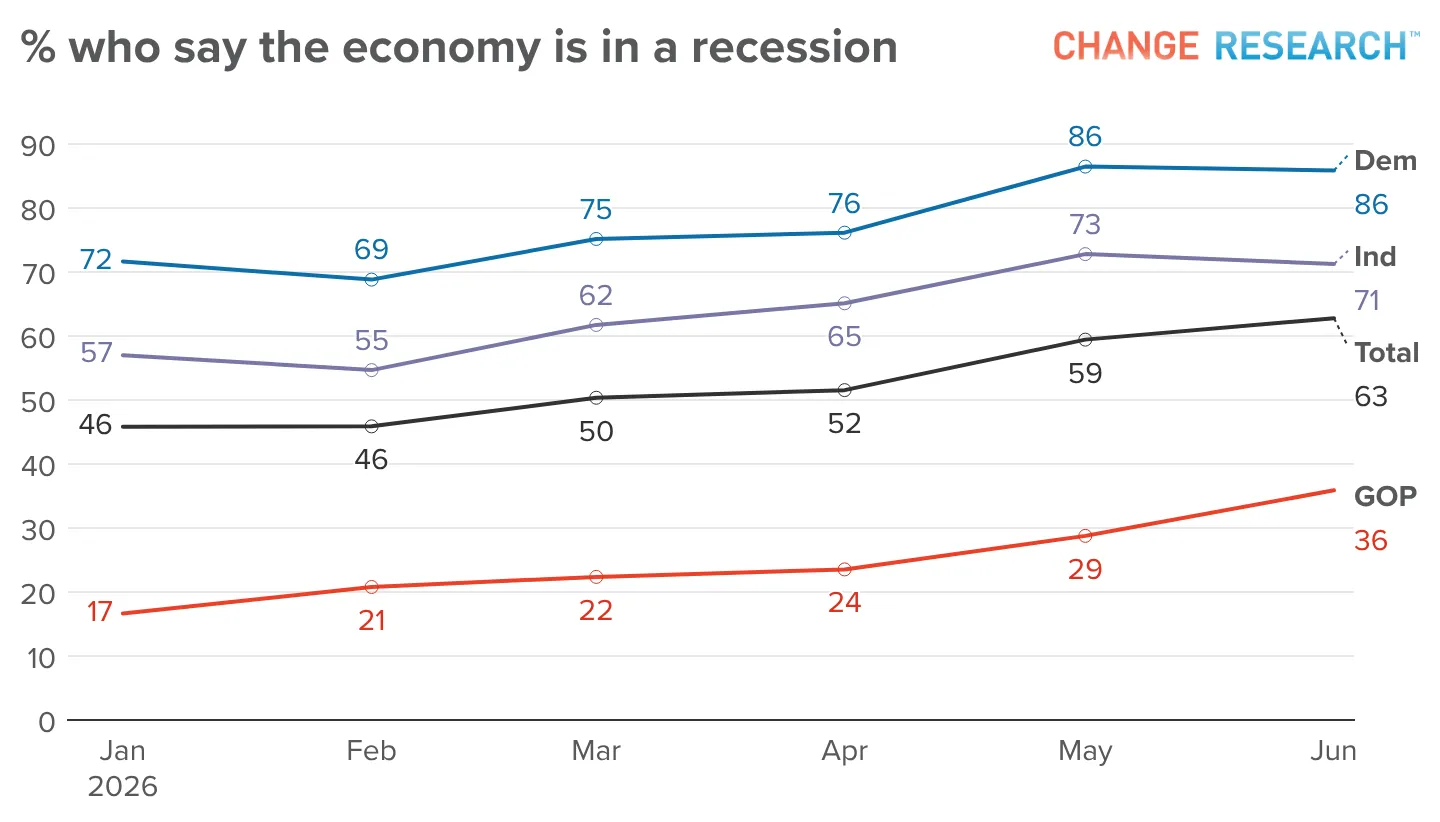
Republicans showed the largest negative shift over the six-month period. In January, 17% said the economy was in a recession. By June, that number had doubled to 36%. Democrats also increasingly indicated that they feel the economy is in recession (increasing from 72% to 86%), as did pure independents (increasing from 57% to 71%).
Outlook on the Economy and Personal Finances
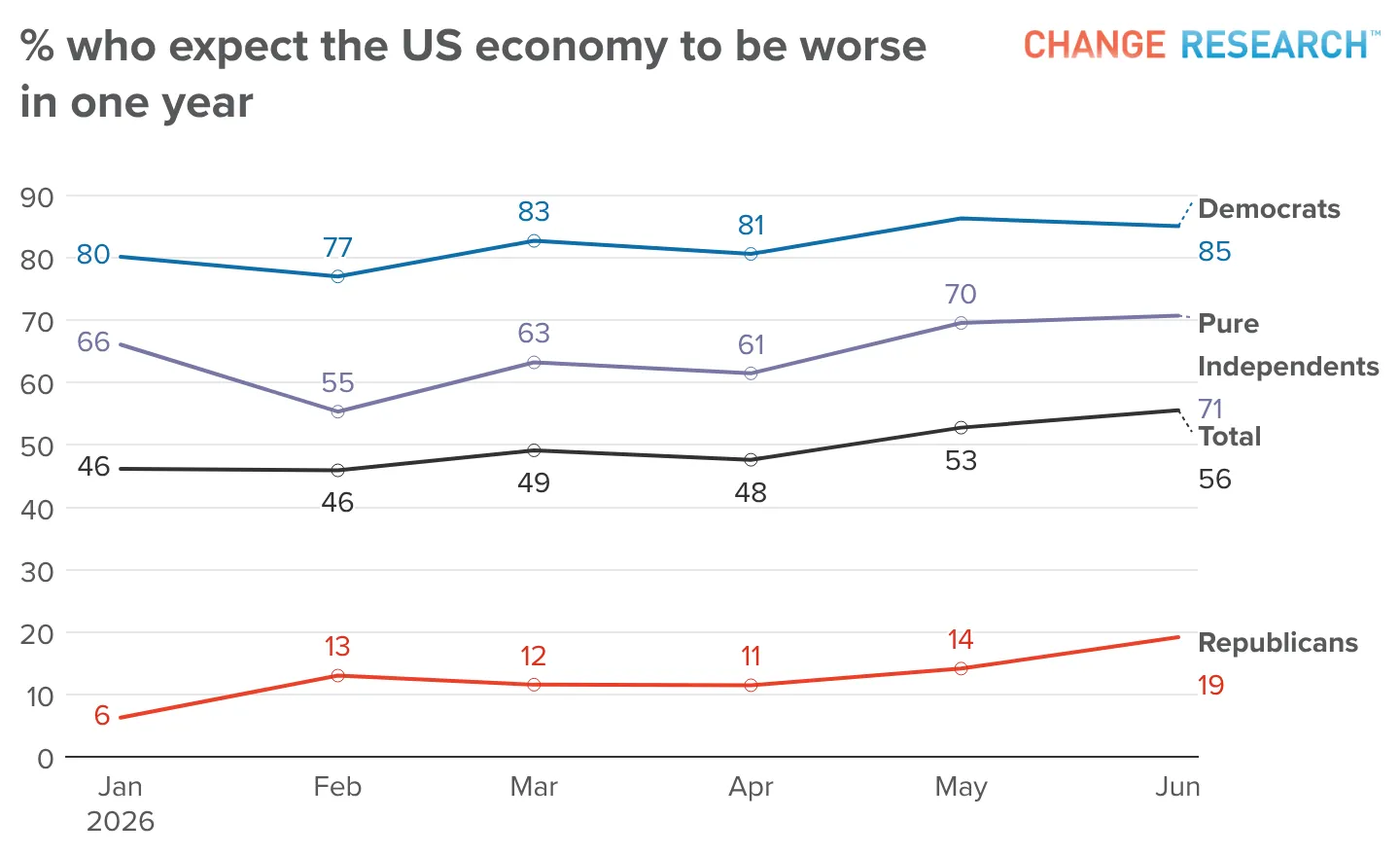
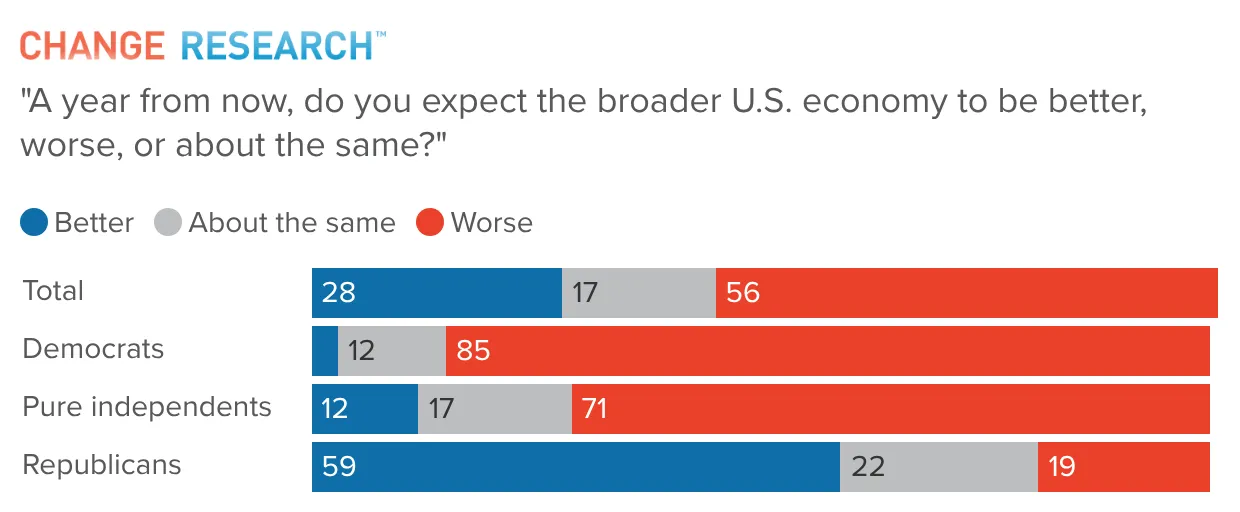
Eighty-five percent of Democrats expect the broader U.S. economy to be worse a year from now, while just 3% expect improvement. Among Republicans, those expectations essentially flip: 59% say it will be better, 19% say it will be worse. Pure independents sit closer to Democrats: 71% say worse, 12% say better. Overall, 56% of voters expect things to get worse, and 28% expect improvement.
At the start of the year, 76% of Republicans expected the economy to improve in the next twelve months. By June, that figure had dropped to 59%, a 17-point decline over six months. The Republican share expecting things to get worse fell from 6% in January to 19% in June. Among pure independents, the share expecting things to get worse climbed from 66% to 71% over the same period.
Seventy-one percent of voters 18 to 34 expect the economy to worsen. Voters 65 and older are the most optimistic, though still only 37% expect improvement over the next year.
Personal finances tell a different story. From January through April, the share of voters expecting their personal finances to worsen held steady between 23% and 25%. The share of voters expecting their personal finances to get worse rose to 33% in May and 36% in June. The partisan gap on this question is large but narrower than the gap on views toward the economy: 53% of Democrats expect their finances to worsen over the next year, compared to 15% of Republicans.
Views on personal finances don’t vary much by age. Voters 18 to 34 are nearly evenly split on whether their personal finances will improve in the next year: 37% say better, 36% say worse. Among voters 65 and older, 33% feel things will get worse and 28% believe they will get better.
The Price of Everyday Goods
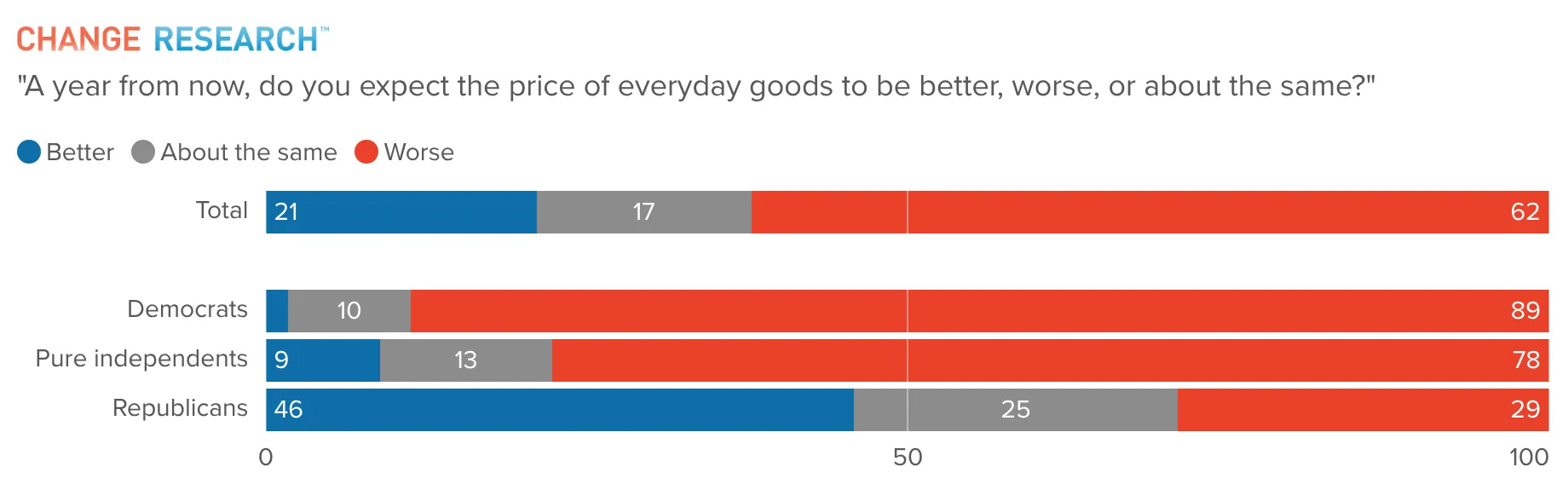
In January, half of voters expected everyday goods to cost more a year from now. By June, 62% say the same.
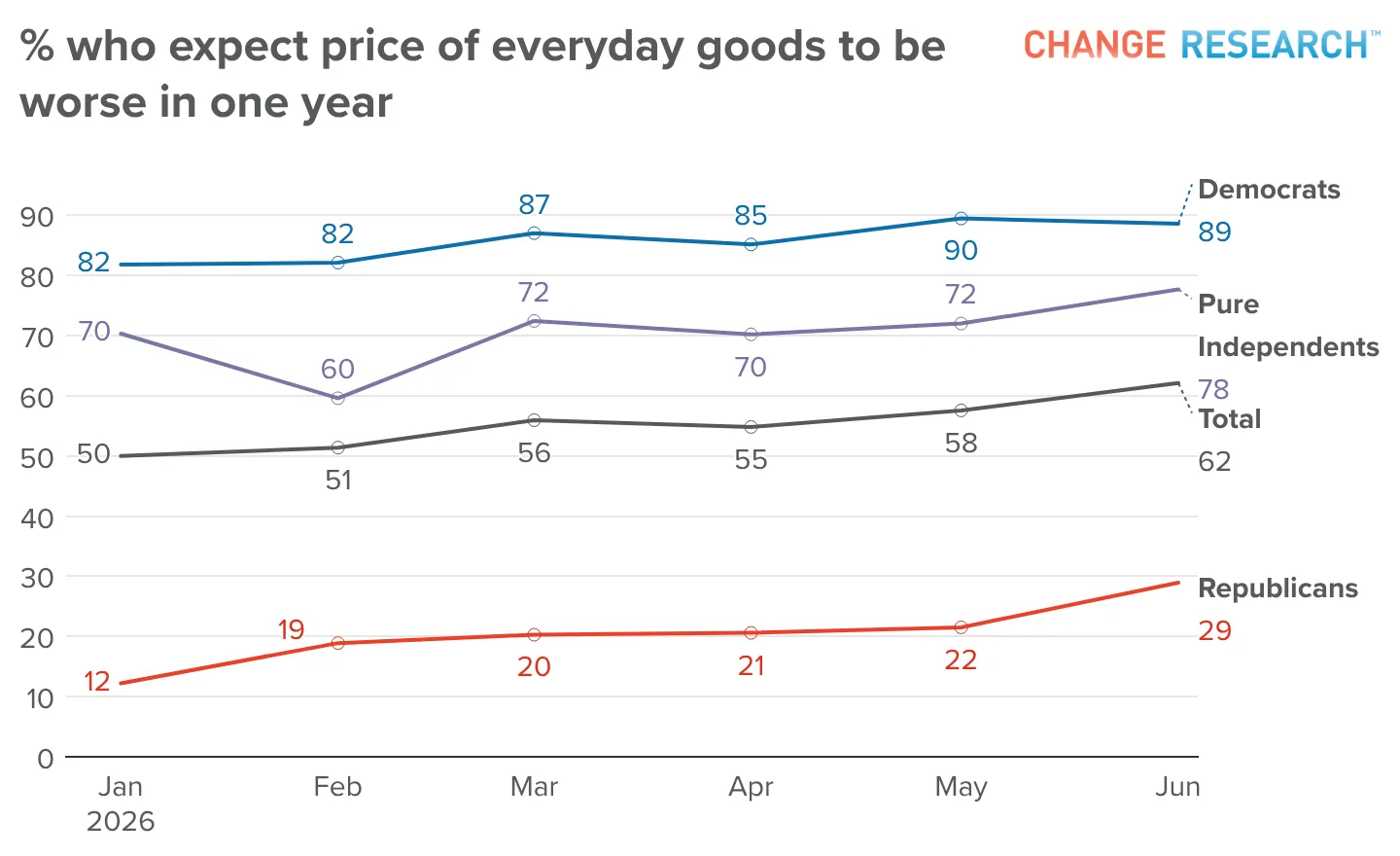
Democrats are the most pessimistic at 89%. Twenty-nine percent of Republicans now expect prices to go up, up from 12% in January. Voters between 18 and 34, have become much more pessimistic: in January, 55% thought prices would go up, and in June that number was 78%.
Asked separately to describe the overall direction of prices across groceries, housing, fuel, and healthcare over the past year, 64% of voters say prices are still rising and they see no relief coming. Another 20% say prices have stabilized but are still too high, and 9% say things have actually improved compared to a year or two ago.
That no-relief view is near-universal among Democrats at 88%. Among Republicans, it splits more evenly: 38% say no relief is coming, 36% say prices have stabilized but are still too high.
Among voters 18 to 34, 72% see no relief coming. Voters 50 to 64 are the least likely to feel that way: 57% see rising prices and no relief.
Part of what drives this is a longer-running gap between what things cost and what people take home. A May 2026 Change Research survey found that 65% of middle-income Americans said their income was falling behind the cost of living, a share that had barely moved across several consecutive quarters.
Fuel and Gas Prices
Thirty-eight percent say rising fuel and gas prices have affected their household a great deal in the past two months, and another 32% say it has somewhat affected their household. Combined, nearly seven in ten respondents report at least some household impact.
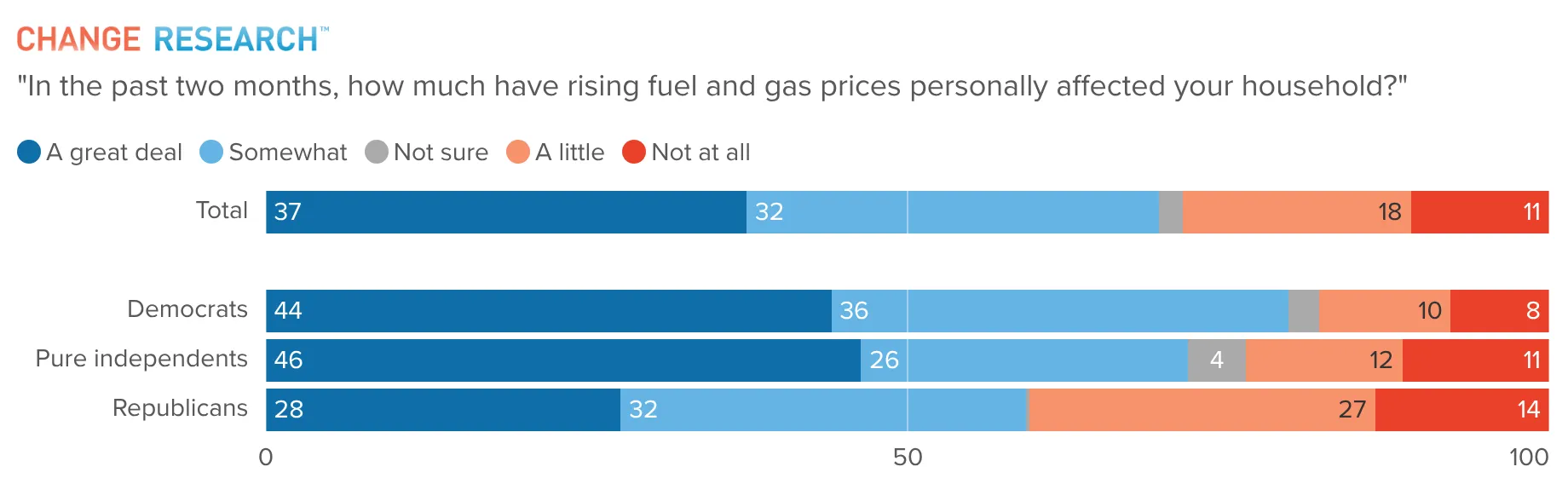
Pure independents report the highest level of severe impact at 46%. Democrats report 44%, and Republicans 28%. Voters 35 to 49 feelthe impact of gas prices most (42%). Voters 65 and older report the lowest impact, with 31% saying they feel the impact a great deal.
When asked what they think is driving higher gas and energy prices, 51% point to the Middle East conflict and its disruption to global oil supply. Democrats are the most likely to name this cause at 66%. Republicans (40%) and pure independents (43%) are less likely to, more often naming oil company pricing decisions or the lingering effects of prior inflation.
Housing Stability
Twenty-eight percent of voters say they own their home and feel financially stable. An additional 29% own their home but express concern about costs such as mortgage rates or property taxes. Sixteen percent say they are renting and struggling with rising housing costs, while 14% rent and feel stable.
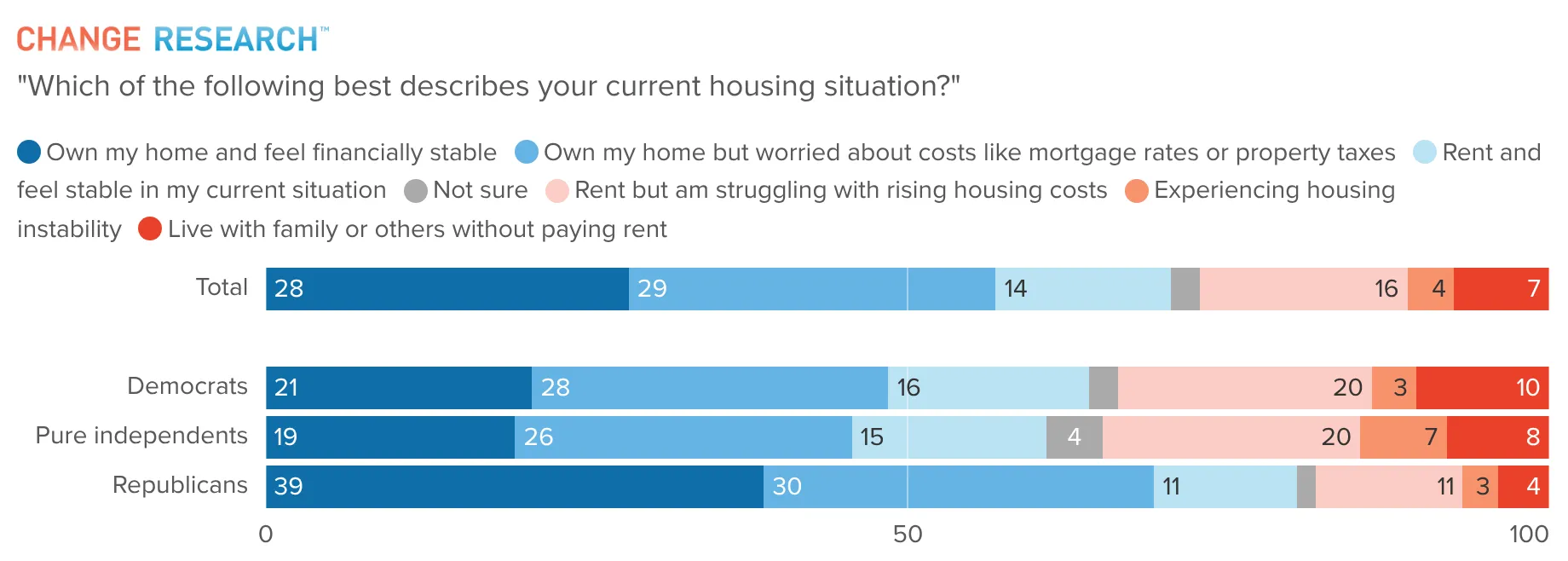
Thirty-nine percent of Republicans say they own their home and feel financially stable, compared to 21% of Democrats.
Among voters 18 to 34, 10% own their home and feel financially stable, the lowest of any age group, while 27% are renting and struggling, the highest of any age group. Among voters 65 and older, 43% own their home and feel stable, and 7% are renting and struggling.
That generational gap in housing stability tracks with broader perceptions about housing access. An April 2026 Change Research survey found that 86% of voters said buying a home was harder today than it was for their parents’ generation, including 96% of voters 18 to 34. Among that same age group, 37% said they did not have enough money saved to make major financial purchases, more than double the rate seen among older voters.
What Voters Say They Need
In response to an open-ended question about what would need to happen over the next six months to make them feel more financially secure, the most frequently cited theme across parties and ages is lower prices for groceries, gas, utilities, and housing. References to fuel and energy costs come up by a wide margin and are often linked explicitly to the conflict in Iran. Wages not keeping pace with the cost of necessities appears frequently as a secondary theme.
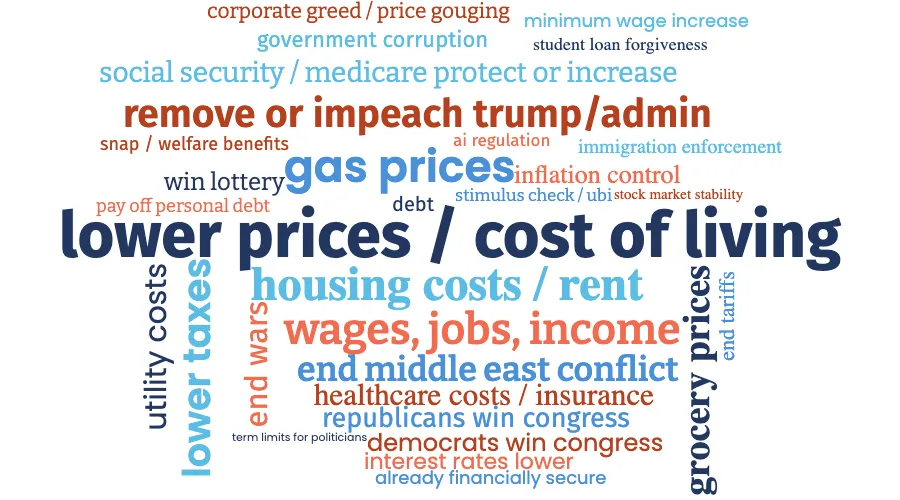
Democratic respondents are most likely to connect economic conditions to political leadership and to describe a change in government as a precondition for financial relief. Republican respondents are more likely to point to the end of the Iran conflict and the effect that peace would have on energy prices, and to describe the current administration’s policies as the path toward improvement. Pure independents are more likely to express structural frustration about wages, pricing, and government spending without anchoring the solution to a specific electoral outcome.
Housing and rent figure heavily in responses from younger voters. Several describe their rental costs as having risen sharply in recent years with no parallel increase in income. For voters in the 18-to-34 range, homeownership comes up frequently as something that feels out of reach.
“Access to better paying jobs, lower health care costs, rent decreasing, as my rent rose from $1,600/month to $4,900 which led to moving.”
White Woman, 35 to 49, Democrat
“My energy and gas bills have doubled year-over-year compared to before the Iran war. Also, grocery prices keep going up. They need to come back down.”
Hispanic/Latino Man, 18 to 34, Democrat
Older voters are more likely to describe fixed-income constraints, Social Security benefits that have not kept up with rising prices, and concerns about healthcare and prescription drug costs.
“A proper increase in Social Security. Congress gets 8½ times more than me when they retire and I know they didn’t work as hard as I did in 47 years.”
White Man, 50 to 64, Republican
Fuel prices come up as a pressure point across party lines. Several respondents connect gas prices directly to the broader cost of goods, describing fuel as a multiplier on other expenses.
“Fuel prices need to come down over $3.00 per gallon for diesel fuel, at the pump. Our entire economy is based on the cost of diesel fuel.”
White Man, 35 to 49, Republican
A subset of respondents across all groups describe their situation as unlikely to improve in the near term, regardless of what happens politically or economically. Several note that winning the lottery is the most realistic scenario for feeling financially secure, responses that register as expressions of frustration more than specific policy preferences.
See the full data behind this poll
Sign up for the award winning Change Research Data Portal to gain insights like these every month with new polling.