Over Half of Voters See the American Dream As Out of Reach
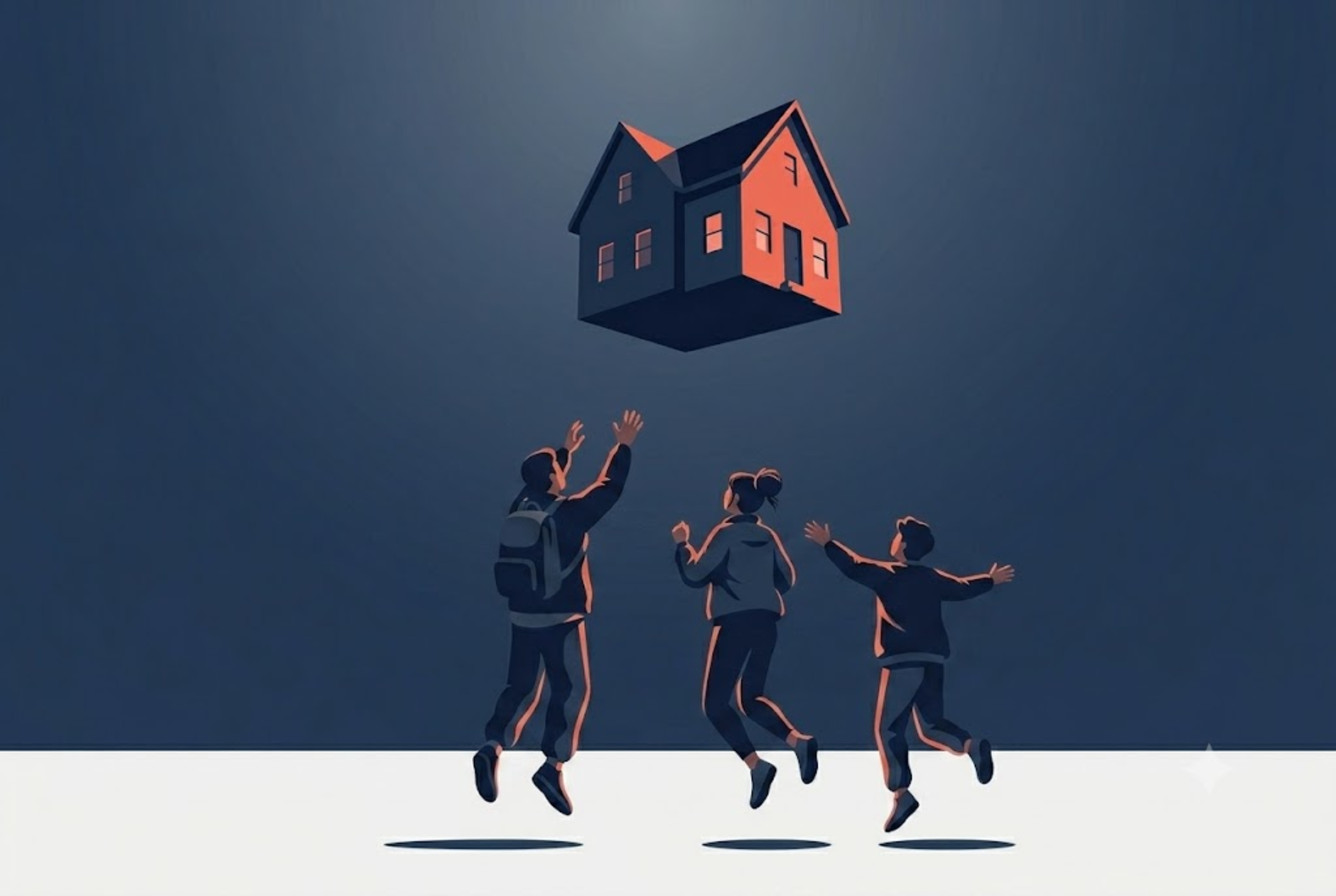
A Change Research national survey of 2,702 registered voters, conducted April 3 to 7, 2026, finds that most voters rate inflation and the cost of living poorly, and a majority say the American Dream is either a thing of the past or was never as achievable as promised.
Consumer confidence has sunk to historic lows heading into the spring. The University of Michigan’s Consumer Sentiment Index dropped to 47.6 in early April 2026, its lowest reading on record, driven by rising energy prices and economic uncertainty tied to the ongoing conflict in Iran. The findings below reflect a voter base that has been feeling these pressures for some time.
The Affordability Picture
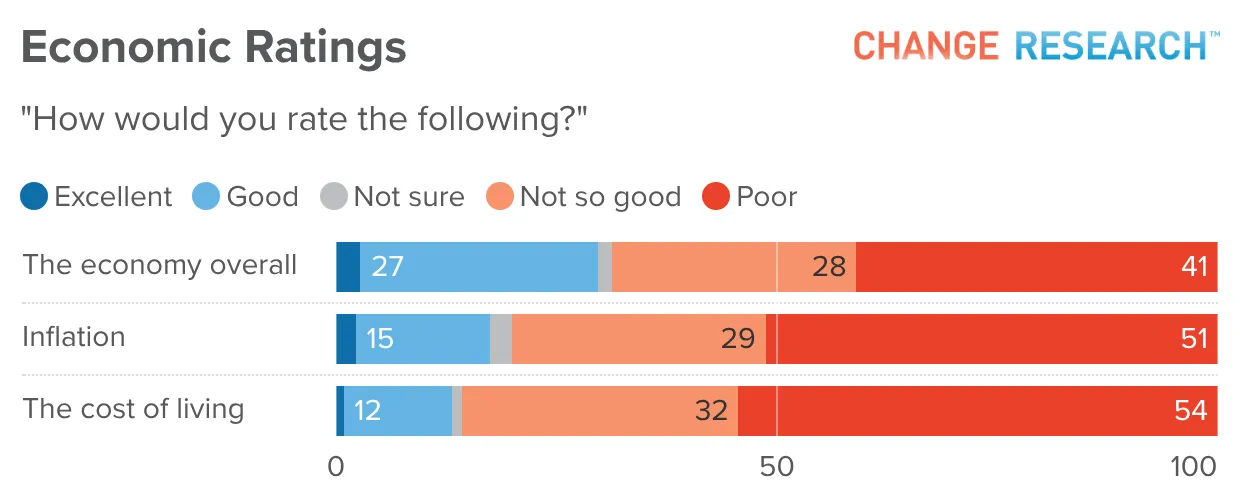
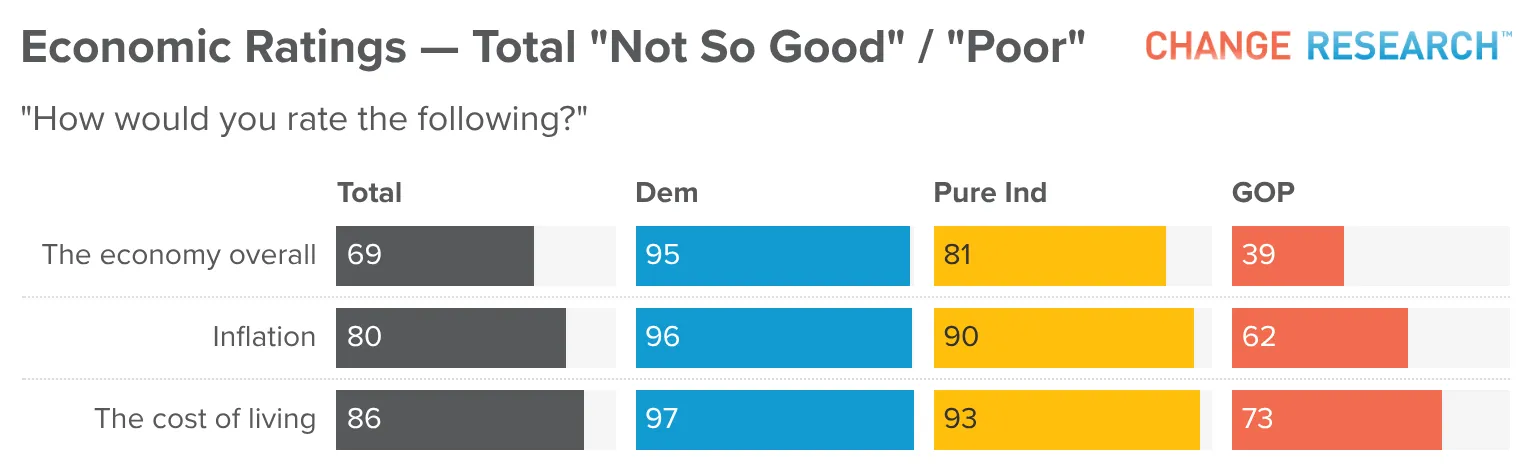
Voters give the economy’s cost dimensions near-failing marks. Eighty-six percent rate the cost of living as not so good or poor, and 80% say the same about inflation. The overall economy fares somewhat better but still draws lots of negativity: 69% rate it not so good or poor.
Party affiliation shapes these ratings considerably. 70% of Republicans rate the overall economy as excellent or good, compared to 4% of Democrats. That gap narrows on inflation and the cost of living, where majorities across both parties give negative marks, though Democrats are more critical on every measure.
Voters are more positive about their own financial situations. Fifty-seven percent rate their personal finances as excellent or good, a meaningful contrast to how they view broader conditions. Still, most describe their finances as constrained: 36% say they have enough for their needs but can only save a little, and 29% say they cover their needs, but it is tight and they rarely save.
The American Dream
Against that backdrop, a slight majority of voters think the American Dream is fading or out of reach. Thirty-four percent say it used to be true but is not anymore. Another 17% say it was never really as achievable as advertised. Combined, 51% of voters hold a skeptical view of the American Dream. Twenty-nine percent say it is still real and they have seen or lived it, and 18% say it is real but only for some.
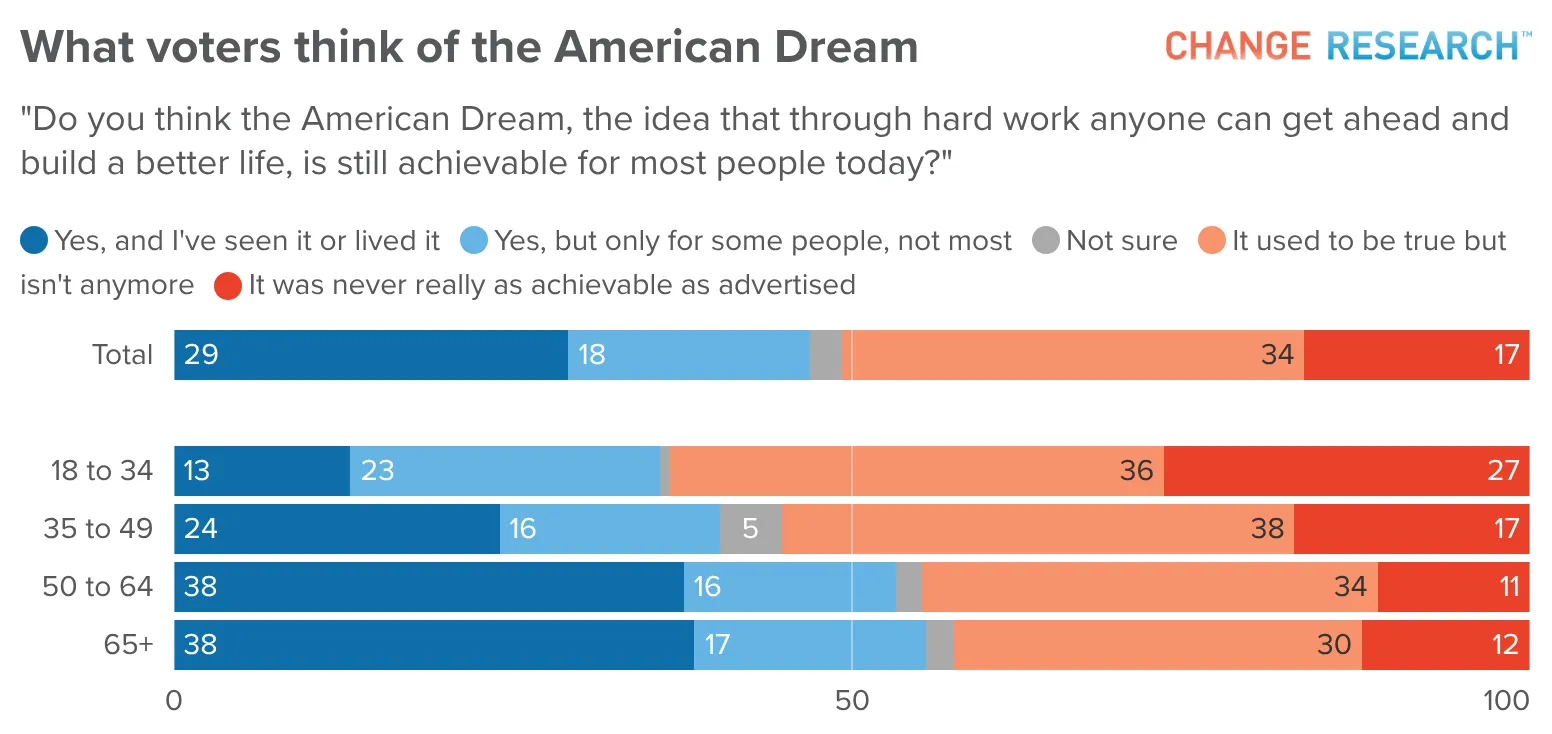
The generational divide on this question is one of the widest in the survey. Only 13% of voters aged 18 to 34 say they have seen or lived the American Dream, compared to 38% of those 65 and older. Party affiliation also shapes these views: 58% of Republicans say they have seen or lived it, while 6% of Democrats say the same.
Some older voters who have lived the American Dream say they believe it has not carried forward:
“I lived it but unfortunately most who came after me. I came from a solid middle class family, graduated from college, got married at 25, bought a condo immediately, and a first house two years later. We both worked. I’d say we had the American dream.”
Woman, 65+, Democrat
For many younger voters, the American Dream registers less as a realistic aspiration and more as an unattainable goal:
“It used to mean the opportunity to better your situation with hard work. You used to be able to genuinely achieve your dreams. But the ladder got pulled up generations ago, and now it’s too expensive to do anything.”
Man, 18 to 34, Democrat
Not all younger voters share that skepticism. Some maintain that persistence and personal responsibility remain the path forward:
“The idea that if you continue working hard, making the right connections and decisions, and persist… you and/or your children and family can achieve success and move upward financially and socially.”
Man, 18 to 34, Republican
Harder Than Their Parents
Whatever voters think of the American Dream as a concept, most agree that reaching the milestones associated with it is harder today than it was for the previous generation. Eighty-six percent say buying a home is harder now than it was for their parents, 82% say affording healthcare is harder, 80% say feeling financially secure by age 40 is harder, and 77% say saving for retirement is harder.
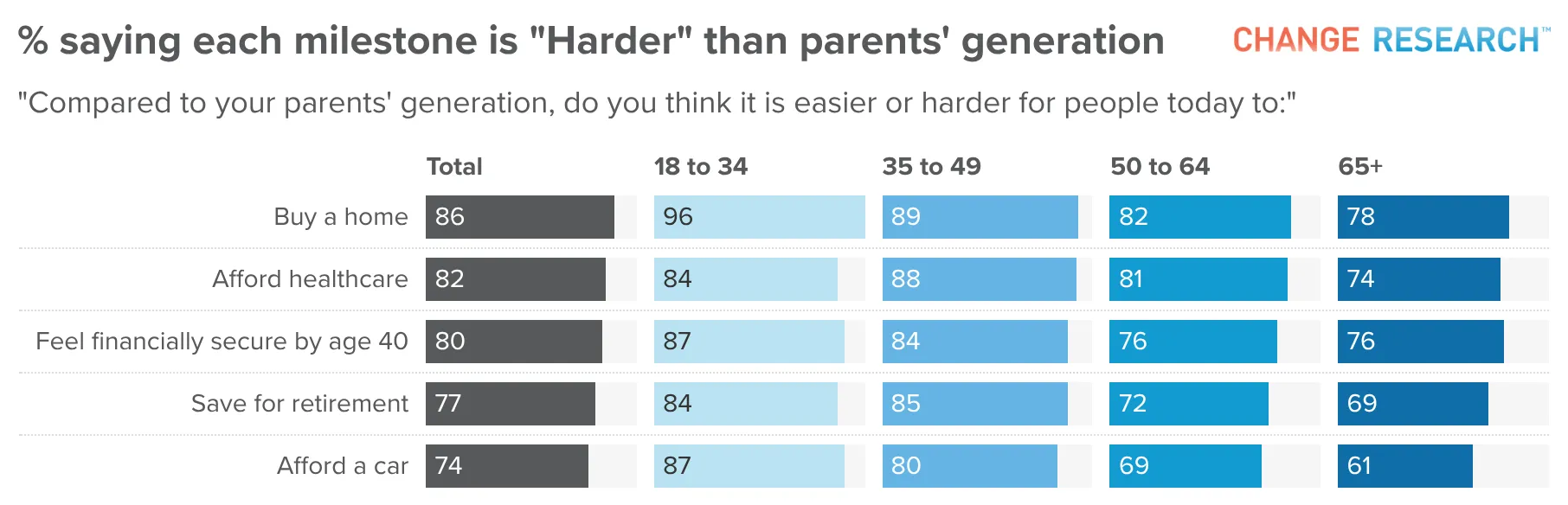
These views cross party lines more than almost any other finding in the survey. Among Republicans, 76% say buying a home is harder today; among Democrats, 95% say the same. Younger voters feel the generational gap most sharply: 96% of 18-to-34-year-olds say buying a home is harder, and 87% say the same about feeling financially secure by age 40.
Older voters describe the shift:
“The American dream I grew up with is dead. Today’s young people can’t afford housing or cost of living expenses that I handled just fine 40 years ago.”
Woman, 65+, Independent
For voters in the middle generation, the comparison feels more personal:
“It used to buy a home and build a family on one income. No longer the dream.”
Woman, 35 to 49, Republican
What Is Standing in the Way
When asked to name the single biggest barrier preventing them from making major financial purchases, 44% of voters point to prices being too high and not coming down. Interest rates rank second at 22%.
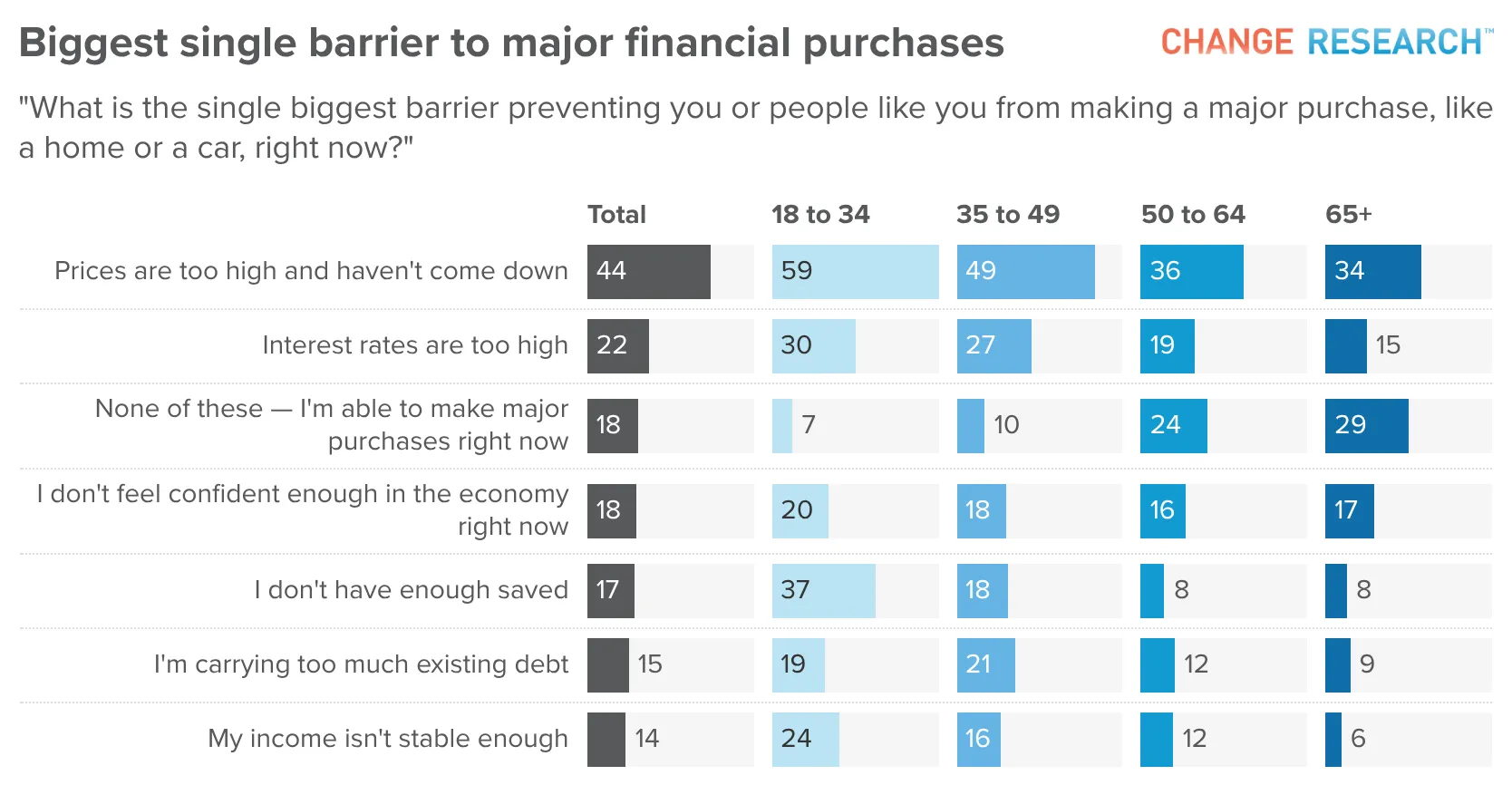
Younger voters feel this squeeze more acutely. Among those aged 18 to 34, 59% cite high prices as their biggest barrier. Interest rates rank second at 30%. 37% say they do not have enough saved, more than double the rate seen among older voters.
For many voters, the American Dream has been reduced to a basic solvency question:
“Being able to live on a single income while also being able to save for retirement, buy a house, buy a car, save for kids’ college. Not drown in medical debt.”
Woman, 18 to 34, Democrat
Others frame the problem as a structural mismatch between wages and prices:
“If someone is working a full time job, they should be able to afford basics. This is not the case currently. Prices of housing and goods have far outpaced salaries for many.”
Woman, 35 to 49, Democrat
Who Voters Hold Responsible
Voters spread responsibility across several factors. Companies raising prices beyond their costs, excessive government spending, and wages not keeping up with the cost of living rank highest among options offered: 65% say each has contributed “a great deal” to the “affordability crisis.” Trade tariffs and import costs are seen as a driver by 49% of voters.
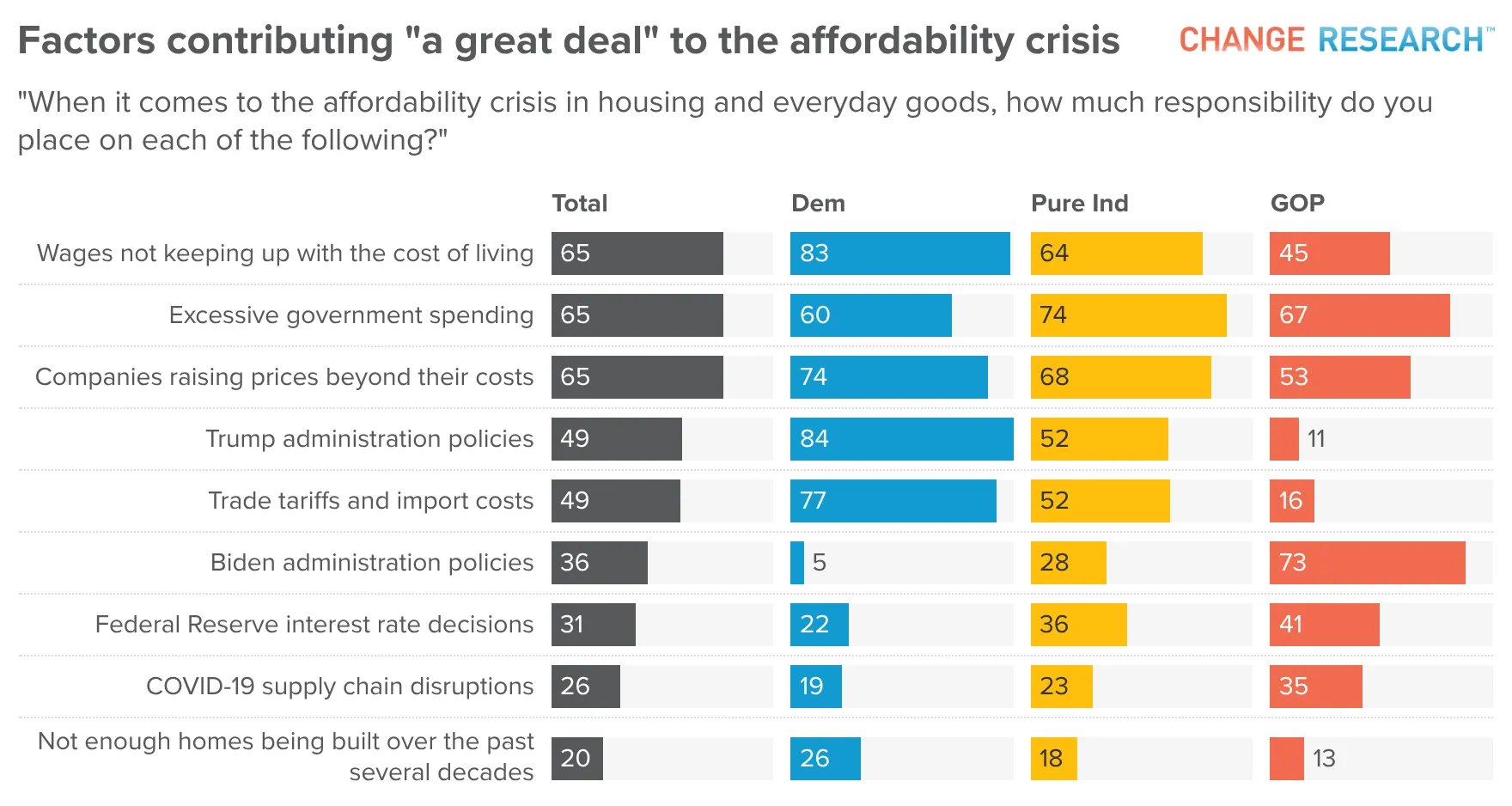
When it comes to the current and previous administrations, more voters hold the Trump administration responsible than the Biden administration. Forty-nine percent say Trump administration policies have contributed “a great deal,” compared to 36% who say the same about Biden’s. Party lines are sharp here: 84% of Democrats say Trump policies have contributed a great deal, while 73% of Republicans say the same about Biden’s.
The consequences voters describe are not abstract. For some, the question is whether retirement remains possible at all:
“It used to mean I could retire at 65. Now I will end up dying at my job.”
Woman, 50 to 64, Republican
What Voters Want Politically
Affordability sits near the top of voters’ political priorities. When asked to choose their three most important issues, voters rank government corruption first (37%) and inflation and the high cost of goods second (29%). The high cost of healthcare ranks fourth at 20%, and housing costs rank at 15% overall. Among voters aged 18 to 34, housing jumps to 29%, placing it among their top concerns at roughly double the overall rate.
Change Research conducted this survey of 2,702 registered voters from April 3 to 7, 2026. The modeled margin of error is ±2.0 percentage points at the 95% confidence level.
See the full data behind this poll
Sign up for the award winning Change Research Data Portal to gain insights like these every month with new polling.