Voters Perceive Gender as Influential in Presidential Elections
A Change Research national survey of 2,240 registered voters in October 2026 found that 38% saw gender as a factor in the outcomes of two recent presidential elections where a woman was a candidate for President. The partisan divide was stark: about two in three Democrats cited gender as influential in the 2016 and 2024 outcomes, compared with roughly one in ten Republicans.

In July 2026, we found that fewer voters viewed women and men as equally suited to serve as President (61%) than as Secretary of State (73%), Senator (74%), Governor (74%), or Mayor (79%). This month, we asked several follow-up questions related to gender and the presidency:
For each of the past three presidential elections, we asked: “Which of the following, if any, do you think may have played a role in Donald Trump winning/losing the 2016/2020/2024 presidential election against Hillary Clinton/Joe Biden/Kamala Harris?” The response options included gender, people wanting a change from the incumbent, the winner running a better campaign, the winner being a better candidate, more of the winning party voting, the election being rigged, and, for 2024 only, race, as well as something else and not sure.
For the upcoming presidential election, we asked: “If the 2028 presidential election were held today and the candidates were the following, who do you think would win?” There were four different matchups, including a female Democrat vs. a female Republican, a male Democrat vs. a male Republican, a female Democrat vs. a male Republican, and a male Democrat vs. a female Republican.
Key Takeaways
- When asked what may have played a role in the outcomes of the past three presidential elections, many voters perceived gender as a factor in those where a woman was on the ballot. Specifically, 38% thought gender played a role in both 2016 and 2024.
- Perception of the importance of past presidential candidates’ gender split by party. About two in three Democrats chose gender as a factor for 2016 and 2024 (68% and 67%), compared with about one in ten Republicans (11% and 10%).
- When asked who they think would win in the 2028 presidential election in two hypothetical matchups between a man and a woman, most voters would expect the man to beat the woman. In both cross-gender matchups – one with a Republican man and a Democratic woman, one with a Democratic man and a Republican woman – 18 to 23 percentage points more voters think the man would win.
- Women are less confident than men that a woman could win the presidency against a man in 2028 by between 2 and 9 percentage points, and Democrats are less confident than Republicans that a woman from their party could win against a man from the other party (49% vs. 56%).
- This survey was conducted before the 2026 election, in which many prominent women won, including in races for Governor in Ohio, Georgia, and Texas.
The 2016 Election
When asked about the 2016 election, in which a Republican man (Donald Trump) won against a Democratic woman (Hillary Clinton), voters perceived “Trump being a man and Clinton being a woman” (38%) as the second-most influential factor. Gender was seen as slightly less of a factor than “people wanting a change from a Democratic president/Barack Obama” (42%) and was tied with “Trump being a better candidate than Clinton” (38%).
The ranking of gender differed among demographic groups. Gender was the most cited explanation among women at 43%, but was third most cited among men at 34%. Gender was the top choice among Democrats by far at 68%, but it was near the bottom among Republicans at just 11%.
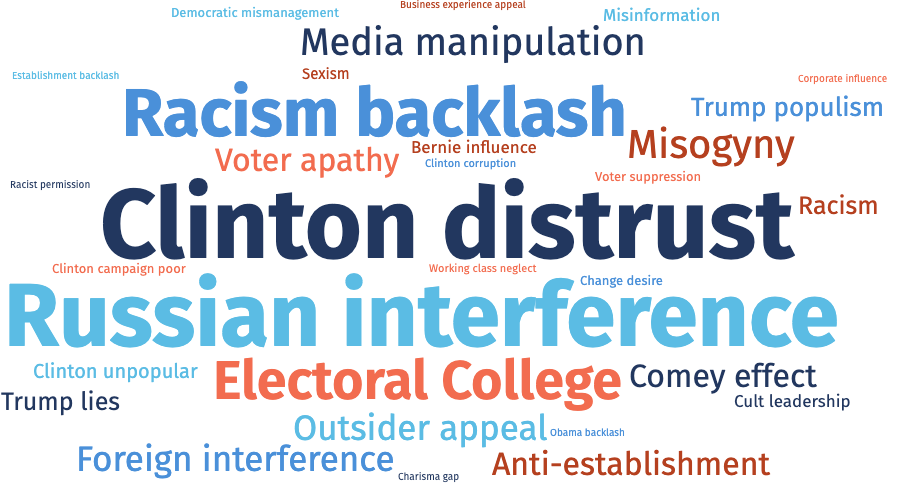
Almost one in four voters chose “something else” (23%), which resulted in 215 open-ended responses. The most common themes of the open-ended responses were “Clinton distrust” (n=31) and “Russian interference” (n=28).
The 2020 Election
For the 2020 election, in which a Democratic man (Joe Biden) won against a Republican man (Donald Trump), the most cited explanations were “people wanting a change from a Republican president/ Trump” (42%), “the election being rigged” (38%), and “Biden being a better candidate than Trump” (32%). “Both candidates being men” was seen as a factor by only 7% of voters.
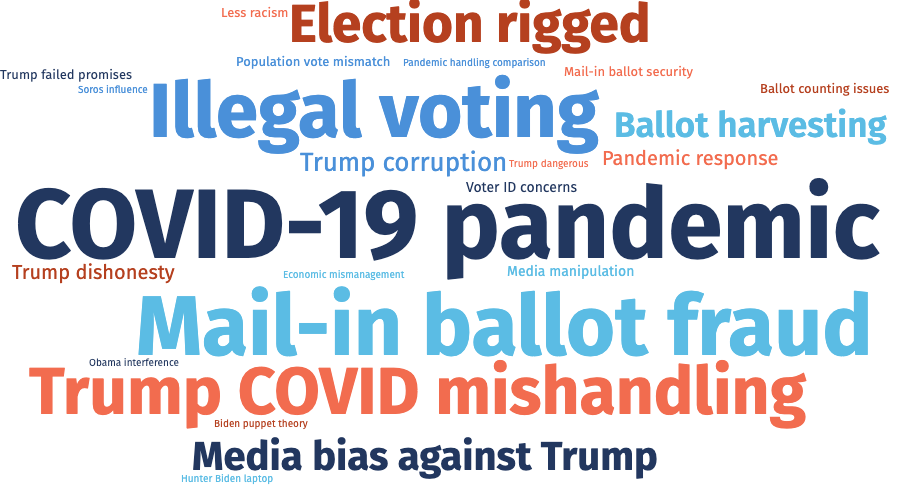
Almost one in five voters chose “something else” (18%), which resulted in 165 open-ended responses. The most common themes of the open-ended responses were “COVID-19 pandemic”/”Trump COVID mishandling” (n=27) and “mail-in ballot fraud”/”illegal voting” (n=25).
The 2024 Election
Gender made it back as one of the top three explanations for the outcome of the 2024 election, in which a Republican man (Donald Trump) again won against a Democratic woman (Kamala Harris). “Trump being a man and Harris being a woman” (38%) was essentially tied as the most selected choice, alongside “people wanting a change from a Democratic president/Biden” (37%) and “Trump being a better candidate than Harris” (37%). These results were similar to those for the 2016 election.
Also like the 2016 results, gender was cited most among women at 44% but only fourth most among men at 31%. It was also the top choice among Democrats at 67% but near the bottom among Republicans at just 10%. Among Democrats, “Trump being white and Harris being a person of color” (62%) was the second-most selected option.
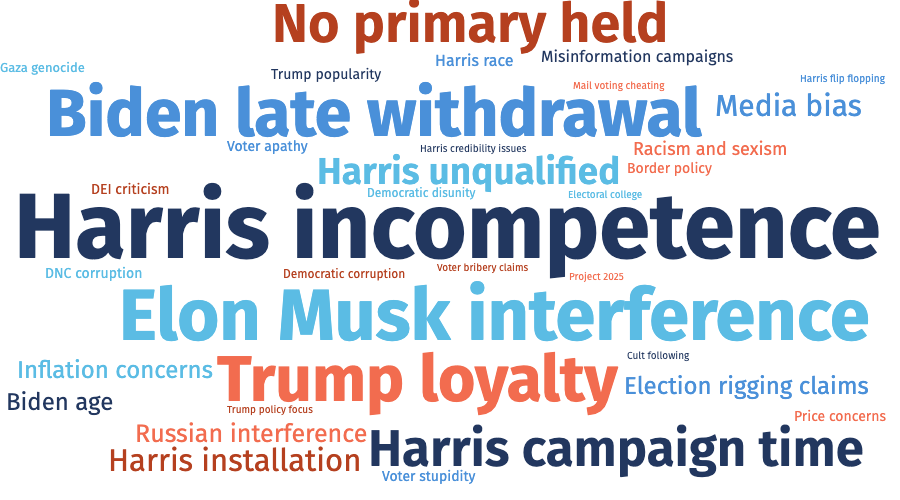
One in five voters chose “something else” (20%), resulting in 188 open-ended responses. The most common themes of the open-ended responses were “Harris incompetence” (n=28) and “Biden late withdrawal”/”Harris campaign time” (n=28).
The 2028 Election
Voters were then asked who they think would win in hypothetical races for the presidency in 2028. The matchups included a Democratic woman vs. a Republican woman, a Democratic man vs. a Republican man, a Democratic woman vs. a Republican man, and a Democratic man vs. a Republican woman.
In the matchup where both candidates were women, the Democratic woman (41%) was seen as more likely to win than the Republican woman (30%) by 11 percentage points. In the matchup where both candidates were men, the Democratic man (45%) was seen as more likely to win than the Republican man (34%) by 11 percentage points. In the matchups with a woman against a man, the man was seen as more likely to win regardless of party: by 23 percentage points for the Democratic man (48%) vs. the Republican woman (25%) and by 18 percentage points for the Republican man (45%) vs. the Democratic woman (27%). However, between 21% and 29% of voters were unsure who would win each matchup, which suggests these perceptions are far from fixed.
Voters currently expect Democrats to do well in 2028: the Democrat leads the Republican in three of the four matchups. The only race in which most voters would expect a Republican win is one pitting a Democratic woman against a Republican man.
Women were less confident than men that a woman could win against a man. Among women, the Republican man (43%) was seen as more likely to win than the Democratic woman (26%) by 17 percentage points, and the Democratic man (51%) was seen as more likely to win than the Republican woman (21%) by 30 percentage points. Among men, the Republican man (47%) was seen as more likely to win than the Democratic woman (28%) by 19 percentage points, and the Democratic man (45%) was seen as more likely to win than the Republican woman (30%) by 15 percentage points.
Democrats and Republicans both expect that the candidate from their party would win in 2028, though Democrats are less confident than Republicans that a woman from their party could win against a man from the other party. Slightly less than half (49%) of Democrats thought a Democratic woman could beat a Republican man, compared to well over half for other matchups. More than half of Republicans thought the Republican candidate could beat the Democratic candidate in all the matchups, regardless of gender.
From October 12-18, 2026, Change Research conducted a poll of 2,240 registered voters nationwide, with a margin of error of +/- 2.3%. This sample was representative of the current demographic makeup of registered voters nationwide. To lessen survey fatigue, we limited the number of non-demographic questions respondents saw, leading to about 1,000 responses for such questions.
See the full data behind this poll
Sign up for the award winning Change Research Data Portal to gain insights like these every month with new polling.