Change Research Ranks Among Most Accurate 2026 Pollsters
Change Research tied for 3rd most accurate among 32 national polling organizations in AtlasIntel's 2026 midterm evaluation, finishing alongside the New York Times/Siena College and RMG Research. Our Compass Poll tracked the Democratic wave from a 7-point congressional lead in September to 11 points in October; the national count is now heading toward 13. Here is how the numbers held up across the ballot.

Change Research tied for 3rd most accurate among 32 national polling organizations evaluated by AtlasIntel for the 2026 midterms, finishing tied with the New York Times/Siena College and RMG Research. The ranking measured each pollster's final national generic ballot poll against the projected House result. Our state-level work held up too: four of five internal polls of competitive Senate races conducted October 29 through November 1 were within the margin of error. There was some internal skepticism when our internal poll found Annie Andrews four points ahead of Darline Graham in South Carolina. As of this writing, Andrews leads Graham by 4.48 points.
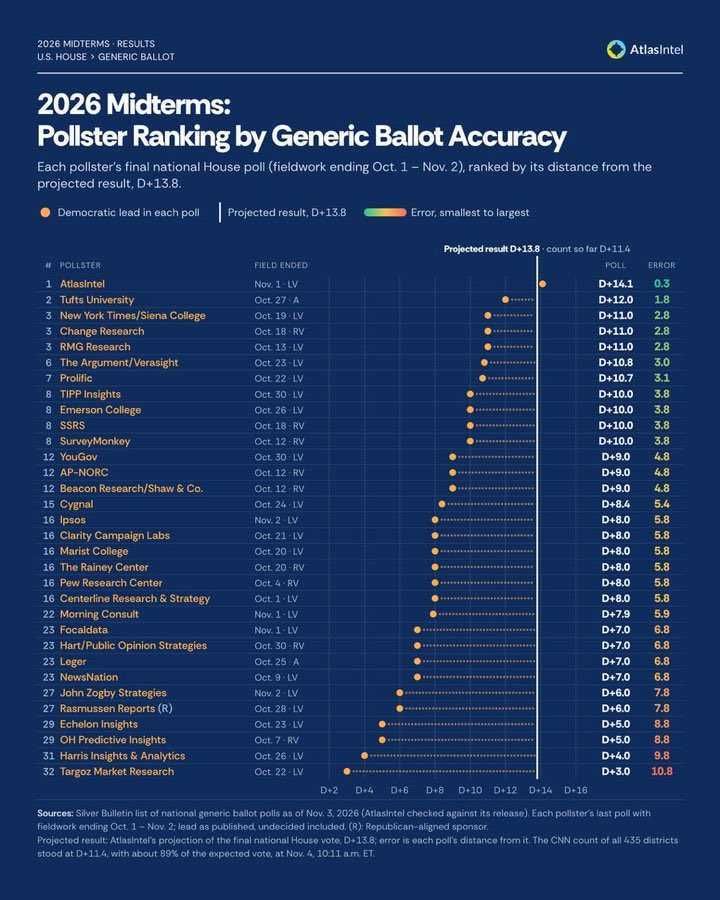
AtlasIntel's ranking of 32 national pollsters by final generic ballot accuracy, as reported by Axios on November 4, 2026.
Tracking the Congressional Wave
Our Compass Poll tracked the congressional generic ballot, a standard measure of which party voters prefer to control Congress, throughout the fall. Democrats led by 7 points in September and by 11 points in October. That October reading landed 2.8 points from the projected D+13.8 result, the margin that placed us 3rd in AtlasIntel's ranking. Among the voters most motivated to turn out, Democrats led by 13 points in both waves. Head of Polling Stephen Clermont flagged that pattern weeks before Election Day, identifying high-motivation voters as a leading signal of the wave's size. The national count is now heading toward that same 13-point margin.
Senate Race Results
In the final days before the election, Change Research surveyed likely voters in five competitive Senate states (Maine, Michigan, Nebraska, Ohio, and South Carolina) to get a final read on the races. All of the races appeared close, an indicator that Democrats could compete even in deep-red states like South Carolina.
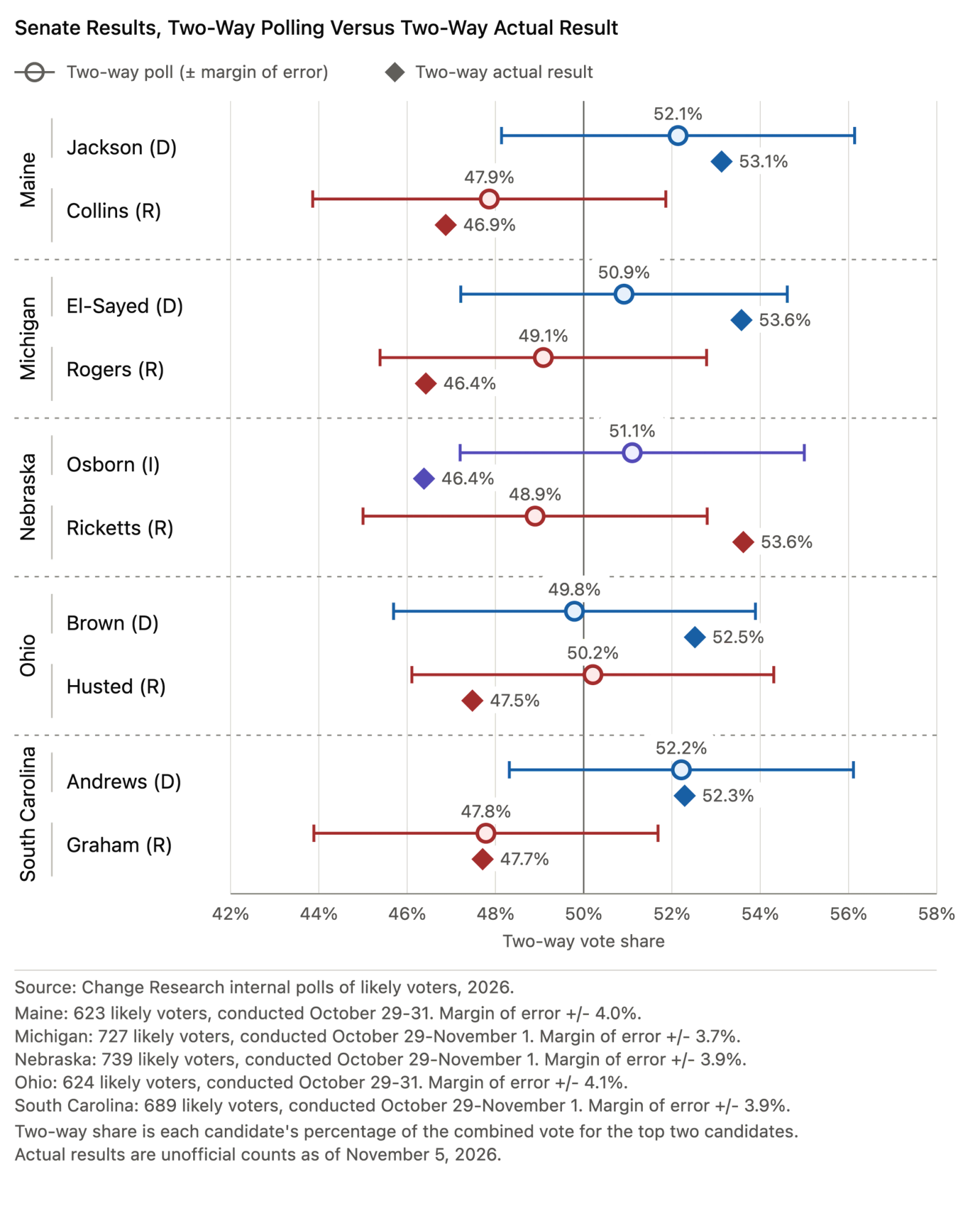
Our polls were close in four of the five states. South Carolina was the closest: our final poll had Andrews leading Graham 52.2% to 47.8% in the two-way vote, within 0.1 points of the actual result of 52.3% to 47.7%. In Maine, our poll had Jackson up 4.2 points, and he won by 6.2.
In Ohio and Michigan, Democratic Senate candidates outperformed our final polls. In Michigan, our poll showed El-Sayed up 2, and he went on to defeat Rogers by 7 points. In Ohio, our poll had Brown and Husted effectively tied; Brown outperformed the poll, defeating Husted by 5 points.
Nebraska was the one race where the Republican outperformed our poll, and the only result outside the margin of error. Our poll showed Osborn with a 2-point lead, but Ricketts won by 7. In our poll, Ricketts led Osborn by 7 points among voters who rated their motivation to vote a "10"; some of the lower-propensity voters who preferred Osborn may have decided to stay home.
Statewide and Down-Ballot Accuracy
North Carolina: The Carolina Forward Poll, which Change Research has fielded for North Carolina think tank Carolina Forward across five public waves in 2026, tracked the U.S. Senate race from January through Election Day. Each wave found Democrat Roy Cooper ahead of Republican Michael Whatley. The October wave, the first to find Cooper ahead by double digits at 50% to Whatley's 40%, also found Democrats holding a 7-point advantage on the state legislative generic ballot. Cooper won the race with 58.7% of the vote in unofficial counts as of November 5, 2026; Democrats also flipped the North Carolina state House for the first time since 2010.
Kentucky: On behalf of partner organization Kentuckians Not Corruption, Change Research polled 524 likely voters in Kentucky's 6th Congressional District from September 29 to October 7, 2026. Our poll found Democrat Zach Dembo ahead of Republican Ralph Alvarado by 9 points. Dembo won the race 52.3% to 43.7%, an 8.6-point margin, in a district Trump carried by 15 points in 2024.
Los Angeles: Locally, our pre-primary polling in Los Angeles's 11th City Council District landed within half a point of the primary result, one of several validated calls from the 2026 primary cycle documented in our August 2026 report.
State legislative: Our state legislative track record is detailed in our 2024 Accuracy Report: average error of 2.3 points in Ohio State House districts in 2024, against a typical industry range of 6 to 8 points, and 3.8 points across 30 Pennsylvania State House and Senate races. Change Research will release a full 2026 Accuracy Report, covering state legislative and congressional races from this cycle, once election results are finalized.
Methodology: All polls were conducted online. Using Dynamic Online Sampling to attain a representative sample, Change Research polled the following samples. Compass Poll (national): 2,021 registered voters, September 15 to 24, modeled margin of error ±2.3 percentage points; 2,240 registered voters, October 12 to 18. Carolina Forward Poll (October wave): 829 North Carolina likely voters, October 1 to 7, margin of error ±3.7 percentage points. Kentucky's 6th Congressional District: 524 likely voters, September 29 to October 7, conducted on behalf of Kentuckians Not Corruption. Senate polls, all among likely voters: Maine, 623 likely voters, October 29 to 31, modeled margin of error ±4.0 percentage points; Michigan, 727 likely voters, October 29 to November 1, modeled margin of error ±3.7 percentage points; Nebraska, 739 likely voters, October 29 to November 1, modeled margin of error ±3.9 percentage points; Ohio, 624 likely voters, October 29 to 31, modeled margin of error ±4.1 percentage points; South Carolina, 689 likely voters, October 29 to November 1, modeled margin of error ±3.9 percentage points. Two-way vote share represents each candidate's percentage of the combined vote for the top two candidates. Actual results are unofficial counts as of November 5, 2026. As a member of AAPOR's Transparency Initiative, Change Research discloses all relevant details about our research, with the principle that the public should be able to evaluate and understand research-based findings in order to instill and restore public confidence in survey results.
Want intelligence like this for your campaign?
Custom research, AI targeting, and rapid-turn polling — built around your race, your districts, and your timeline.