Corruption Is Rising as A Top Voter Issue
Government corruption tops voters' list of most important political issues in August 2026, cited by 40% of registered voters nationally, up six points from 34% in February. The finding draws cross-partisan agreement, with 43% of Democrats, 46% of independents, and 36% of Republicans all ranking it near the top of their lists, even as open-ended responses show they mean very different things by the word.
A Change Research national survey of 2,045 registered voters, conducted August 8 to 13, 2026, finds that 40% of voters cite government corruption as one of their three most important political issues, more than any other option we asked about. Inflation and the high cost of goods follow at 36%, the high cost of healthcare at 27%, and immigration and border security at 27%.
Anti-corruption legislation has been active in Congress throughout 2026, with a bipartisan stock trading ban passing the House in July and Democrats introducing a competing, broader bill targeting the executive branch in September. Republicans and Democrats disagree substantially on where the corruption problem lives and what the solution should be.
Outpacing Inflation and Immigration
40% of voters cited government corruption as one of their top three political priorities, more than any other issue we asked about. Inflation followed at 36%, healthcare costs at 27%, and immigration and border security at 27%. Housing costs were cited by 23% and the cost of insurance by 22%.
Cross-Partisan Salience
46% of independents cited government corruption, the highest rate of any partisan group, placing it first on their list. 43% ofDemocrats, 43% cited corruption, also ranking it first. Among Republicans, 36% cited corruption, placing it second behind immigration and border security(50%).
Many issues show partisan gaps. Immigration was named by 50% of Republicans but only 7% of Democrats. Healthcare costs were named by 33% of Democrats but only 18% of Republicans. Corruption is different: all three groups rank it near the top, even though they are thinking of different actors, different money, and different decisions when they say the word.
The Unifying Thread
We also asked voters, in their own words, what government corruption means to them. Around 815 responded. Three themes came up consistently across party lines: elected officials who get rich in office, money buying political access, and no real consequences when officials break the rules.
Independent respondents most often named both parties in the same response, treating corruption as a structural condition rather than a partisan one. But similar themes surface in Democratic and Republican responses too.
“Politicians and appointed officials using privileged, non-public governmental information to enrich themselves. It is about people taking advantage of their position, access, and political authority to profit financially rather than serving the public interest.”
- White Man, 35 to 49, Independent
“Senators and Congressmen being allowed to make stock trades based on insider information, also borrowing money from Social Security fund, voting for UNEARNED pay raises.”
- White Woman, 50 to 64, Independent
“Democrats and republicans that have been in office for more than a decade.”
- Black/African American Man, 18 to 34, Independent
“When people entrusted with public authority stop treating that authority as a public trust and start treating it as their personal property by using their power for private, political, financial, or personal benefit through bribery, favoritism, abuse of power, conflicts of interest, manipulation, or cover-ups.”
- White Woman, 35 to 49, Republican
“Lack of accountability for politicians and bureaucrats violating the law openly.”
- White Man, 18 to 34, Independent
What Democrats Mean by Corruption
Democratic respondents focused most heavily on financial self-dealing by the current administration. Responses pointed to the use of presidential power to benefit the president’s own business interests, cryptocurrency ventures and market promotions involving the president’s family, government contracting decisions that direct taxpayer money to political allies, and the practice of selling pardons in exchange for campaign contributions. Congressional insider trading, which cuts across party lines in the open-ended data broadly, appeared frequently among Democratic respondents as well, often named alongside administration-specific concerns in the same response.
Several Democratic respondents described a structural concern: that political power and private wealth have become so intertwined that ordinary citizens cannot reliably know whose interests are being served. About 7% used words like “billionaires,” “corporations,” and “oligarchy” to make that point.
“Government officials enriching themselves instead of making people’s lives better.”
- White Woman, 35 to 49, Democrat
“Lobbying, public land being sold out, crime without justice.”
- Asian/Pacific Islander Woman, 18 to 34, Democrat
“It hurts people in concrete ways, and the risk has never been greater given today’s unprecedented mixing of private wealth and political power.”
- Hispanic/Latino Man, 65+, Democrat
“Those governing us are not transparent and watched appropriately.”
- Black/African American Woman, 65+, Democrat
“Greed from our politicians who are supposed to be working for the people and not for corporations.”
- Hispanic/Latina Woman, 18 to 34, Democrat
What Republicans Mean by Corruption
Republican respondents brought a different set of examples with similar underlying concerns. Wasteful or misdirected federal spending was the most common framing: USAID and its distribution of taxpayer money abroad was the single most-named specific example, followed by NGO funding that respondents see as channeling public dollars to partisan causes. Multiple respondents mentioned fraud in state-level government assistance programs, particularly in Minnesota and California. Career politicians from both parties growing wealthy in office appeared throughout, with specific names cited alongside a broader frustration with Washington insiders of any party affiliation.
Congressional stock trading came up regularly among Republican respondents as well, framed as a systemic problem tied to career politicians who write the rules and exempt themselves from them. A notable subset of responses described corruption as something that exists across party lines, an institutional failure rather than a partisan one, while still directing most of their named examples toward Democratic officeholders.
“Politicians who go into office poor and one term later are millionaires.”
- White Man, 65+, Republican
“No accountability on how tax money is being spent. Spying on citizens. Misuse of information and power.”
- White Woman, 65+, Republican
“The people making the laws that don’t have to live by them.”
- White Man, 65+, Republican
“Career politicians getting away with crime in office without accountability and loss of benefits.”
- White Man, 50 to 64, Republican
“Insider trading, giving our tax money to NGO’s that support an agenda that is an antithesis to our country.”
- Hispanic/Latina Woman, 50 to 64, Republican
“Elected officials abusing their positions for their own personal gain instead of serving the American people as they are meant to.”
- White Woman, 18 to 34, Republican
Specific Examples That Come to Mind
We also asked voters whether a specific example of corruption comes to mind right now. Around 776 responded. The examples split along partisan lines more sharply than the abstract definition, but several categories crossed party boundaries.
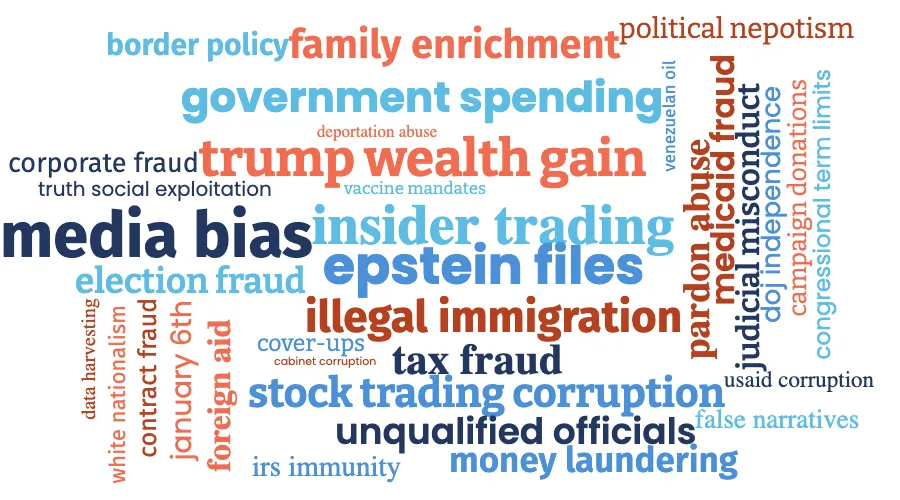
Democratic respondents most frequently cited cryptocurrency ventures involving the president and his family, the use of government contracting to reward political allies, pardons issued after campaign donations, and the dismantling of independent oversight. Several referenced the Mar-a-Lago ballroom and the White House reflecting pool renovation project.
Republican respondents most frequently named USAID, federal money routed through NGOs to fund progressive causes, the handling of Medicaid and learning program funds in Minnesota, and California spending programs where money went in and the results never came out.
The Epstein files appeared across all three partisan groups.. Respondents across the political spectrum highlighted an an absence of accountability as evidence of a protection system for those with power and money.
Congressional stock trading was the one specific example named with consistent frequency by all three groups. Respondents across party identification described it as a concrete, named conflict of interest, framing it not as a partisan allegation but as a known feature of how Washington operates.
Methodology
Polling was conducted online from August 8 to 13, 2026. Using Dynamic Online Sampling to attain a representative sample, Change Research polled 2,045 registered voters nationally. The modeled margin of error is ±2.3 percentage points. Members of AAPOR’s Transparency Initiative disclose all relevant details about our research, with the principle that the public should be able to evaluate and understand research-based findings, in order to instill and restore public confidence in survey results.
See the full data behind this poll
Sign up for the award winning Change Research Data Portal to gain insights like these every month with new polling.