The Gender Gap in Political Ambition Persists in 2026
Women just set a new candidacy record for governor. But a new Change Research survey of 2,006 voters finds one gap hasn't moved: men are still far more likely than women to say they've thought about running for office, 36% to 20%. The qualification gap is even wider. Here's why it hasn't closed in two decades.

More women are running for political office than ever. In 2026, women set a new candidacy record for governor, with 85 women filed as major-party candidates, breaking the previous mark of 69 set in 2022, while women’s candidacies for the U.S. House are nearing an all-time high as well. Women have also become breadwinners in a growing share of American households: the share of women who are the sole or primary earner in opposite-sex marriages has roughly tripled since 1972, to 16% in 2022, and employment among women ages 25 to 54 reached a record high in 2023.
A Change Research national survey of 2,006 registered voters, conducted from July 13 to 17, 2026, finds that one gap has remained about the same size regardless: men are still far more likely than women to say they have personally thought about running for public office.
Political scientists have documented this pattern for more than two decades. In 2001, a national study of potential candidates conducted found that 59% of men had considered running for some elective office, compared with 43% of women. A follow-up study a decade later found the gap had barely moved, and a 2021 survey found it still hadn’t closed. That same 2021 research also found women were about twice as likely as men to describe themselves as “not at all qualified” to run for office, even when the women and men in the study held equivalent professional credentials. Researchers have called it the “invincible gender gap” in political ambition, a pattern that hasn’t budged even as more women have entered politics.
Considering a Candidacy
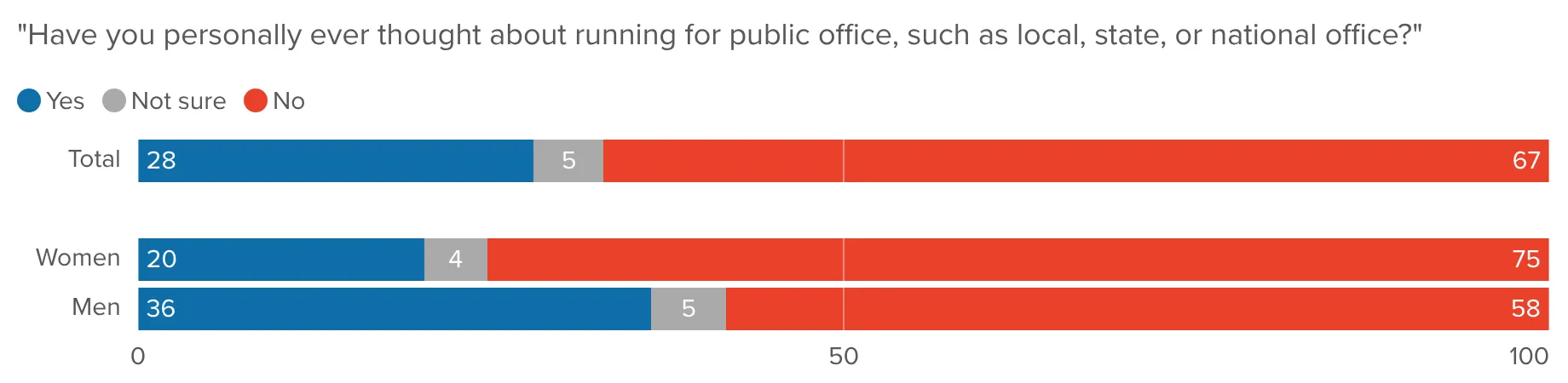
In July, Change Research found that only 28% of voters say they have personally thought about running for local, state, or national office at some point, while 67% say they have not. Men are significantly more likely than women to say they’ve considered running, 36% to 20%, a 16-point gap that closely tracks the gap researchers first identified in 2001.
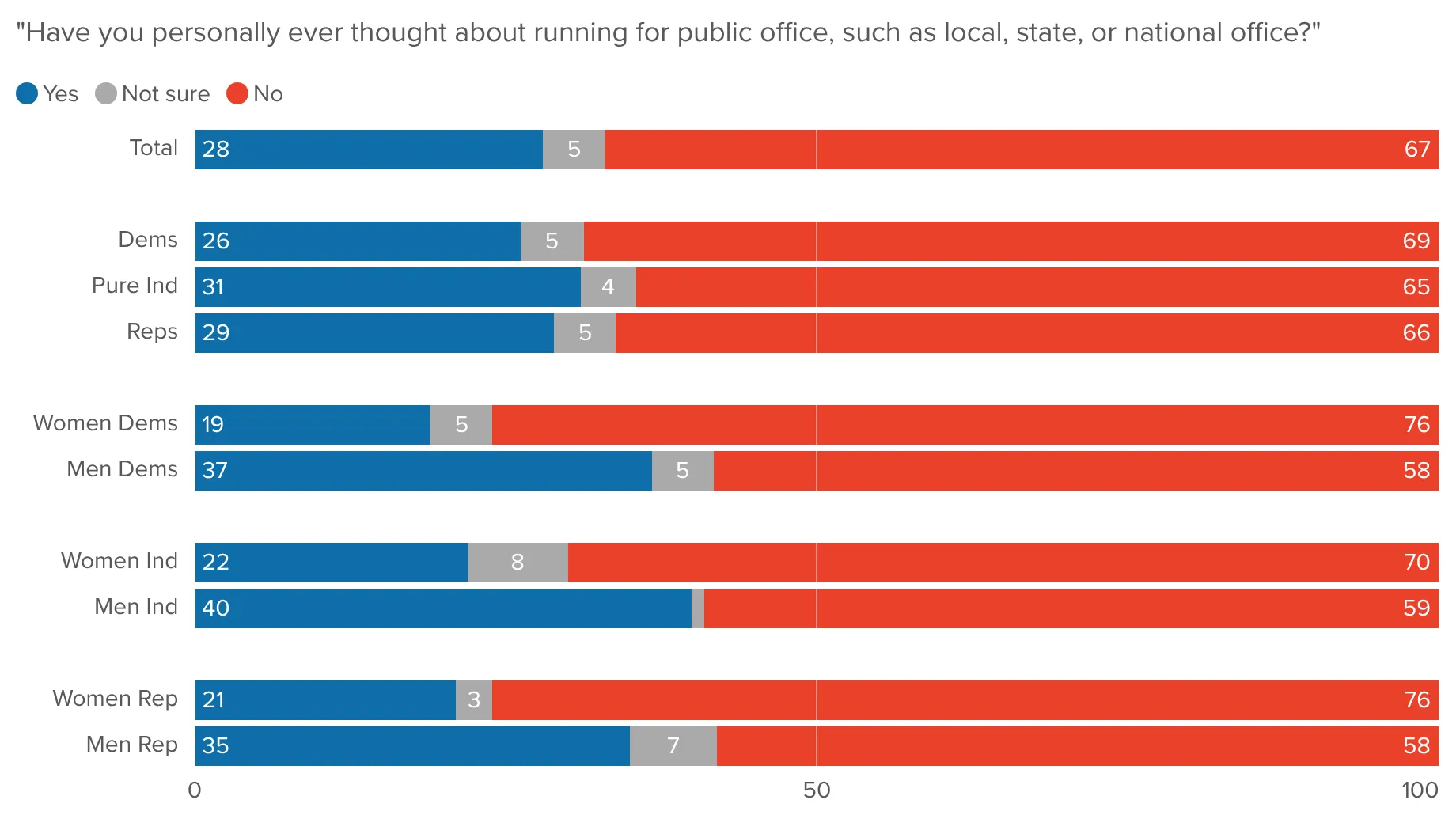
We see similar levels of political ambition across party affiliations. 31% of independents say they’ve thought about running, compared with 29% of Republicans and 26% of Democrats. None of the political parties are resistant to the gender gap, suggesting that political ideology is likely not to blame. The gender gap in ambition is similar: 14 points among Republicans and 18 points among Democrats and independents.
Widest Among Younger Voters
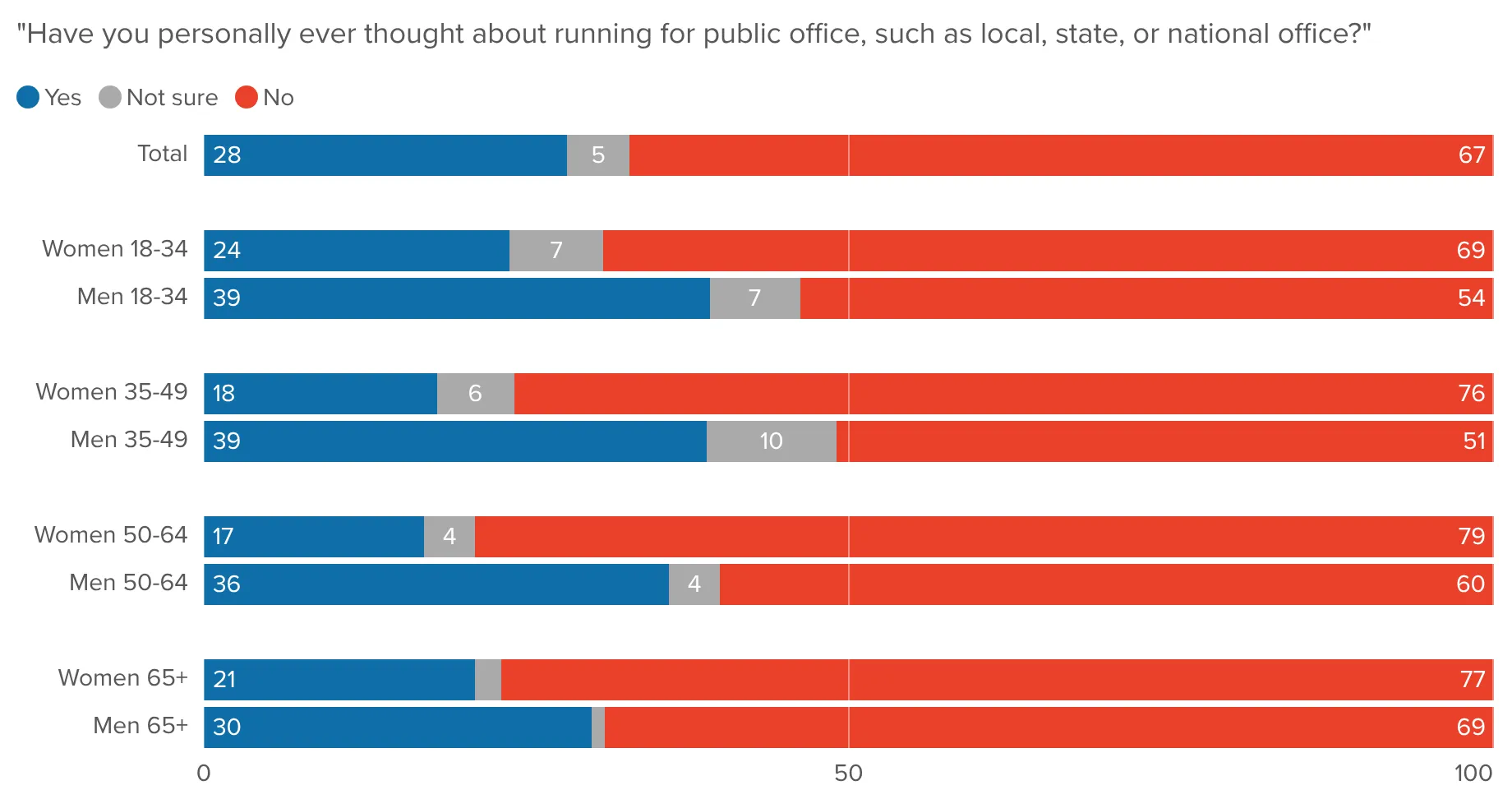
Given other trends in American life, we might expect this gender gap to have closed over time. As newer generations are raised with stronger norms of gender equality, we might expect that the gap between men and women within the youngest age groups might be smaller. However, there does not seem to be clear movement in that direction. The smallest gap is between men and women 65 and older, 9 points (30% of men compared with 21% of women). The gap is widest among voters 35 to 49, at 21 points (39% of men compared with 18% of women), followed by a 19-point gap among voters 50 to 64 (36% of men compared with 17% of women) and a 15-point gap among voters 18 to 34 (39% of men compared with 24% of women).
Feeling Qualified to Run
Researchers point to several factors behind the ambition gap beyond a simple lack of interest. Experimental studies have found that women are more averse than men to the competitive, adversarial nature of campaigns, a pattern researchers have termed “election aversion”. Running for office also carries direct financial costs that fall unevenly by gender: campaign fundraising and the cost of running are frequently cited as structural barriers to women’s candidacies, particularly for women with less access to donor networks. Researchers have also documented that women continue to shoulder a larger share of caregiving and other domestic responsibilities than men, a factor studies have linked to women’s decisions about whether and when to run for office.
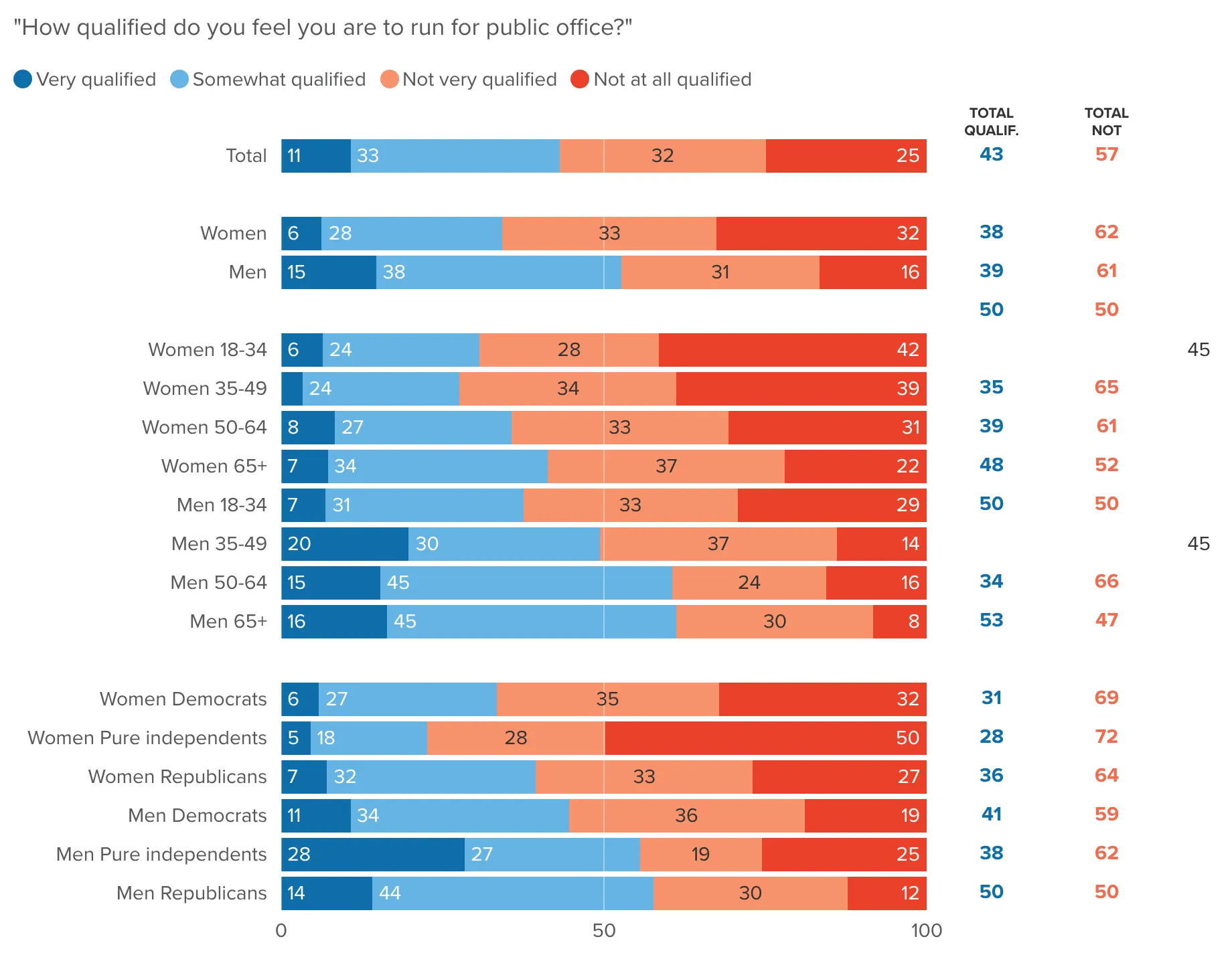
This survey speaks to one additional factor identified in that research: whether people feel qualified to run in the first place. Like the research above, scholars, practitioners, and those working on the ground have shown a similar gender gap. We validated that this gap continues to persist in 2026. When asked how qualified they feel to run for public office, 43% of voters describe themselves as very or somewhat qualified, while 57% describe themselves as not very or not at all qualified.
The gender gap in perceived qualification is wider than the gap in ambition. 34% of women describe themselves as qualified to run, compared with 53% of men. 32% of women say they feel not at all qualified, roughly twice the share of men who say the same, 16%. Men who have thought about running are, on net, more likely to call themselves qualified than not; women are not.
On the question of feeling qualified, however, the gender gap is far wider among independents than among Democrats or Republicans: independent men are among the most likely of any group in the survey to call themselves qualified to run, while independent women are among the least likely, a gap of 66 points in net qualification. That comparison is based on a smaller subgroup of the sample and carries a wider margin of error than the party-line figures.
The gap by age is not steady, and it is not smallest among the youngest voters like we saw with political ambition. Among voters 18 to 34, 31% of women and 38% of men describe themselves as qualified to run, a 7-point gap, the narrowest of any age group measured. The gap widens sharply among voters 35 to 49, where 28% of women and 50% of men describe themselves as qualified, a 22-point gap. It stays wide among older voters: 36% of women and 61% of men ages 50 to 64 call themselves qualified, and 41% of women and 61% of men 65 and older do.
What the Numbers Show
Two decades after researchers first identified a gender gap in political ambition, this survey finds a similar gap still remains in place. Men remain more likely than women to say they’ve thought about running for office, and considerably more likely to say they feel qualified to do so.
Methodology
Change Research surveyed 2,006 registered voters nationally from July 13 to 17, 2026. The modeled margin of error is ±2.3%.
See the full data behind this poll
Sign up for the award winning Change Research Data Portal to gain insights like these every month with new polling.