Why Voters Support or Oppose Military Action in Iran

A Change Research national survey of 2,702 registered voters, conducted April 3–7, 2026, gave supporters and opponents of the Iran conflict the opportunity to explain their positions in their own words. Their responses reveal two largely separate universes of reasoning, shaped by distinct emotional registers, different relationships to authority, and different interpretations of what the conflict is fundamentally about.
These findings were among the topics discussed during a Change Research webinar on April 9, 2026. Watch the full recording here. The conversation was led by Melanie Phillips, Head of Analyst Team, and Stephen Clermont, Head of Polling.
Why Supporters Back Military Action
Supporters of military action most commonly cite the nuclear threat from IranThis concern appears across nearly every age group and demographic. Concerns about Iran’s nuclear program are frequently tied to the Strait of Hormuz and its role in global trade.
A second dominant theme is historical: many supporters frame the conflict as a long-overdue response to Iranian hostility beginning in 1979, often citing 47 years of brutal governance. A third thread, particularly prominent among women supporters, centers on the Iranian people themselves, with many framing the conflict as an opportunity for liberation from an oppressive regime.
“Iran having nukes is a danger to the whole world and their ability to control the Strait of Hormuz could give them control over global trade if they have that power.” Man, 18 to 34, Republican
“Iran was admittedly on the verge of developing a nuclear weapon. They had breached the terms of the agreement with Obama.” Man, 65+, Republican
“For nearly 50 years the Iranian regime has cried ‘death to America.’ They are the number one sponsors of terror and have committed mass murder of their own people.” Woman, 35 to 49, Republican
Concerns Among Supporters
Among supporters of the US-Israeli actions in Iran, the most commonly expressed fear is a prolonged war. References to Iraq and Afghanistan appear frequently, and many supporters set explicit timelines, describing months as acceptable and years as disqualifying. The word “drag” surfaces repeatedly. A second anxiety runs in the opposite direction: that the United States will pull out too soon and leave the regime intact, repeating what many describe as a historical pattern of incomplete action. These two concerns coexist in many responses, reflecting a desire for a mission that is both swift and thorough.
A third concern among war supporters centers on ground troops. Many supporters draw a hard line at a ground invasion, treating air and naval strikes as acceptable while viewing boots on the ground as a threshold that would shift their position.
“No troops on ground without congressional approval and a clearly defined mission.” Man, 50 to 64, Republican
“Boots on the ground, length of conflict, no clear exit ramp.” Woman, 35 to 49, Republican
“My concern is that Congress will force an end to the operation before it is concluded, leaving the regime to rise again.” Man, 18 to 34, Republican
The Domestic Retaliation Concern
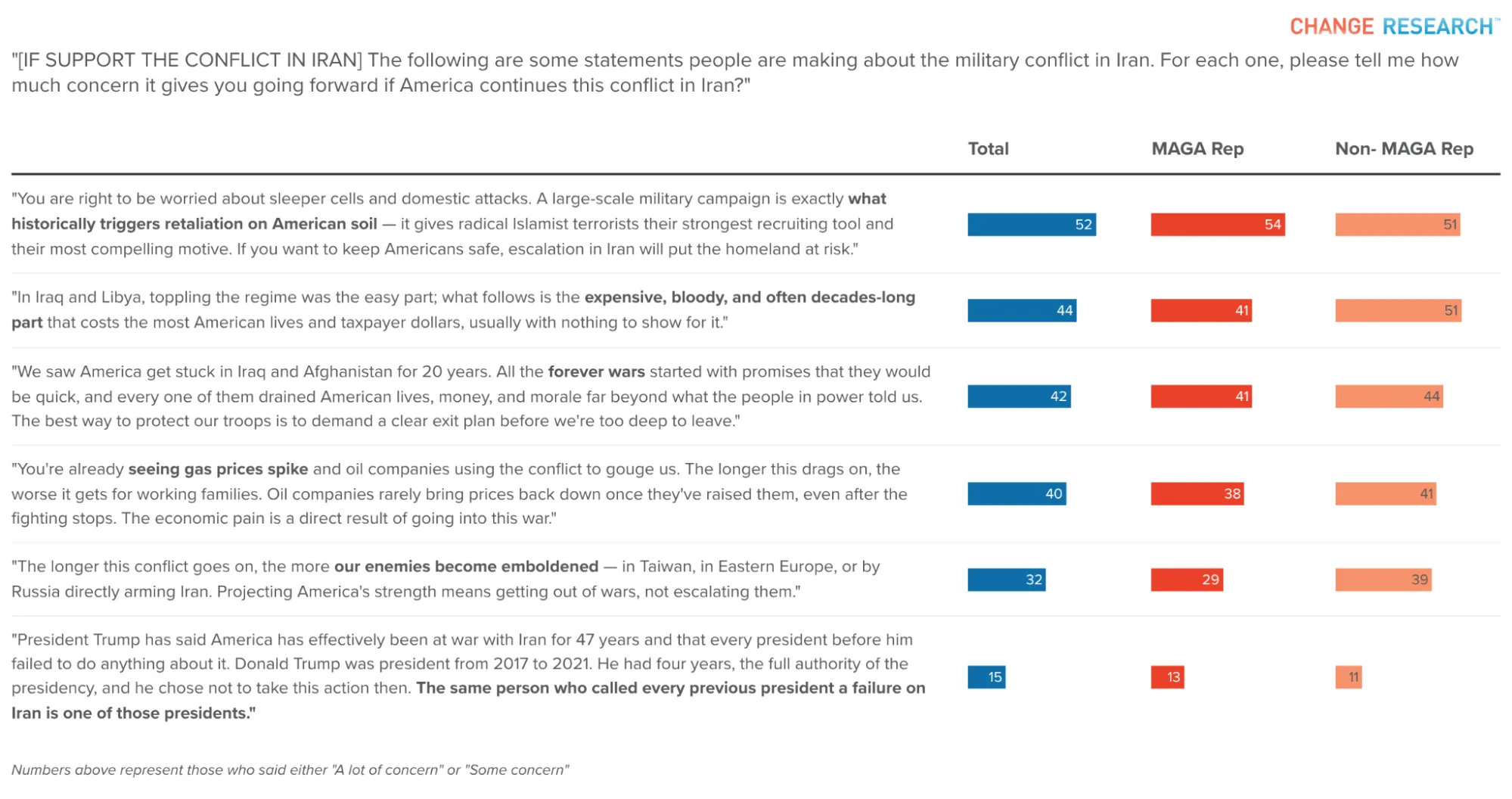
One worry exists among both MAGA and non-MAGA Republican voters: the threat of retaliation on American soil. In the quantitative data, 54% of MAGA supporters express concern about domestic attacks tied to the Iran conflict, including worries about Iranian-linked actors who may have entered the country in prior years. In the open-ended responses, this concern surfaces repeatedly and carries a distinct emotional weight, blending national security anxiety with opposition to immigration.
The survey tested several messages for their ability to generate concern among conflict supporters. Messaging framing the conflict as a risk factor for domestic terrorism scores highest of all frames tested, above economic pain messaging and above historical parallels to Iraq and Afghanistan.
What Would Change Supporters’ Minds
Among supporters asked what could change their position, the most common response by a wide margin is some version of “nothing.” Among those who offer conditions under which they might withdraw support, a prolonged conflict is the most frequently named threshold. Many set explicit time limits, and several specifically flag a ground troop deployment as the scenario that would shift their support to opposition.
Why Opponents Oppose
Among opponents who explained their reasoning, several themes appear with particular frequency. The most common is the absence of congressional authorization, with a large share of respondents pointing to the constitutional requirement that Congress declare war and describing the administration’s decision to act unilaterally as illegal or illegitimate. Closely related is the view that Iran did not pose an imminent threat to the United States at the time the conflict began.
A third recurring theme is the abandoned diplomatic framework: many opponents cite the Obama-era nuclear agreement, arguing that the conflict would not have occurred had that deal remained intact. A fourth thread, running through a notable share of responses, particularly among older Democrats, draws explicit parallels to prior U.S. military interventions in the Middle East. References to Iraq, Afghanistan, Vietnam, and the 1953 U.S.-backed overthrow of the Iranian government appear across these responses. A fifth theme, concentrated among opponents and almost entirely absent from supporter responses, frames the conflict as a deliberate distraction from unrelated domestic political controversy.
Young women express opposition with particular frequency and intensity. Their responses are among the most structured in the dataset, often listing numbered reasons, citing historical precedents, and invoking constitutional or international law. Older men among opponents tend toward briefer, more categorical responses.
“No plan and Congress did not vote on it.” Woman, 50 to 64, Democrat
“If Trump had left the Obama deal in place, this never would have happened. Trump allowed himself to be goaded into it.” Woman, 50 to 64, Pure Independent
“It seems overly aggressive and costing [sic] the country billions that could be put towards more pressing domestic needs that should be addressed.” Woman, 18 to 34, Democrat
“1. It was illegal, as Congress did not provide authorization. 2. It was unprovoked. 3. The Western world is not united in this action.” Man, 18 to 34, Democrat
“Korea, Vietnam, Afghanistan, Iraq.” Woman, 65+, Democrat
What Would Change Opponents’ Minds
Among opponents asked what could change their position, the overwhelming response is also “nothing.” Among the smaller share who offer conditions, a direct attack on American soil is the most frequently named reason they might change their minds, though many add qualifications suggesting that even that scenario would not be sufficient given their (usually negative) assessments of the current administration’s credibility. Congressional authorization, clear evidence of an imminent threat, and allied coalition support appear as conditions among a smaller group of opponents.
“If they attacked us or an ally first, then I’d support it, but that hasn’t happened.” Man, 35 to 49, Democrat
On both sides of the conflict, a large majority say their position is fixed. Where supporters and opponents diverge is in why they hold that view and what, if anything, they identify as the threshold for reconsideration.
Change Research conducted this survey of 2,702 registered voters nationwide from April 3–7, 2026. Open-ended questions were asked separately of supporters and opponents of the Iran conflict. Respondents were recruited via dynamic online sampling to reflect the national voter population. Post-stratification was performed on age, gender, race/ethnicity, region, education, urbanicity, and 2024 presidential vote. The modeled margin of error is ±2.0 percentage points.
See the full data behind this poll
Sign up for the award winning Change Research Data Portal to gain insights like these every month with new polling.