Who Do Voters Want in 2028?

It’s never too early to start looking towards 2028, right?
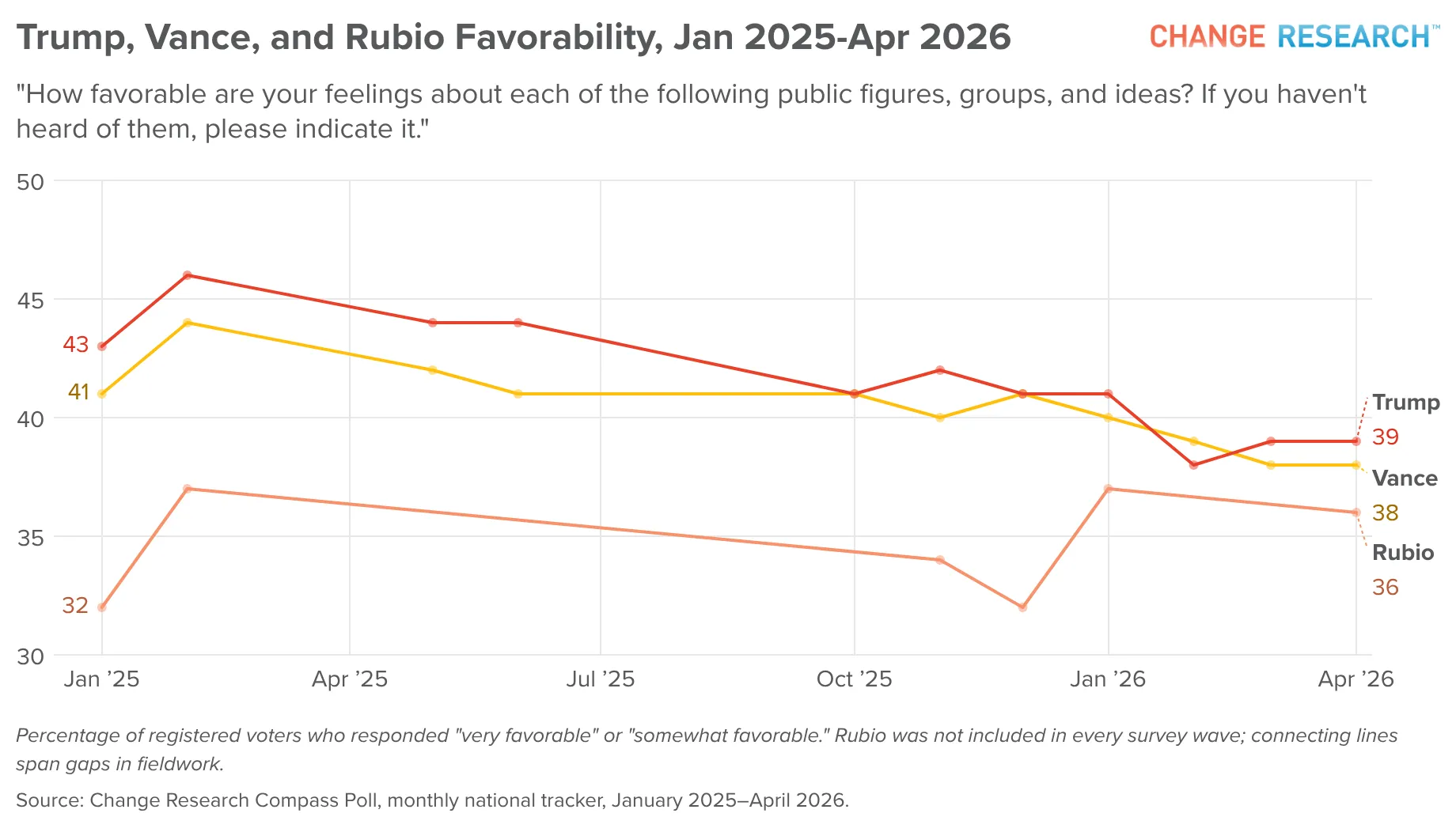
Since January 2025, favorable ratings for President Trump, Vice President Vance, and Secretary of State Rubio have fallen from their post-2024 election peaks. A Change Research Compass Poll tracker spanning more than a year of monthly surveys, combined with a March 2026 national survey of 1,038 registered voters on 2028 preferences, finds a mixed picture for all three across age groups, and among young men and independents.
The 2028 Republican primary is starting to take shape, even if nobody will say so out loud. Trump is constitutionally barred from a third term, and Axios reported in February that he has started floating the Vance-versus-Rubio question with advisers. Vance enters that conversation as the frontrunner. Our polling data, though, tells a more complicated story.
The Post-Inauguration Decline
All three figures reached their strongest readings in the Compass Poll tracker just after the January 2025 inauguration. In the February 2025 survey, Trump’s favorability stood at 46%, his best reading in years. Vance’s favorability was at 44% in the same wave. Rubio was at 37% favorable.
By April 2026, all three have lost ground, though Rubio has held steadier than Trump or Vance. In the most recent survey, 55% of voters view Trump unfavorably, compared to 39% favorably. Vance stands at 38% favorable and 51% unfavorable. Rubio holds at 36% favorable and 45% unfavorable.
On job approval, 42% of voters approve of Trump’s performance and 56% disapprove. The intensity of opposition stands out: 51% say they strongly disapprove, compared to 28% who strongly approve.
One signal that runs through the trend data involves men 65 and older. As recently as October 2025, older men were among the warmer subgroups for both Trump and Vance. By April 2026, that warmth has largely dissipated, with older men viewing both figures in line with the broader electorate.
Independent Voters
Among pure independents, views of all three figures have fallen over the course of the administration. In the April 2026 survey, 14% of pure independents view Trump favorably and 72% view him unfavorably. Vance’s numbers with independents are similar: 15% favorable and 62% unfavorable. Rubio fares somewhat better at 16% favorable and 52% unfavorable. Fewer than 1 in 5 independents view any of the three favorably.
The gap between Rubio and the other two figures widened over the course of the tracker. At the start of the administration, all three were viewed similarly by independents. Trump and Vance have each lost more ground with independents than Rubio did over the past 15 months.
Young Voters
Young Republicans view all three figures favorably in the April 2026 survey. More than half of Republicans aged 18 to 34 view Vance (58%) and Trump (61%) favorably, though both trail their older counterparts. Among Republicans 65 and older, about 9 in 10 view all three figures favorably.
Among young Republican voters, a gender gap is visible in Trump’s numbers. Republican men aged 18 to 29 view Trump favorably at 64%, compared to 43% among Republican women in the same age range, a 21-point gap within the party’s own base. No comparable gap appears for Vance, who draws nearly identical favorable ratings from young Republican men (50%) and women (49%).
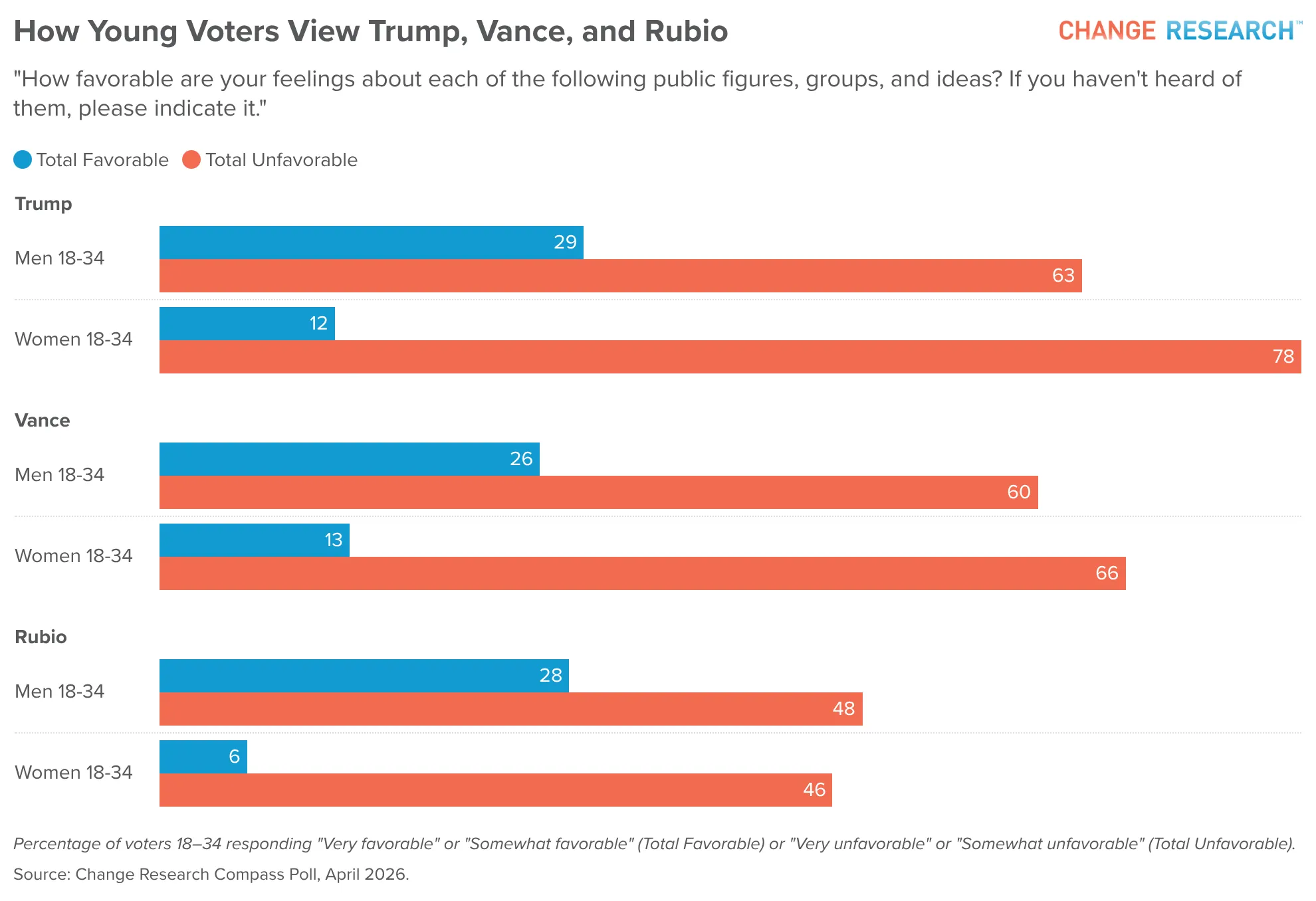
Among all men 18 to 34, the picture looks different. In the April 2026 survey, 26% of young men view Vance favorably and 60% view him unfavorably. Trump’s numbers with young men are similar: 29% favorable and 63% unfavorable. Rubio draws unfavorable views from a majority of men in this age group as well, though his unfavorable rating is lower than the other two at 48%.
Among voters 18 to 34 who identify as pure independents, the gap widens. Only about 1 in 20 view Vance favorably (5%), with nearly three-quarters viewing him unfavorably. Trump’s numbers with this group are more lopsided: 3% favorable and 87% unfavorable. Rubio reaches 7% favorable, a small share, but better than the other two.
Women aged 18 to 34 are the most unfavorable subgroup across every figure in the full tracker. In the April 2026 survey, 12% of young women view Trump favorably and 78% view him unfavorably. Vance stands at 13% favorable and 66% unfavorable with the same group.
Looking Ahead to 2028
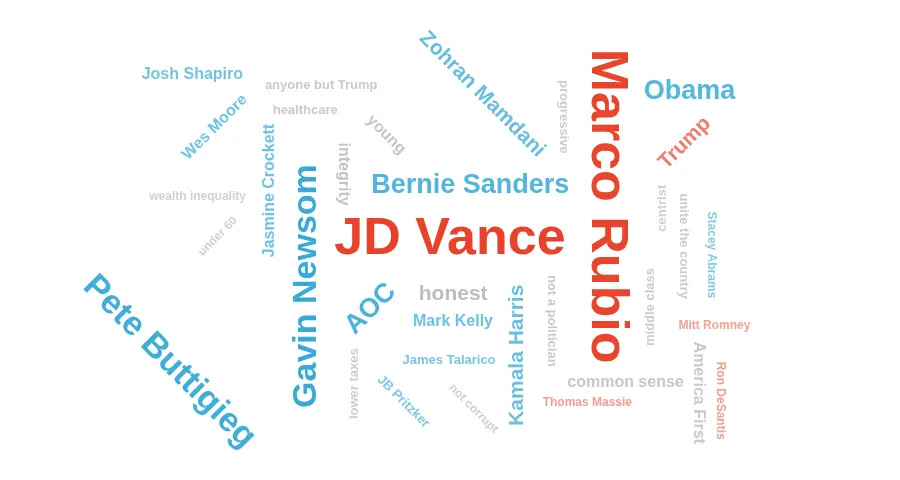
Beyond the favorability numbers, we asked voters directly: if you could pick anyone to run in 2028, who would it be? The open-ended responses, drawn from 1,038 registered voters in March 2026, reflect no clear consensus on either side.
The Republican Field
Vice President Vance drew more unprompted mentions than any other candidate. Roughly a fifth of all respondents named him, either alone or alongside Secretary of State Rubio. Among 2024 Trump voters, he was named at roughly double the rate of any other single candidate.
The age distribution of those who named him tells its own story. The 65-and-over group accounted for more Vance mentions than any other age bracket, and voters 50 and older accounted for more than three-quarters of all his mentions. Among respondents under 35, Vance was named almost exclusively by strong Republicans.
Rubio drew fewer mentions overall, but the coalition nominating him skewed somewhat broader, with more mentions from independent-leaning and weak Republicans. Among young independent men who lean Republican, Rubio drew more 2028 mentions than Vance.
Among young men overall, no Republican candidate consolidated support in the open-ended responses. Strong Republicans disproportionately named Vance. Independent-leaning Republican young men were more likely to name harder-right or libertarian-adjacent figures, or to describe a type of person without naming anyone.
The Democratic Field
On the Democratic side, Gavin Newsom led the open-ended responses among Harris voters by a wide margin, drawing particular support from voters 65 and older who backed Harris in 2024.
Alexandria Ocasio-Cortez drew a high share of her mentions from younger respondents. Among voters under 35, she was the most frequently named Democrat, with support appearing across both young women and young men who leaned Democratic.
Pete Buttigieg drew a similar level of mentions across age groups, with particular strength among older Harris voters.
Zohran Mamdani received a small number of mentions in the survey, even though he cannot legally run as a foreign-born citizen. Those mentions appeared disproportionately among younger voters and independents who leaned Democratic.
A Voter Without a Candidate
Roughly one in four respondents did not name a candidate at all. Instead, they described qualities: honest, not beholden to corporations or special interests, not a career politician, under 60. The pattern appeared across party lines and among 2024 Trump and Harris voters in comparable numbers.
“Someone under 65, left-wing but not annoying, and electable.” - White Man, 18 to 34, Strong Democrat
“No ego, has common sense, no special interest, logical, honest, willing to listen.” - White Man, 50 to 64, Weak Republican
As the field takes shape, we will continue tracking how voters’ preferences evolve.
Methodology
Change Research conducted the 2028 preferences survey of 1,038 registered voters in March 2026. The favorability and approval trend data are drawn from the Change Research Compass Poll monthly tracker, which surveys approximately 1,000 registered voters each month. The tracker covers 19 waves of Trump favorability (September 2023 through April 2026), 16 waves of Vance favorability (June 2024 through April 2026), and 5 waves of Trump job approval (December 2025 through April 2026).
See the full data behind this poll
Sign up for the award winning Change Research Data Portal to gain insights like these every month with new polling.