Where Americans Stand on Social Media Regulation
The TikTok divestiture is done. But polling reveals Americans want the government to stay out of regulating social media.
The TikTok saga reached its conclusion last week when a new American-majority ownership consortium officially took control of the platform’s U.S. operations. The deal, finalized January 22, transfers 80.1% ownership to non-Chinese investors, with ByteDance retaining 19.9%. It’s a shift driven by national security concerns about potential Chinese government access to American user data.
While the government successfully forced this ownership change to address national security risks, polling from Change Research reveals broader skepticism about government involvement in social media. Americans broadly oppose government oversight of social media platforms, even as debates intensify over how platforms should moderate content, combat misleading content and misinformation, and protect users.
The Distinction That Matters
The TikTok deal addressed ownership and national security. Government oversight of social media, by contrast, is about content moderation: what speech gets amplified or suppressed, and who decides what’s allowed online. Those are fundamentally different questions.
The debate has intensified dramatically. Just weeks after the survey fielded, Meta ended its fact-checking program on Facebook and Instagram. Congress is wrestling with Section 230 of the Communications Decency Act, the law that shields technology companies from liability for user-generated content. In December 2025, a bipartisan group of senators introduced legislation to repeal it entirely.
Multiple states have tried regulating content moderation, though courts have blocked many efforts on First Amendment grounds. Texas and Florida passed laws restricting platforms’ ability to moderate based on viewpoint, but the Supreme Court flagged serious constitutional concerns in 2024. Federal judges have struck down laws requiring parental permission for minors to access social media and restricting algorithmic feeds for young users.
Americans Oppose Government Oversight of Social Media
In a Change Research nationwide survey of 1,991 adults fielded in November and December 2025, 56% of respondents oppose the U.S. government having a role in overseeing or regulating major social media platforms. Just 32% support it, yielding a net opposition of 24 points.
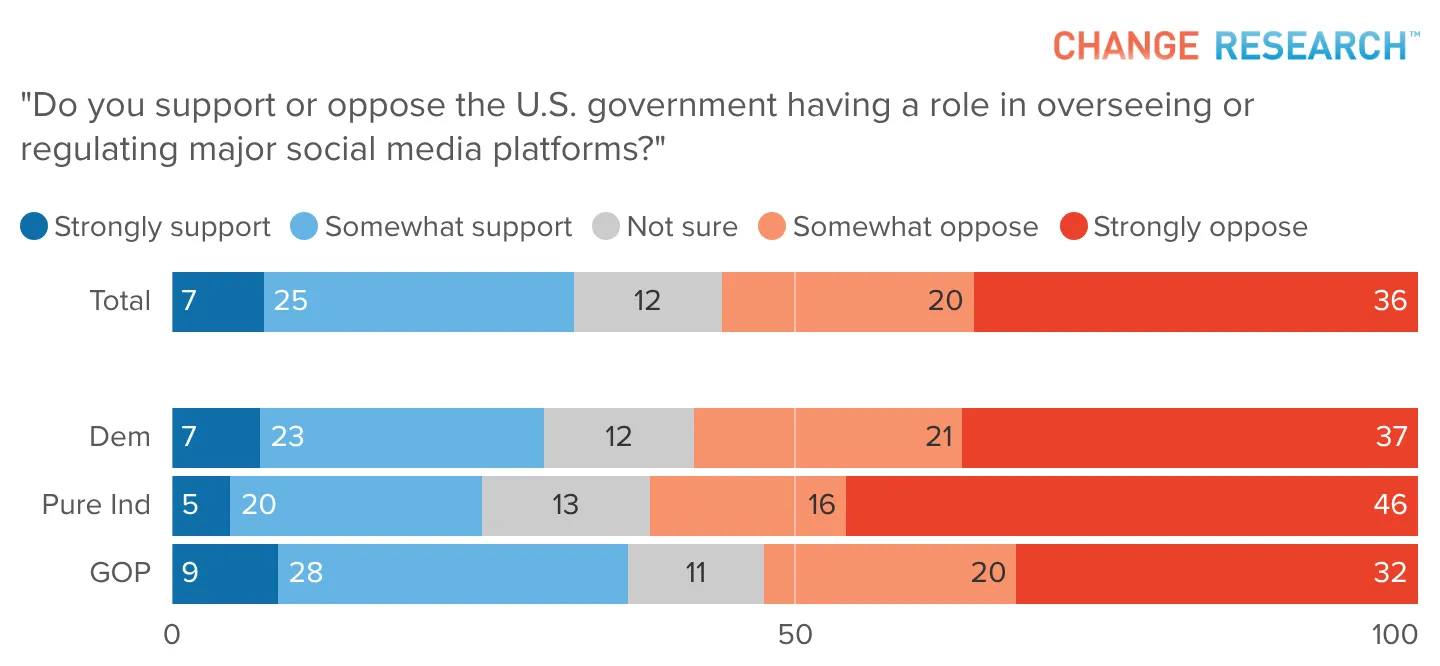
That opposition crosses party lines, though not uniformly. Independents are the most opposed, with 62% against government oversight and only 25% in favor (net negative 37). Democrats follow at 58% opposed and 30% in support (net negative 28). Republicans show relatively less opposition, with 52% against and 37% in favor (net negative 15).
Among adults 18 to 34, 63% oppose government oversight of social media, with only 26% in support (net negative 37). Opposition remains strong among those 35 to 49 (59% oppose, 30% support) and those 50 to 64 (56% oppose, 32% support). Only among those 65 and older does opposition soften: 46% oppose government oversight while 40% support it, the closest any age group comes to an even split.
The Daily Scroll: TikTok Usage Patterns
Among those who use TikTok, nearly half (48%) report using it at least multiple times per day. But usage intensity varies sharply by age. Among TikTok users aged 18 to 34, 62% use the app multiple times daily, with nearly a quarter (24%) saying they use it constantly or hourly. That intensity drops with age: 47% of TikTok users aged 35 to 49 use it multiple times daily, compared to 44% of those 50 to 64, and just 29% of those 65 and older.
Partisanship also shapes usage patterns among TikTok users. Over half of Democrats (53%) and Independents (56%) who use the platform do so multiple times a day or more frequently, compared to 37% of Republicans.
Where Americans Get Their News
That same survey finds social media has become a dominant news source, particularly for younger Americans. Among adults 18 to 34, 74% say they get local or national news from social media platforms like Facebook, X/Twitter, TikTok, Instagram, or YouTube. That far outpaces traditional media (TV, radio, newspapers), which just 34% of young adults use for news.
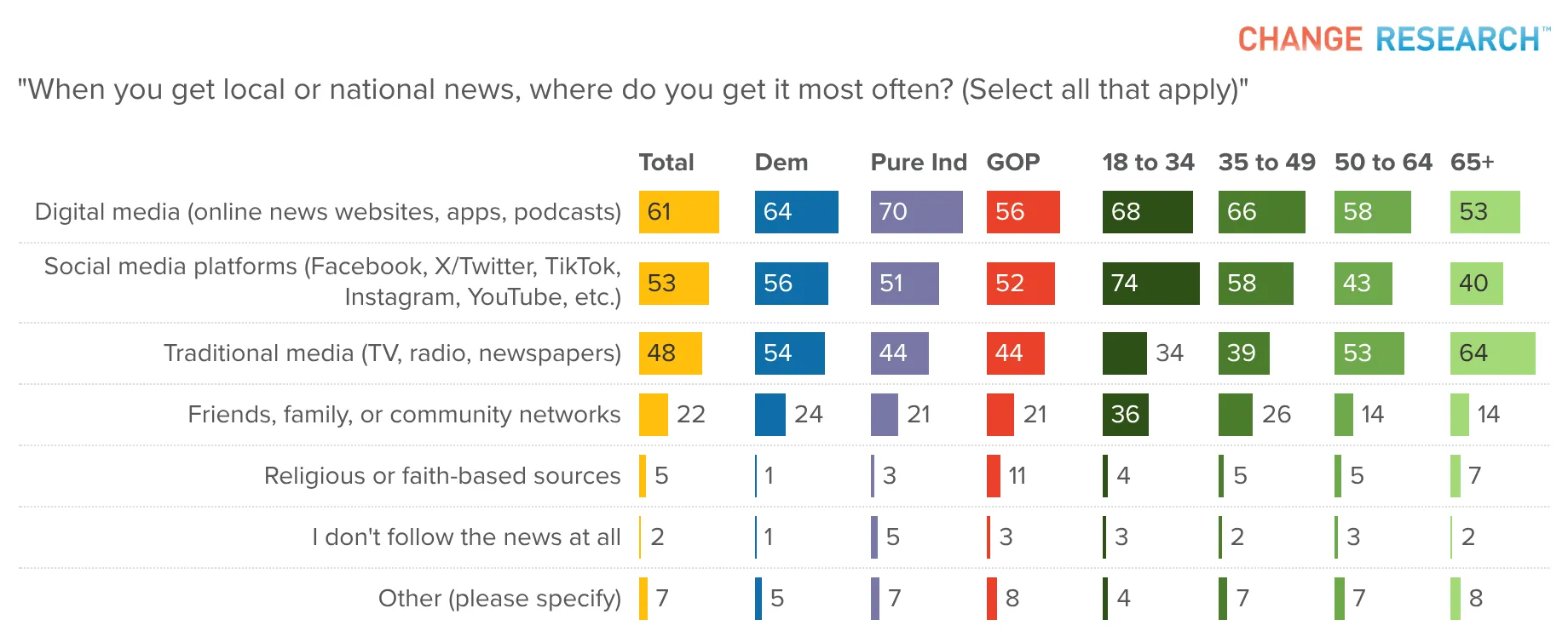
The pattern flips among older Americans. Among those 65 and older, 64% turn to traditional media for news while only 40% rely on social media.
Overall, digital media (online news websites, apps, podcasts) leads at 61%, followed by social media at 53%. Traditional media at 48%. Friends, family, or community networks serve as a news source for 22% of respondents, with that figure rising to 36% among 18 to 34 year olds.
The Bottom Line
The TikTok deal closes a chapter on the platform’s once uncertain future in the United States. The federal government successfully forced an ownership change to address national security concerns about Chinese government influence. But the polling reveals a separate source of skepticism: a majority of Americans oppose government oversight of social media platforms across party lines, with the strongest opposition coming from the youngest adults who are also the most engaged users.
As policymakers debate Section 230 reform, content moderation, and oversight, these numbers offer a baseline for understanding public sentiment. Americans may accept government mandated ownership changes for national security, but they’re wary of broader government involvement in how social media operates.
Methodology
The Change Research Compass Poll on Media, Identity, and Belonging was conducted November 19 through December 2, 2025, among 1,991 U.S. adults nationwide, with a modeled margin of error of 3.0%.
See the full data behind this poll
Sign up for the award winning Change Research Data Portal to gain insights like these every month with new polling.