
As the nation marks Women’s History Month, new polling from Change Research reveals where Americans stand on some policies shaping women’s lives. The data, drawn from a national survey of 1,741 respondents fielded February 5-18, 2026, finds that large majorities oppose efforts to roll back reproductive rights, and even larger majorities support policies like paid family leave and workplace protections for pregnant workers. However, a deeper look at the crosstabs reveals a more complex picture: ongoing gender gaps, stark racial divisions, and a notable disparity between voter preferences and some policies currently being prioritized by lawmakers.
The Gender Gap
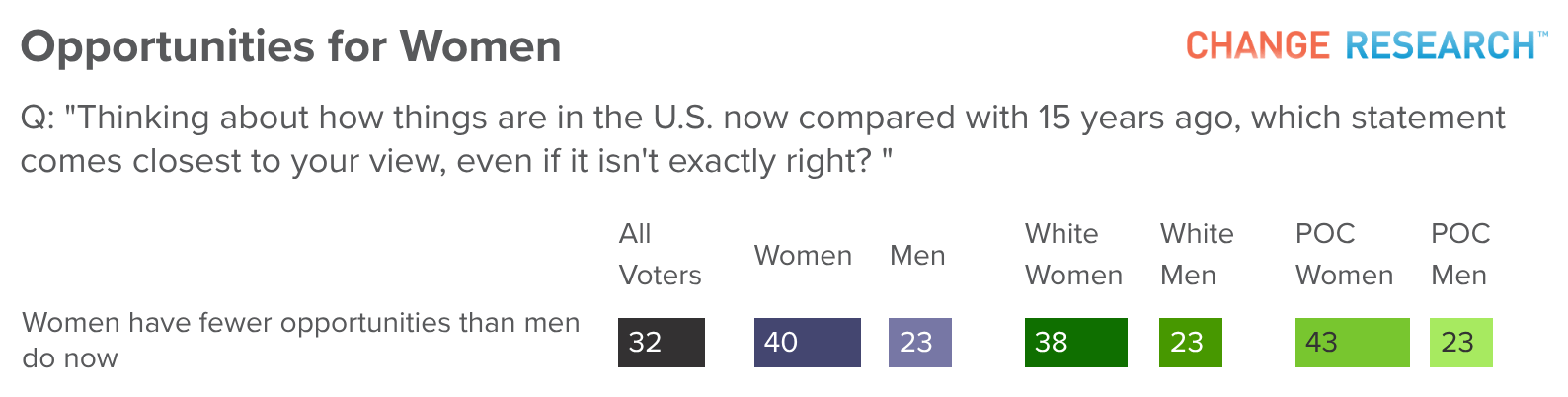
Americans are split on the question of whether women and men have equal opportunities today compared to 15 years ago. A plurality of Americans (39%) believe opportunities are now roughly equal, while 32% say women still have fewer opportunities than men. Additionally, 17% believe women have more opportunities than men.
The gender gap on this question is striking. Among women, 40% say they have fewer opportunities than men, while 36% say things are equal. Men see it differently: 44% say opportunities are roughly equal, and just 23% say women have fewer. Twenty-one percent of men say women have more opportunities, compared to just 13% of women who say the same.
Women of color are far more likely to say women still face an unequal playing field: 46% of non-white women say women have fewer opportunities, compared to 34% of white women. Among men, the pattern holds but at lower levels: 28% of men of color say women have fewer opportunities, versus 20% of white men. Nearly a quarter (23%) of white men believe women now have more opportunities than men.
On Reproductive Rights, the Public Sends a Loud Message
Voters oppose virtually every proposal we asked about that would restrict reproductive access, and they do so by wide margins.
Birth Control
Seventy-nine percent of Americans oppose limiting access to birth control, including 65% who strongly oppose it. Support for restrictions comes from just 13% of respondents. Among women, opposition rises to 84%, with 74% in strong opposition.
Women of color oppose limiting access to birth control even more (89%), with 79% in strong opposition. They are the most intensely opposed group in the survey on this question. Sixty-six percent of Republicans oppose restricting birth control access. This is slightly below the percentage of white non-college educated men, 68%, who oppose limiting access to birth control.
Abortion Pills by Mail
Proposals to limit or ban abortion pills by mail or through telehealth face 57% opposition overall (with 45% strongly opposing), against 34% support. The divide here runs along familiar partisan lines: 84% of Democrats oppose such limits, while 58% of Republicans support them. But the gender story is worth noting. Women oppose these restrictions at 59%, while men oppose them at 54%.
Emergency Pregnancy Care
The idea of making it harder for doctors to provide emergency pregnancy care draws even sharper opposition: 68% oppose, just 15% support. Among women specifically, 72% oppose, including 60% who strongly oppose. Restricting IVF? Seventy-two percent oppose that too, with women opposing at 77%.
Religious Refusals
Allowing hospitals or doctors to refuse care based on religious beliefs finds 72% opposition and just 19% support. Among women, 74% oppose, and among women of color, that number climbs to 75%.
IVF Restrictions
Restricting IVF draws 72% opposition overall. Among women, that rises to 77%, and among women of color, to 80%. Two-thirds of men (67%) are also opposed. Even among Republicans, 61% oppose limiting access to fertility treatments.

Where Almost Everyone Agrees
The family policy data reveals a fairly high level of consensus. Support for paid family leave hits 80% overall, with just 15% opposed. Women support it at 84%, men at 75%. The youngest voters (18-34) are the most enthusiastic at 88%, but even among voters 65 and older, 74% are in favor. And this is genuinely bipartisan: 92% of Democrats and 68% of Republicans support requiring paid family leave for new parents.
Strengthening workplace protections for pregnant workers reaches an even higher threshold: 85% support, 7% oppose. That is a net +78 margin. Among women, support is 89%. Among men, 81%. Democrats back it at 94%, and Republicans at 78%. It is rare in polling to find a policy question where roughly eight in ten members of both parties agree. This is one of them.
Increasing public funding for childcare draws 71% support overall (53% among those aged 18-34 strongly support it). Women back it at 74%, men at 67%. There is a partisan gap here: 92% of Democrats support vs. 51% of Republicans, but even that 51% figure means a majority of Republican voters support more public childcare funding.
Divorce Restrictions, Parental Consent, and the Gender Divide
Two questions in the survey reveal where gender dynamics get particularly interesting. On making it harder to get a divorce (including limiting no-fault divorce), 69% of Americans oppose and 19% support. But the gender gap here is the widest in the survey: 77% of women oppose, compared to 59% of men. Among women, just 13% support making divorce harder. Among men, that number nearly doubles to 25%. Women of color oppose at 80%, while white men show the lowest opposition at 54%.
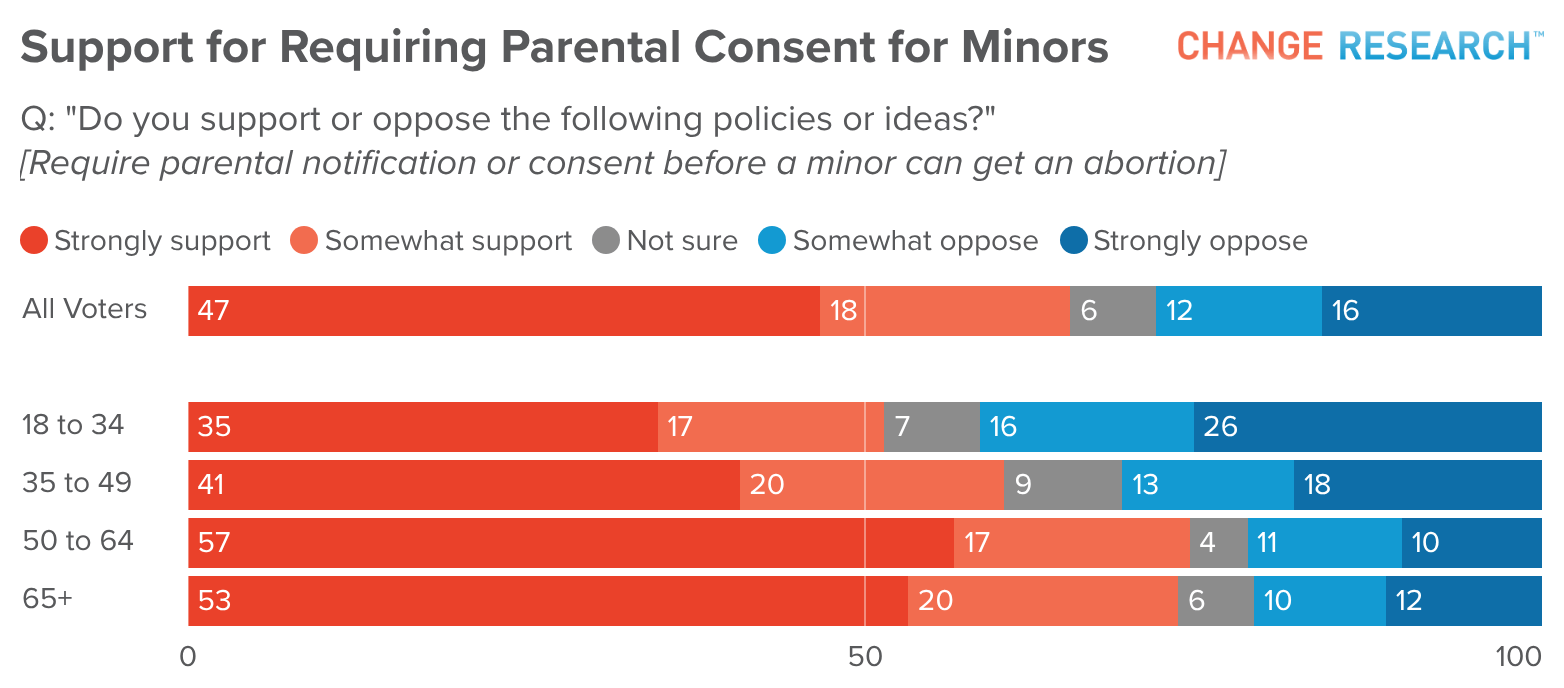
On requiring parental notification or consent before a minor can get an abortion, the script flips. This is the only policy restriction in the survey that earns majority support: 65% in favor, 28% opposed. Men support it at a higher rate (71%) than women (60%), but even women support it by a nearly 2-1 margin. Republicans back it overwhelmingly at 90%, while Democrats are divided, with 39% in support and 52% opposed. Among voters 50 and older, support exceeds 73%.
The Big Picture
Taken together, the data tells a story that is both straightforward and layered. Americans broadly oppose proposals to limit reproductive health access: birth control restrictions, abortion pill bans, emergency care limitations, IVF restrictions, religious refusal carve-outs, and divorce rollbacks all face net-negative support, often by margins exceeding 50 points. At the same time, Americans overwhelmingly support proactive investments in families through paid leave, workplace protections, and childcare.
But the data also reveals a range attitudes on the current state of opportunities. Women, and especially women of color, mostly see a landscape that favors men. Men, particularly white non-college educated men, are more likely to see the playing field as level or tilted towards women. Men are also more likely to favor reproductive restrictions, even when they oppose them on balance.