Voters Question U.S. Military Action in Iran
A Change Research national survey of 1,541 registered voters, conducted March 8–12, 2026, finds majority opposition to U.S. military action in Iran, alongside broad concerns about escalation, lack of congressional oversight, and the administration’s communication of its objectives.
The survey was fielded during the first two weeks of Operation Epic Fury, the joint U.S.–Israeli military campaign that began on February 28, 2026. By the time the poll finished fielding, American and Israeli strikes had killed Iranian Supreme Leader Ayatollah Ali Khamenei and dozens of senior officials, Iran had retaliated both militarily and by blocking access to the Strait of Hormus, and oil prices had risen more than 40%.
Support and Opposition
Forty-one percent of voters supported the U.S. decision to take military action against Iran at the time of this survey, including 30% who strongly supported it. Fifty-four percent opposed the action, with 45% strongly opposed.
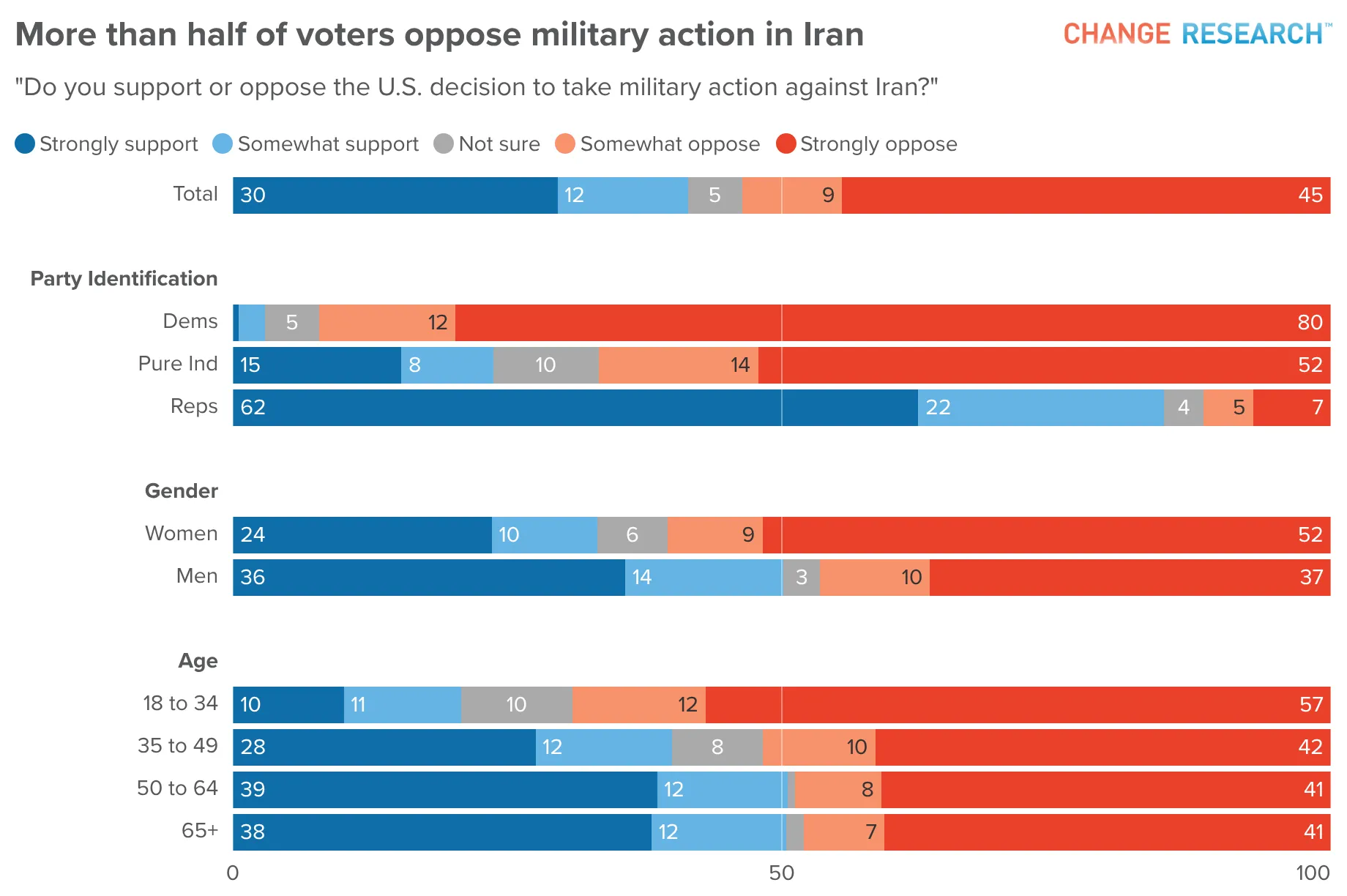
Support was higher among men (50%) than women (33%). Republicans backed the action broadly (85% in support, 12% opposed), while Democrats opposed it at a similar rate (92% opposed, 3% in support).
For comparison, a Pew Research Center poll in October 2002 found 55% of Americans in favor of military action in Iraq to end Saddam Hussein’s rule, roughly 14 points higher than support for the Iran action in this survey.
Among those who supported the action, stated reasons center on Iran’s nuclear program and decades of unresolved tensions with the regime.
“It is a chance to free the people of Iran from persecution, and strengthens the security of the USA.”
— White man, 50 to 64, Independent
“The people of Iran needed change already, let’s hope and pray. They can get it right.”
— Hispanic/Latino man, 50 to 64, Republican
Half of the respondents were asked whether they believed Iran was an immediate threat to the United States before the decision to take military action. In that group, 53% said Iran was not an immediate threat at that point, 37% said it was, and 10% were unsure.
The other half were asked whether Iran is currently an immediate threat: 42% say yes, 44% say no, and 14% are unsure.
Congressional Authorization
Fifty-seven percent of voters say the President should have to get approval from Congress before continuing military action in Iran. Thirty-seven percent say the President should be able to make that decision on his own.
Support for congressional authorization was highest among Democrats (94%) and independents (75%). Among Republicans, 77% say the President should be able to decide on his own, while 15% say Congress should have to approve.
Administration Communication
Fifty-eight percent of voters say the Trump Administration has not explained clearly enough what it is trying to achieve with military action in Iran. Thirty-five percent say it has explained its goals clearly enough.
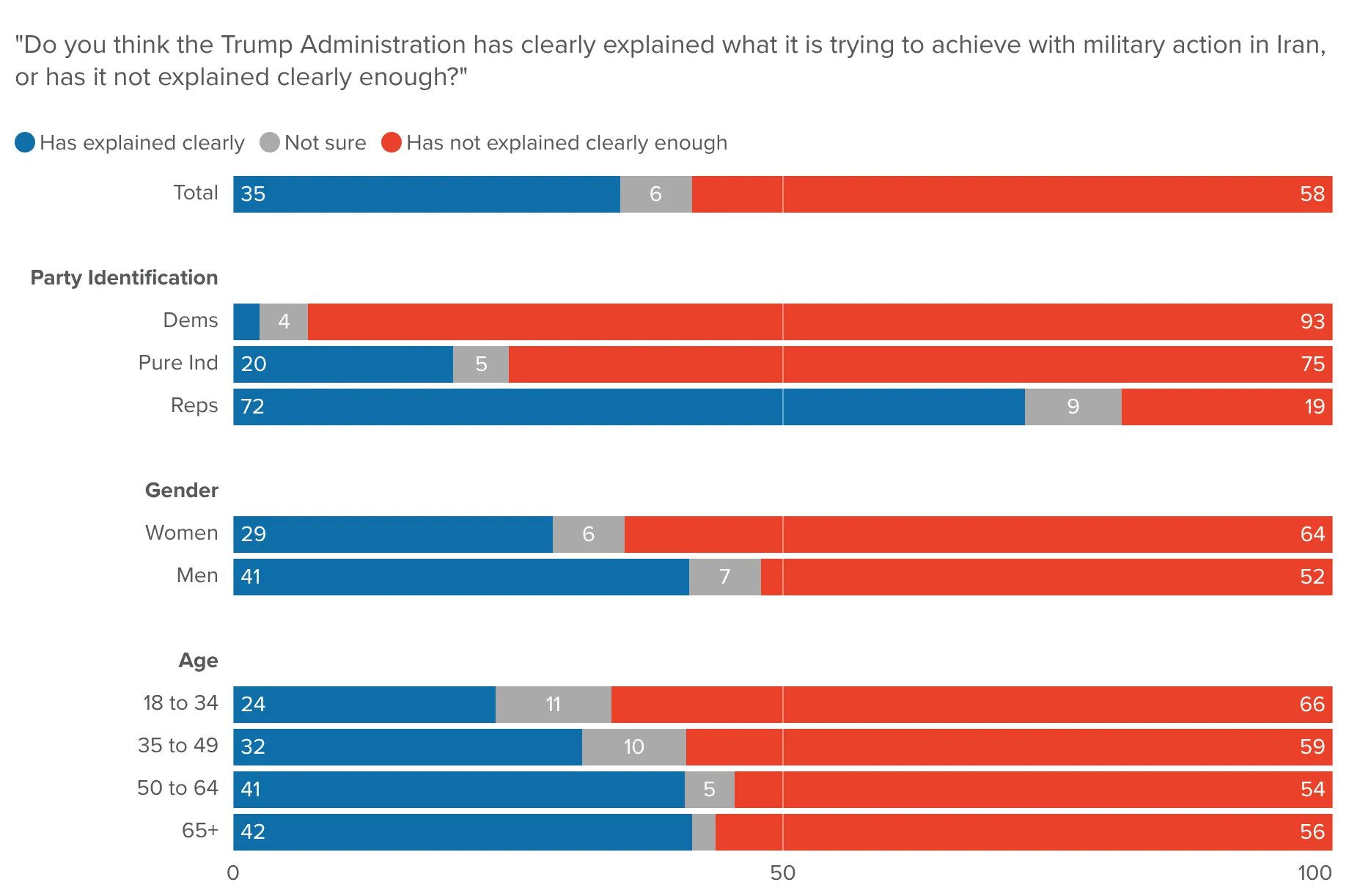
Democrats (93%) and independents (75%) are far more likely to say the goals have not been explained clearly. Among Republicans, 72% say the administration has explained clearly and 19% say it has not.
In October 2002, a Pew Research Center poll asked the same question about President Bush and the Iraq conflict. At the time, 48% said he had explained clearly, and 45% said he had not. The current numbers show a notably wider gap, with the “not explained clearly” share running 23 points higher for the Iran conflict.
Among voters who oppose the action, the survey asked what could change their minds. A large share say nothing would. Among those who describe a potential threshold, the most common conditions are verifiable evidence of an imminent direct threat to the United States — distinct from a threat to U.S. allies — and prior congressional authorization.
“Nothing. The administration’s story has changed numerous times in the past week.”
— White woman, 50 to 64, Democrat
“Legitimate proof they’re actually close to having nuclear weapons. It’s been 40 years Netanyahu has claimed that Iran was weeks away from having them with no proof.”
— White man, 35 to 49, Republican
When asked whose interests are most served by U.S. military action in Iran, 26% of voters say Israel, 24% say Donald Trump, and 18% say the American people. Fourteen percent say the people of Iran benefit most, and 5% point to the defense industry.
Escalation Concerns
Seventy-two percent of voters express concern that military action in Iran could lead to a larger war involving other countries in the Middle East, including 48% who are very concerned. Women (78%) are somewhat more likely than men (66%) to express concern.
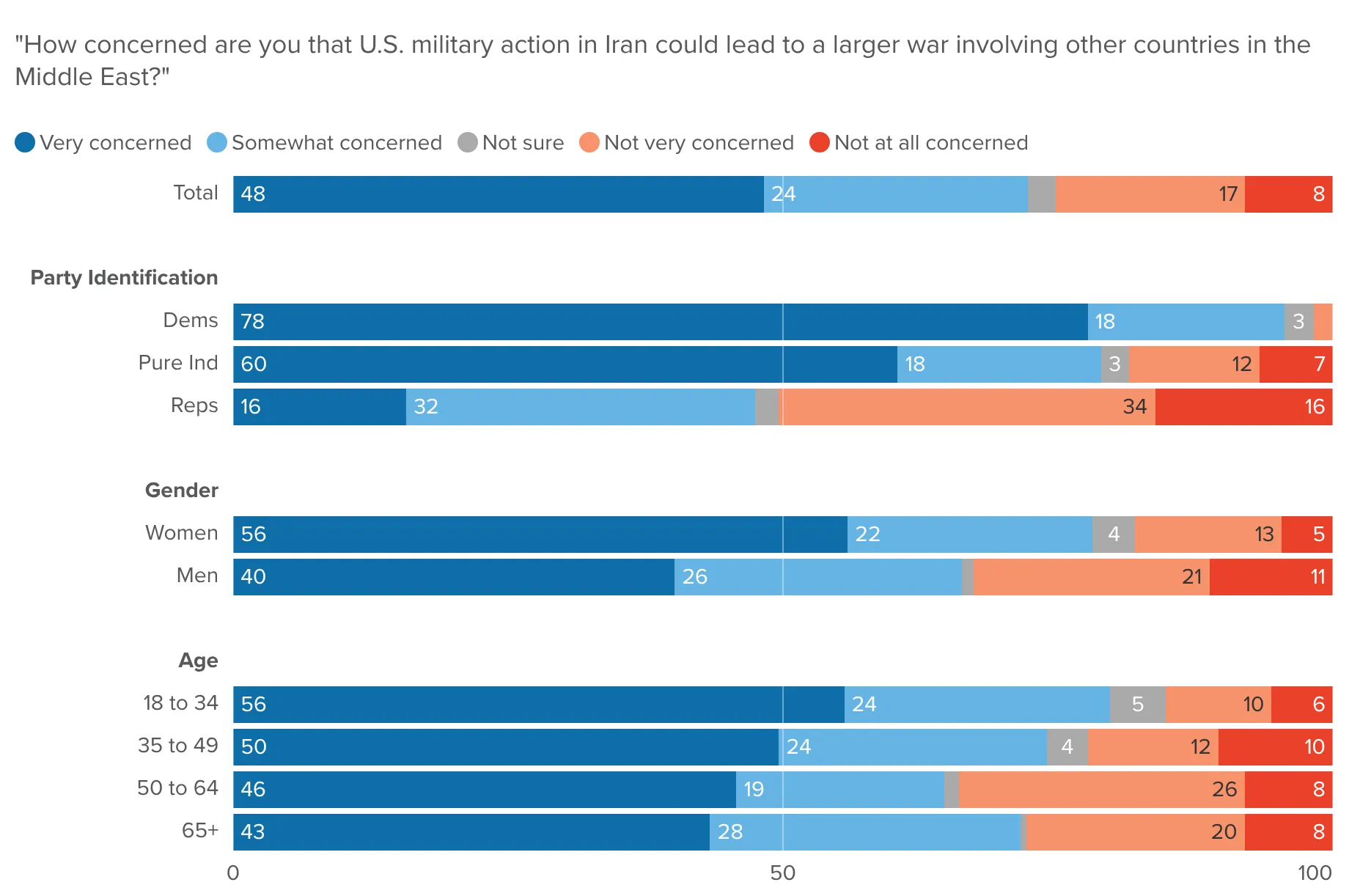
Even among voters who support the action, concern about escalation and the conflict’s duration is widespread.
“That we will end up in a world war.”
— White woman, 18 to 34, Republican
“Lives and safety of our troops.”
— White woman, 65+, Republican
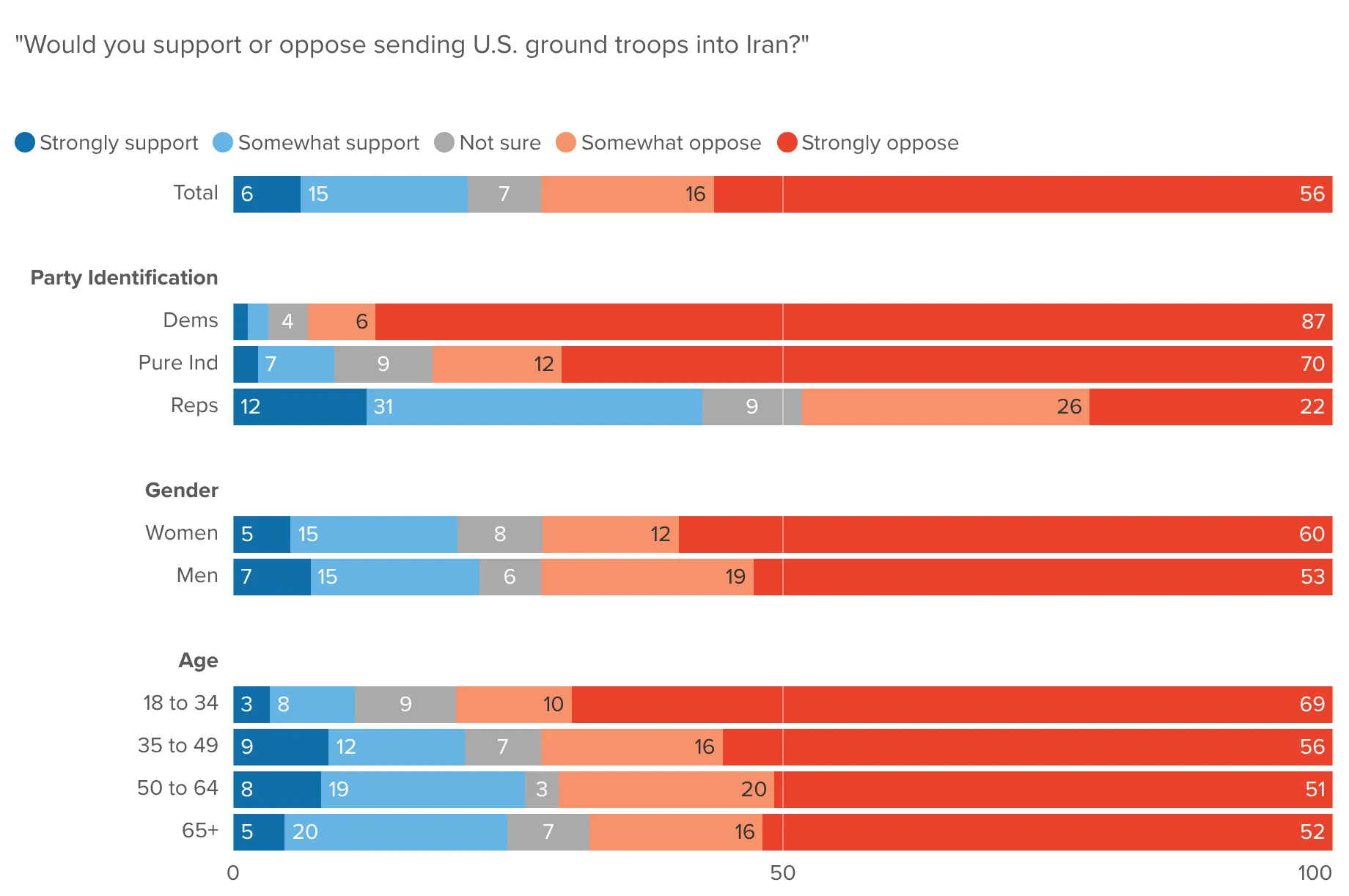
Seventy-two percent of voters oppose sending U.S. ground troops into Iran, including 56% who strongly oppose it. Twenty-one percent support a ground deployment. Opposition is consistent across genders, with both women and men at 72%. Among Republicans, 48% oppose a ground deployment and 43% support it.
Looking ahead one year, 47% of voters say the U.S. will be less safe as a result of military action in Iran, compared to 35% who say it will be safer and 13% who expect things to remain about the same. Women are more pessimistic (53% less safe, 28% safer) than men (41% less safe, 42% safer).
Methodology
Change Research conducted this survey of 1,541 registered voters from March 8–12, 2026. The modeled margin of error is ±2.6 percentage points at the 95% confidence level.
See the full data behind this poll
Sign up for the award winning Change Research Data Portal to gain insights like these every month with new polling.