Voters Oppose Both Taxpayer and Private Funding for Trump's White House Ballroom

A Change Research national survey of 2,244 registered voters, conducted May 5 to 10, 2026, finds that most voters oppose congressional action to fund the Donald J. Trump Presidential Ballroom. Opposition holds regardless of whether the funding comes directly from taxpayers or from private donors authorized by Congress.
A federal judge ruled in April that construction on the White House ballroom must stop until Congress formally approves the project. Following a shooting incident at the White House Correspondents’ Dinner last month, Senate Republicans introduced legislation to authorize $400 million for the ballroom, and the White House has since sought to include up to $1 billion in security-related funding for the project in a broader reconciliation bill. The ballroom was originally promoted by President Trump as privately funded.
Taxpayer Funding
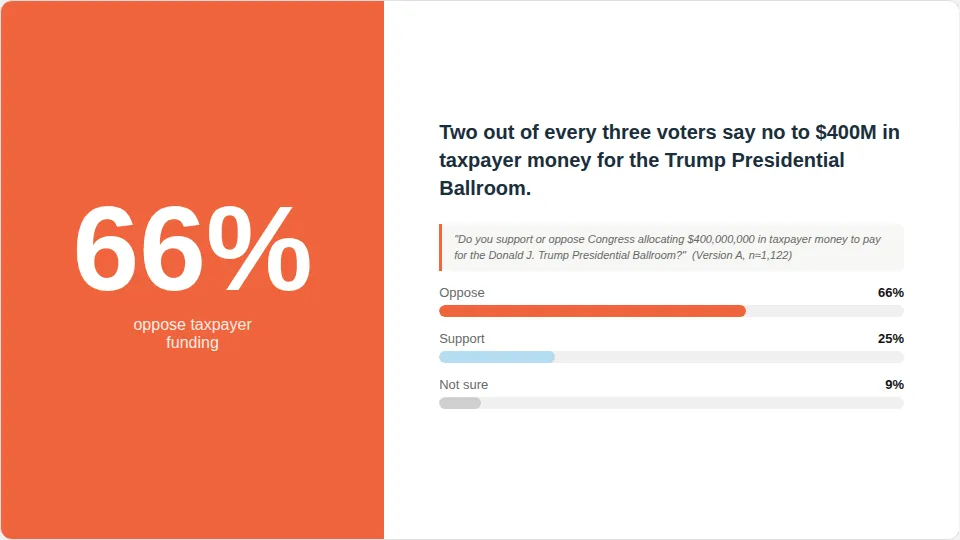
66% of voters oppose Congress allocating $400 million in taxpayer money for the ballroom. 25% support it. 9% are unsure.
The partisan breakdown:
- 97% of Democrats oppose it
- 78% of independents oppose it
- 54% of Republicans support it, 29% oppose it
- Non-MAGA Republicans are nearly split: 40% support it, 39% oppose it
- MAGA Republicans: 63% support it, 22% oppose it
Private Funding Authorization
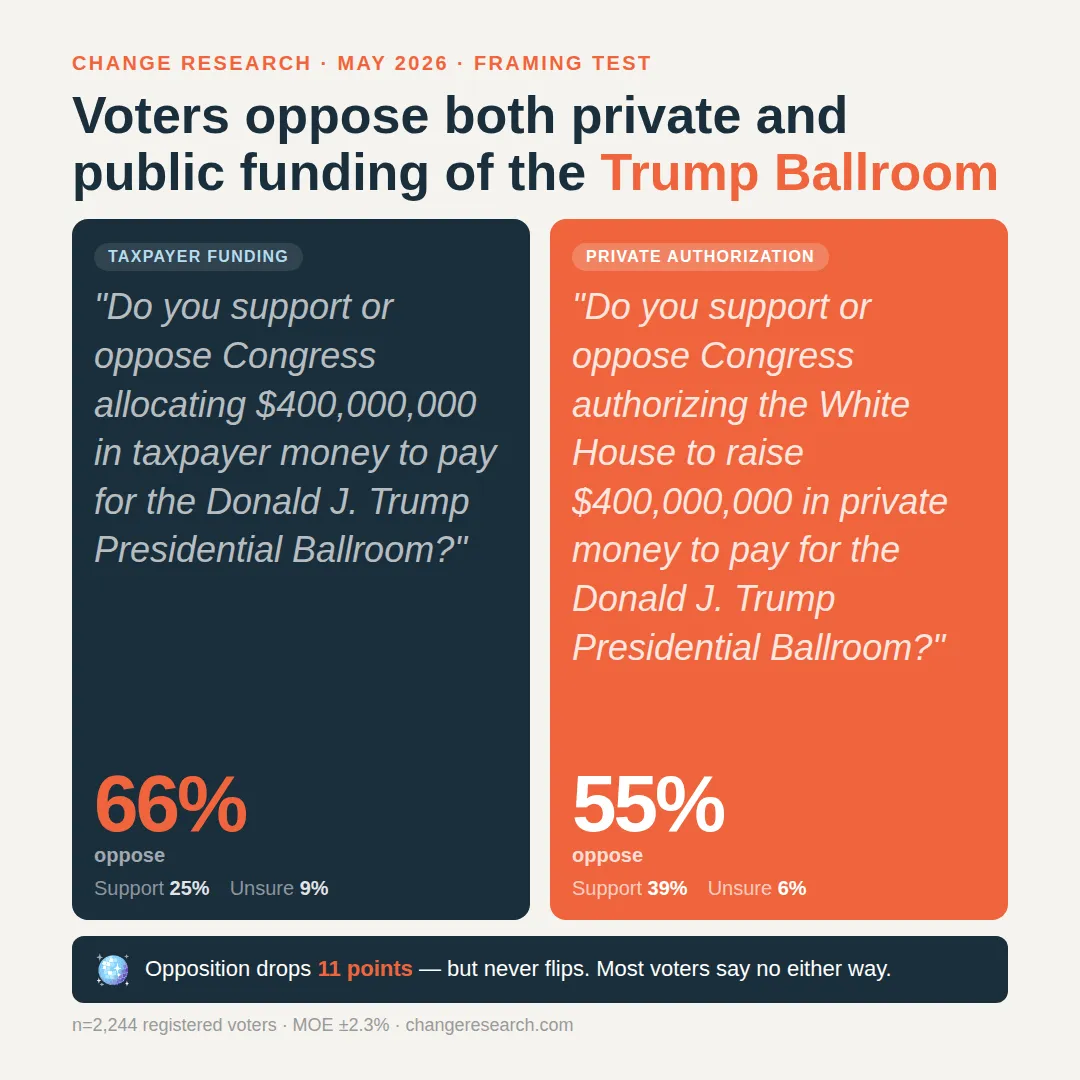
Framing the question as private fundraising rather than direct appropriation narrows opposition but does not flip it. 55% oppose and 39% support a privately funded ballroom.
The shift is largest among Republicans:
- 78% of Republicans support private authorization, compared to 54% who support direct taxpayer funding
- MAGA Republicans: 86% support private funding
- Non-MAGA Republicans: 64% support private funding, up from 40% who support public funding
Independents are unmoved: 79% oppose private authorization, nearly identical to the 78% who oppose taxpayer funding. 94% of Democrats oppose either approach.
Sixty-one percent of women and 47% of men oppose private funding authorization. Men are the demographic most supportive of private funding .
About This Survey
Polling was conducted online from May 5-10, 2026. Using Dynamic Online Sampling to attain a representative sample, Change Research polled 2244 registered voters nationwide. Post-stratification was performed on age, gender, race/ethnicity, education, region, urbanicity, and 2024 presidential vote. You can see a full methodology statement here, which complies with the requirements of AAPOR’s Transparency Initiative. Members of the Transparency Initiative disclose all relevant details about our research, with the principle that the public should be able to evaluate and understand research-based findings, in order to instill and restore public confidence in survey results.
See the full data behind this poll
Sign up for the award winning Change Research Data Portal to gain insights like these every month with new polling.