

A Change Research national survey of 1,714 registered voters, conducted June 10-17, 2026, finds that, when given a choice between “a public agency funded through taxes” or “a private company operating to make a profit” majorities prefer public management of nine essential services. Services tested include emergency responders and children’s health coverage. Support for public agencies is highest on physical infrastructure and lowest on services oriented toward healthcare and delivery.
Federal debate over which services the government should fund and manage has intensified in the past year, most recently through provisions in the One Big Beautiful Bill Act that introduced new eligibility requirements for Medicaid recipients. The Centers for Medicare and Medicaid Services published its implementation framework for those requirements on June 1, 2026, with full national enforcement set to begin January 2027.
Emergency Services and Infrastructure
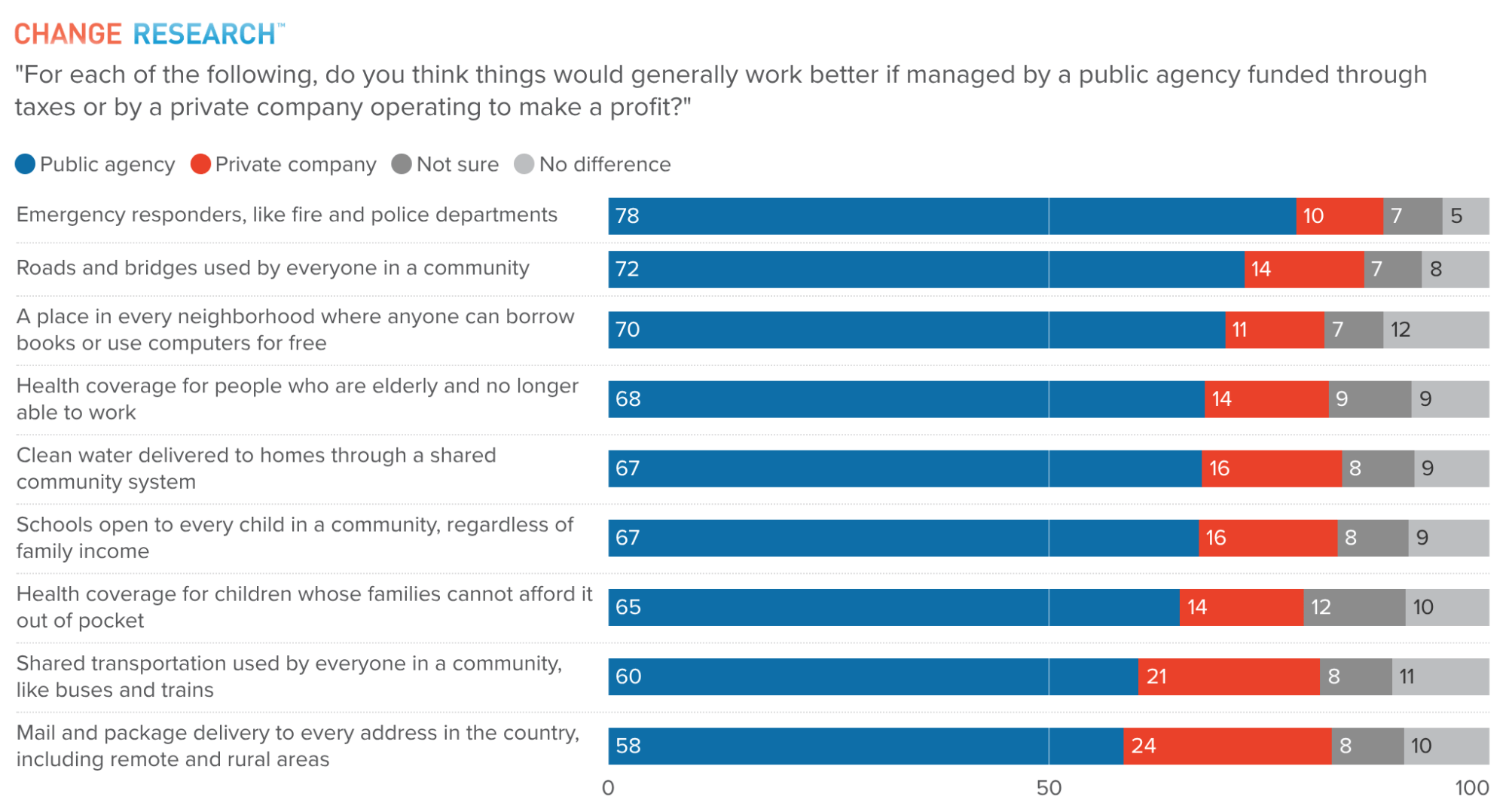
Seventy-eight percent of voters prefer emergency responders, such as fire departments and police departments to be run by a public agency, compared to 10% who say a private company would work better. Democrats and Republicans both have majorities prefering public agencies: 89% of Democrats and 71% of Republicans prefer a public agency for emergency services. Over 50% of Republicans prefer public agenciesfor other infrastructure and community facility items.
Seventy-two percent of all voters prefer public management of roads and bridges (D=87%, R=59%), 70% prefer it for libraries, and 67% prefer it for clean water systems.
Health Coverage, Schools, and Delivery
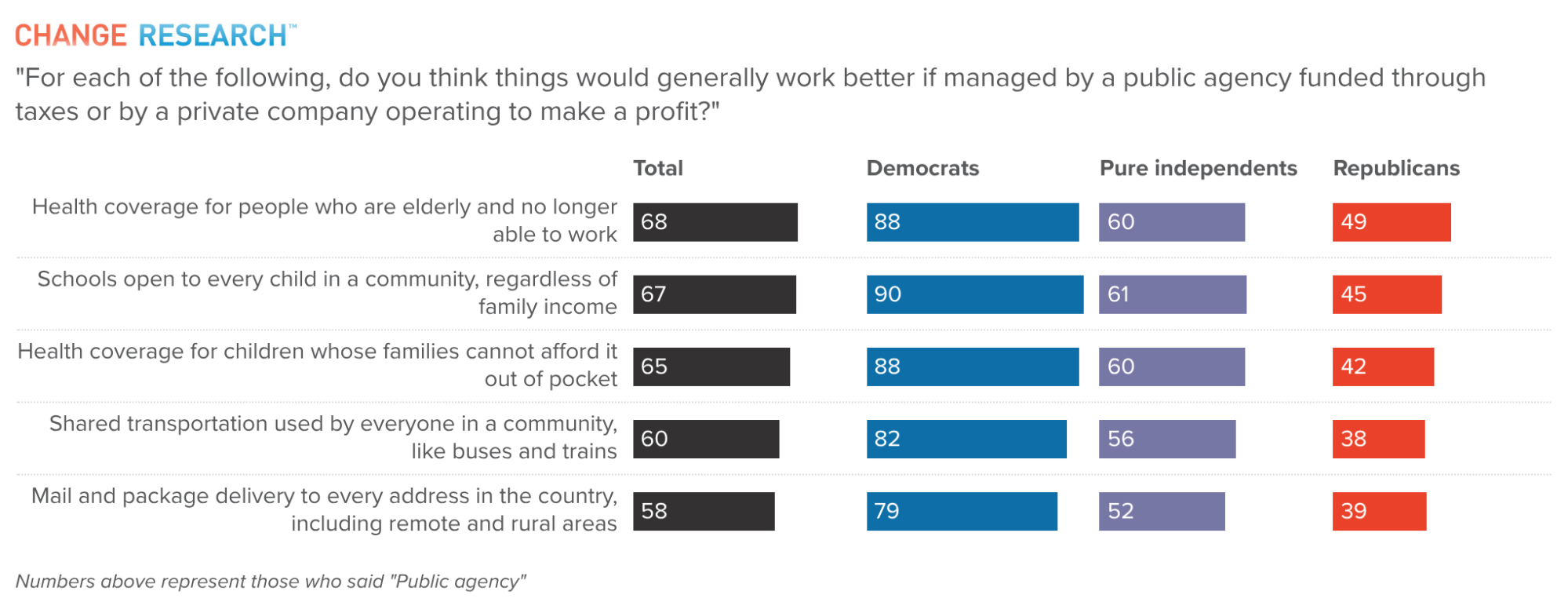
Sixty-eight percent of voters indicated that they would prefer public management of health coverage for the elderly (D=88%, R=49%), and 65% say the same for children’s health coverage (D=88%, R=42%).
Voters 18 to 34 are more likely than voters 65 and older to prefer public management of elderly health coverage, 74% to 64%.
Fifty-nine percent prefer public management of “mail and package delivery to every address in the country” (D=79%, R=39%), and 60% prefer it for shared public transit such as buses and trains (D=82%, R=38%). Mail delivery has the largest share of voters preferring a private company at 24%, compared to 10% for emergency responders.
Shared Costs and Community Support
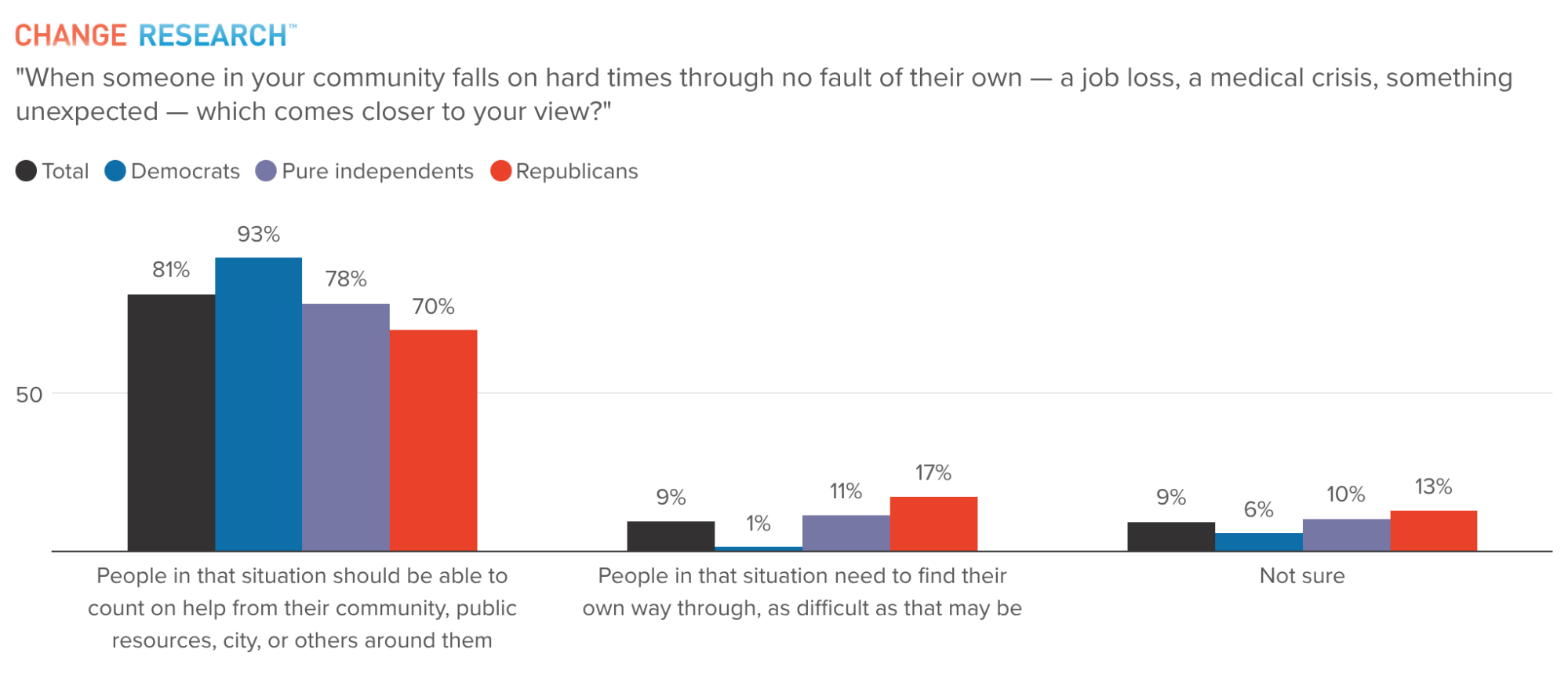
Eighty-one percent of voters say people who fall on hard times should be able to count on help from their community, public resources, or others. Ninety-three percent of Democrats and 78% of pure independents share this view, as do 70% of Republicans. Seventeen percent of Republicans say people in that situation should find their own way, compared to 11% of pure independents and 1% of Democrats. Women are more likely than men to say community help should be available, 84% to 78%.
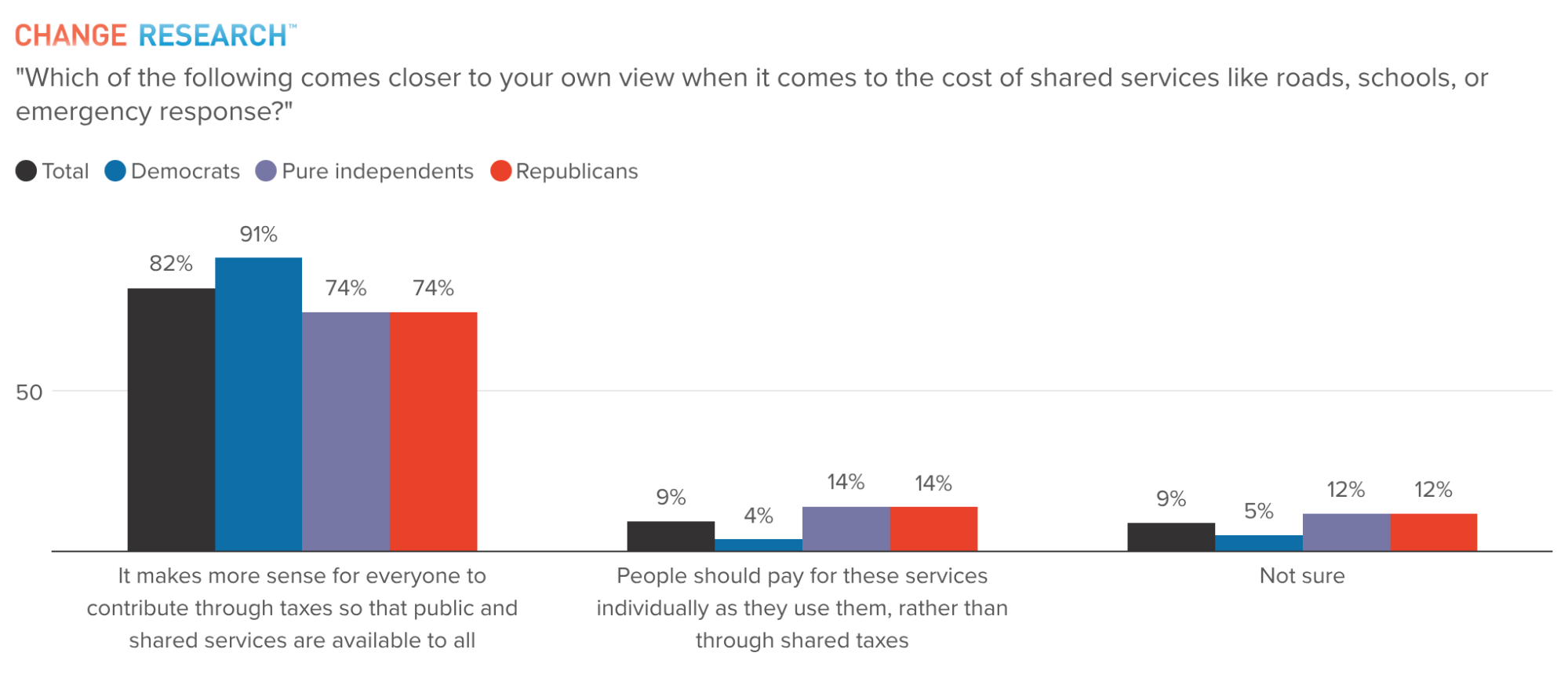
When given a forced choice, eighty-two percent say it makes more sense for everyone to contribute to shared services through taxes rather than pay for them individually as they use them. On this question, Republicans and pure independents give the same answer: 74% of each group prefer the shared tax model, compared to 91% of Democrats. Opposition is also equal between the two groups, with 14% of both Republicans and pure independents preferring a pay-as-you-use model, compared to 4% of Democrats.
Want access to the full crosstabs and data? Sign up for the Change Research Data Portal here. Already have a Data Portal account? Sign in here.