Voter Views on Family, Work, and Caregiving
A Change Research national survey of 2,702 registered voters, conducted April 3 to 7, 2026, finds that men and women hold meaningfully different views on what mothers and caregivers needed, what is driving many younger women toward traditional roles, and what voters want in a romantic partner. As Mother’s Day approaches, those divides extend across party lines and generations in patterns that are consistent throughout the survey.
What Mothers Needed
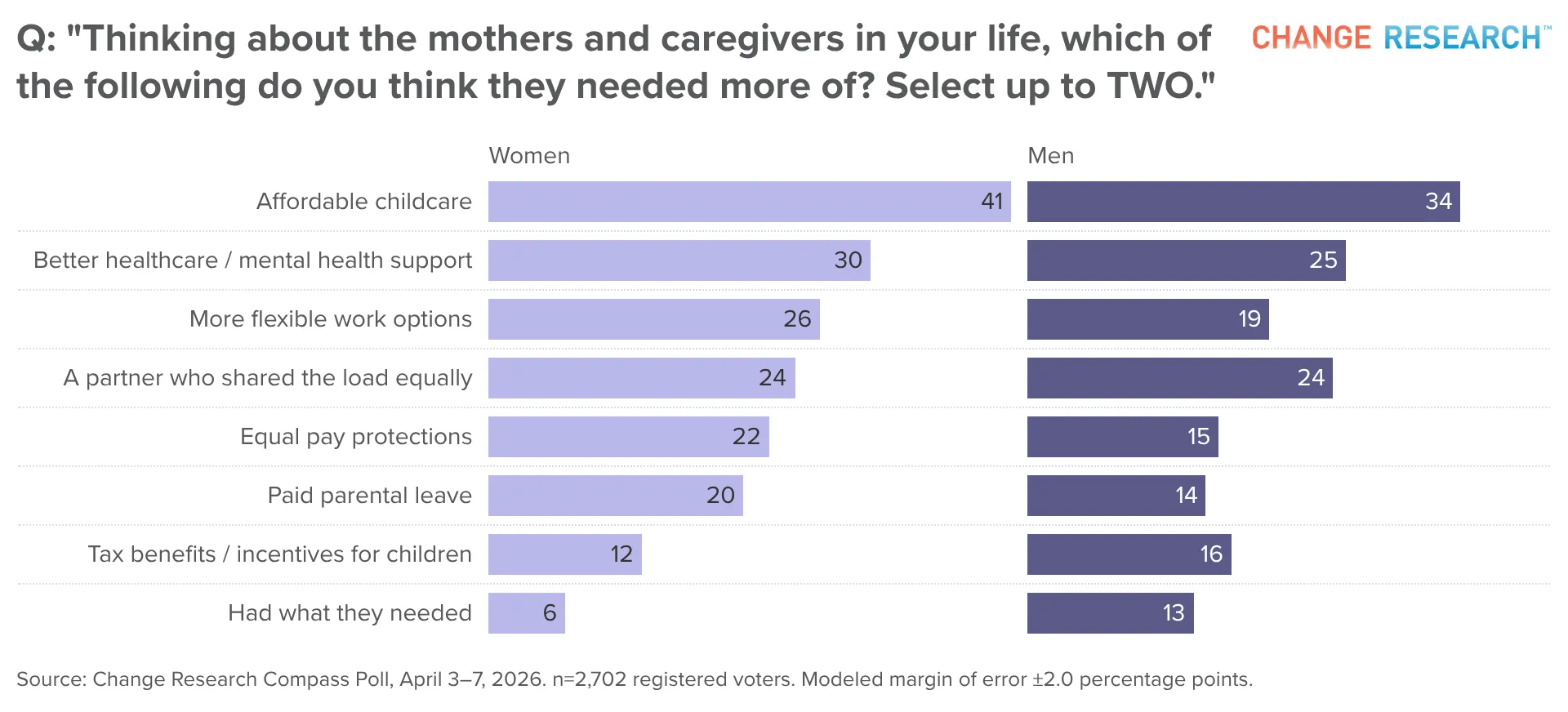
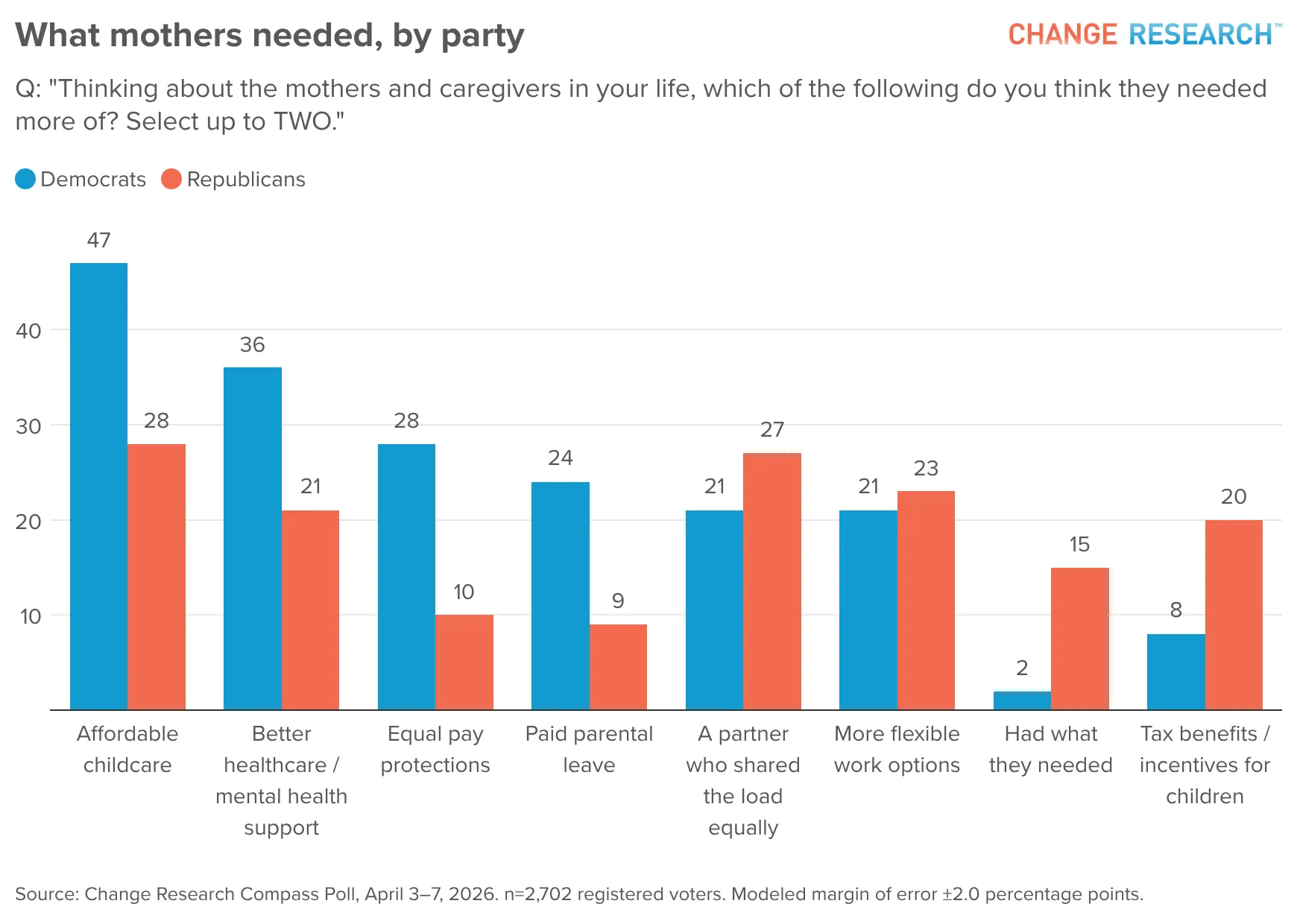
When asked what the mothers and caregivers in their lives needed more of, 38% voters named affordable childcare, more than any other option provided. Women are more likely than men to cite affordable childcare, 41% to 34%, and Democrats more than Republicans, 47% to 28%. Affordable childcare was most cited by voters 18 to 34 with 44% naming it as a top need.
Better healthcare, including mental health support, was the second most cited response at 28%. 30% of women cited, and 25% of men did. 36% of Democrats and 21% of Republicans cited healthcare. More flexible work options are cited by 26% of women and 19% of men, with 28% voters 35 to 49 citing work options as a top priority.
Equal pay protections in the workplace were far more cited by older voters. Voters 65 and older are the most likely to cite equal pay as a need (25%), compared to 10% of voters 18 to 34. The partisan gap is wide: 28% of Democrats cite it versus 10% of Republicans. Paid parental leave follows a sharp generational curve: 28% of voters 18 to 34 say it was something mothers in their lives need, far more than the 19% among 35 to 49 year olds, 12% among 50 to 64 year olds, and 11% among voters 65 and older.
Views on tax benefits for children are more popular among Republicans. Tax benefits and financial incentives for having children are named by 20% of Republicans and 8% of Democrats, with men citing it at 16% and women at 12%.
13% of men say the mothers and caregivers in their lives had what they needed, compared to 6% of women. The partisan gap is larger than the gender gap, with 15% of Republicans and 2% of Democrats saying mothers had sufficient support.
The Shift Toward Home
The survey asked what is most responsible for the reported trend of young women moving toward more traditional roles. The top three are the high cost of childcare, burnout from trying to manage everything, and genuine personal preference.
Thirty-eight percent of voters cite the high cost of childcare making work financially not worth it. 41% of women cite this, and 35% of men. The partisan gap is narrower here than on most other questions, with Democrats at 40% and Republicans at 36%.
Burnout from trying to balance everything is cited by 28% of all voters. Women are more likely to cite burnout than men, 32% to 23%, and voters 18 to 34 are especially likely to cite burnout as well (32%). Partisan differences are minimal on this explanation.
Genuine personal preference, the idea that many women simply want traditional roles, is cited by 26% overall, including 27% of men and 24% of women. The partisan split on this explanation is the largest in the section: 39% of Republicans cite personal preference, compared to 12% of Democrats.
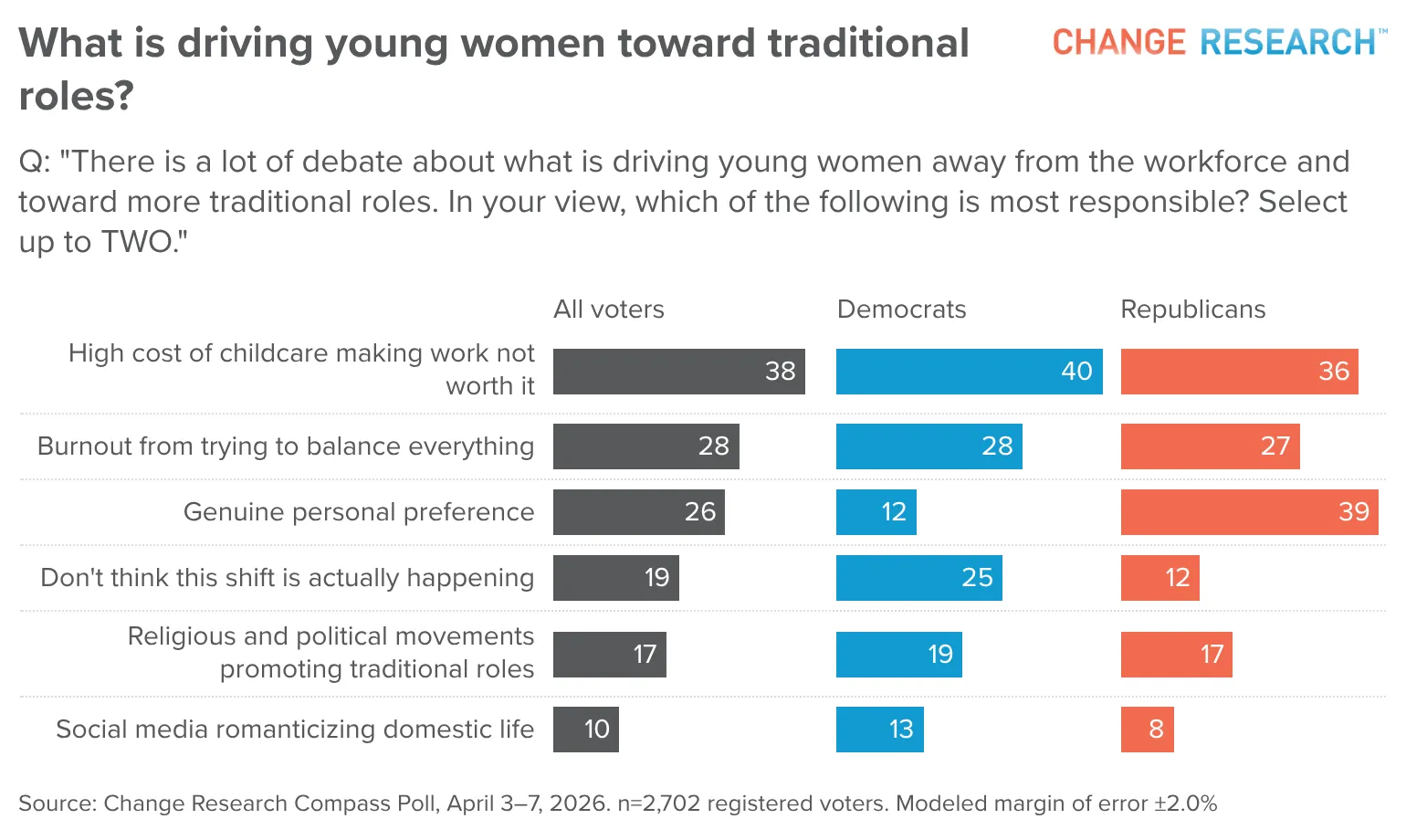
Social media and influencers romanticizing domestic life is named by 17% of voters 18 to 34, the highest of any age group, compared to 6% of voters 65 and older. One in five voters, 19%, say they do not think this shift is happening at all, with that view more common among Democrats, 25%, than Republicans, 12%.
Partner Preferences
Those structural explanations sit alongside a related set of preferences about partnership itself. A majority of voters prefer a partner who balances career and family life, though the share differs substantially by gender. Sixty percent of women hold this view, compared to 46% of men. 56% of Democrats and 51% of Republicans prefer a partner who balances career and family.
Men are more likely than women to prefer a partner who prioritizes home and family over career, 23% to 14%. Among men under 35, 25% would prefer a partner who prioritizes home and family.
Marriage and Birth Rates
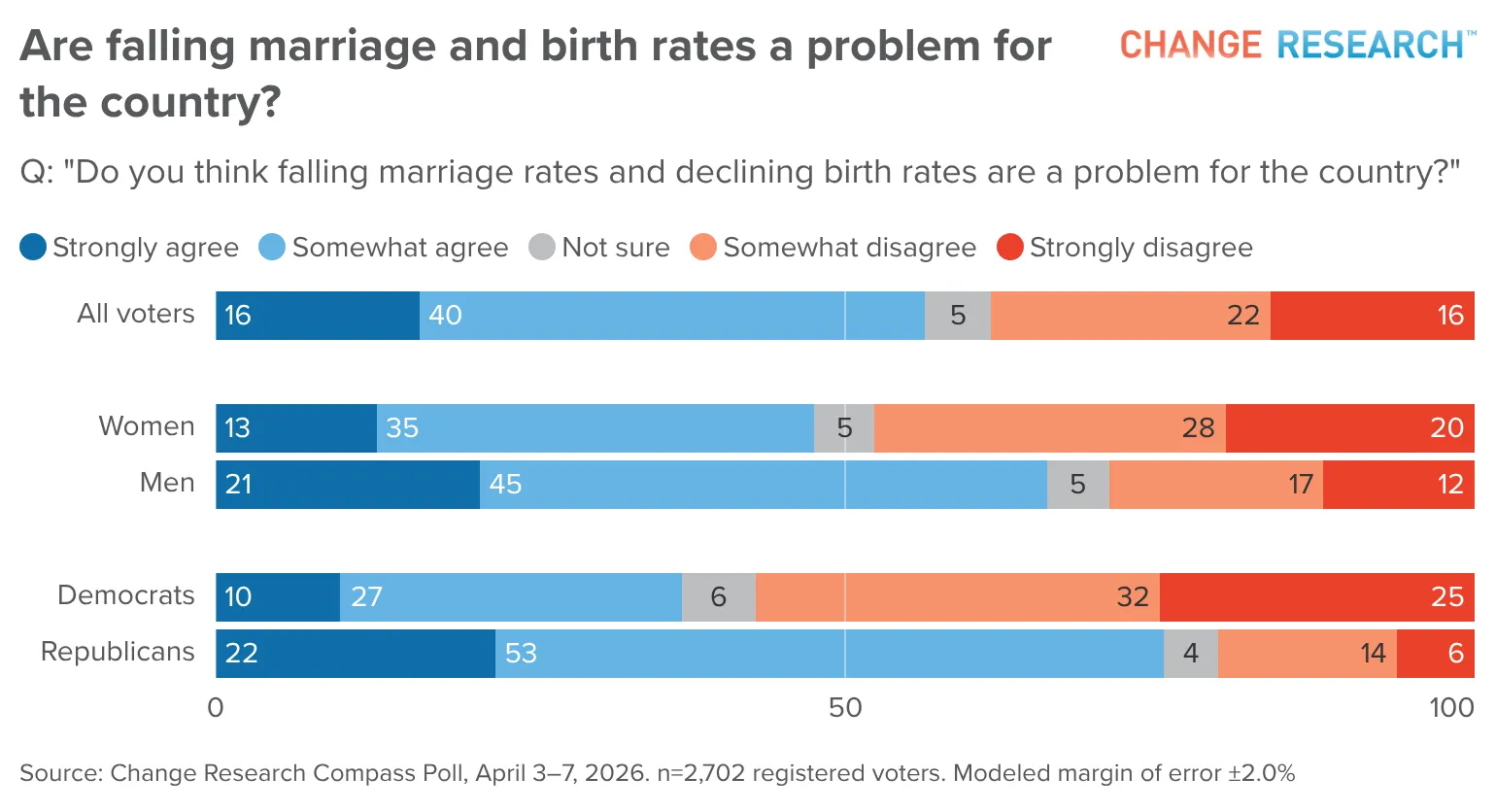
Roughly half of voters, 56%, strongly or somewhat agree that falling marriage rates and declining birth rates are a concern for the country. 66% of men are concerned, and 48% of women. 75% of Republicans and 37% of Democrats are concerned about lower marriage and birth rates.
21% of men want to see government action to address these issues, compared to 13% of women.
Methodology
Change Research conducted this survey of 2,702 registered voters from April 3 to 7, 2026. The modeled margin of error is ±2.0 percentage points at the 95% confidence level. The sample was weighted to be representative of the registered voter population by age, gender, race and ethnicity, education, and 2024 presidential vote.
See the full data behind this poll
Sign up for the award winning Change Research Data Portal to gain insights like these every month with new polling.