Voter Views on AI Companies and Military Use
A Change Research national survey of 1,541 registered voters, conducted from March 8 to 12, 2026, finds that a plurality of voters support AI companies’ autonomy to set limits on military use of their technology, and that nearly half side with Anthropic over Defense Secretary Pete Hegseth in the ongoing dispute over access to its AI models.
In late February 2026, Secretary Hegseth gave Anthropic a deadline to grant the military broader access to its Claude AI models or face losing its $200 million Pentagon contract. Anthropic declined, holding to two conditions: that its technology not be used for fully autonomous weapons, and that it not be used for mass domestic surveillance of Americans. By early March, the Pentagon formally designated Anthropic a supply chain risk, and Anthropic filed suit in federal court challenging the designation. The legal dispute is ongoing.
Company Rights and Military Access
When we asked voters what should happen if a private AI company does not want the U.S. military to use its AI software for certain purposes, 42% say the company should have the right to decide how its technology is used, regardless of what the military wants. Another 23% say the company and military should work out a compromise together. Seventeen percent say the military should be able to use any important U.S. made technology, whether the company agrees or not.
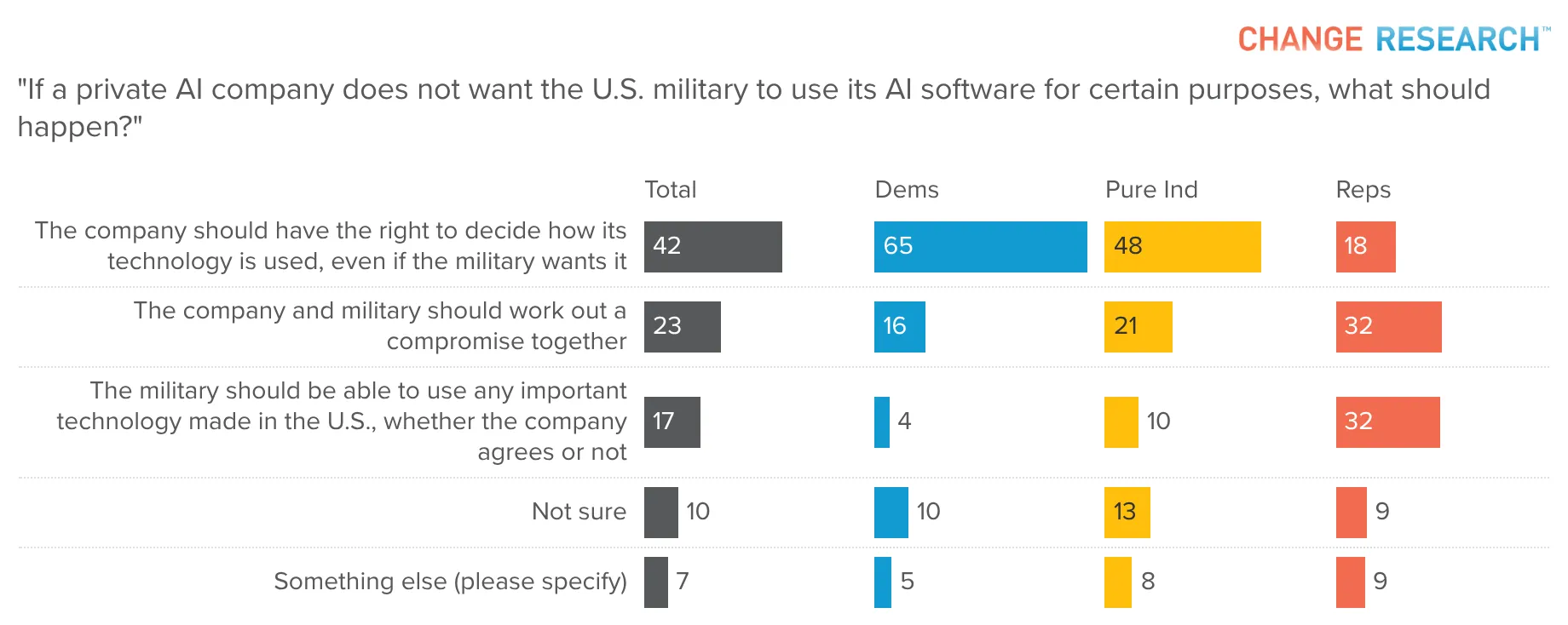
Women are more likely than men to support company autonomy. Forty-eight percent of women say the company should decide, compared to 36% of men.
The Anthropic Dispute
When we described the specific dispute, explaining that Anthropic’s rules limit military uses of its technology to prevent misuse, while Secretary Hegseth has said AI companies have a duty to support national defense without conditions, 47% of voters aligned with Anthropic at the time of this survey. Thirty-one percent aligned with Hegseth and the Department of War, and 21% were not sure.
Support for Anthropic’s position holds across party lines, though the degree varies. Among Independents, 60% were aligned with Anthropic and 17% were aligned with the Department of War and Secretary Hegseth. Democrats align with Anthropic at 78%, with 4% aligned with Hegseth. Among Republicans, the positions reverse: 62% side with Hegseth and 14% with Anthropic.
Among voters from military families, Anthropic holds a plurality: 44% are aligned with Anthropic and 35% with Hegseth, with 19% not sure.
What Voters Say
Concern about AI use in military contexts appears across both Trump and Harris voters. Several respondents describe the integration of AI and the military as carrying serious long-term risks:
“Certain technologies should not be researched. I cannot stop it from happening, but the General AI race feels like a nuclear arms race… No one will win…”
White man, 18-34, Independent
“I worry about the military using AI. I worry about using AI for a lot of things.”
White woman, 35-49, Republican
Calls for congressional oversight come up frequently among respondents who chose ‘something else’:
“Congress should pass regulations that determine the circumstances for when and how the government can use AI companies’ technology.”
Hispanic/Latino Man, 18-34, Independent
Among Trump voters who commented, a common line of thinking is that if a company accepts government funding or signs a defense contract, it should allow the government to use its technology freely:
“Anthropic accepted $200 million of US funding, they can’t say afterwards how this technology is to be used.”
White man, 50-64, Independent
“If there is a contract for use then too bad. You don’t get to dictate foreign policy. It’s like a company who makes forks saying you aren’t allowed to use them right handed.”
White man, 35-49, Republican
Methodology
Change Research surveyed 1,541 registered voters online from March 8 to 12, 2026. The margin of error is +/- 2.6 percentage points. Full crosstabs, including breakouts by party, gender, age, race, and military family status, are available through the Change Research Data Portal.
See the full data behind this poll
Sign up for the award winning Change Research Data Portal to gain insights like these every month with new polling.