Public Divides Over ICE Mirror Washington Standoff as DHS Shuts Down
New polling data from Change Research shows that while Americans are deeply divided on how aggressive immigration enforcement should be, certain reforms enjoy overwhelming bipartisan support. Senate Democrats laid out 10 demands for ICE reform as a condition for funding the department, and Schumer has pointed to public polling to back his position.
Strong Support for Accountability and Transparency
The polling shows near-universal support for certain accountability measures. Ninety-four percent of Americans back requiring ICE officers to wear body cameras during enforcement operations, including 97% of Democrats, 96% of independents, and 90% of Republicans. This aligns directly with one of the Democrats’ key demands, and it’s one of the few areas where the White House has shown some willingness to engage.
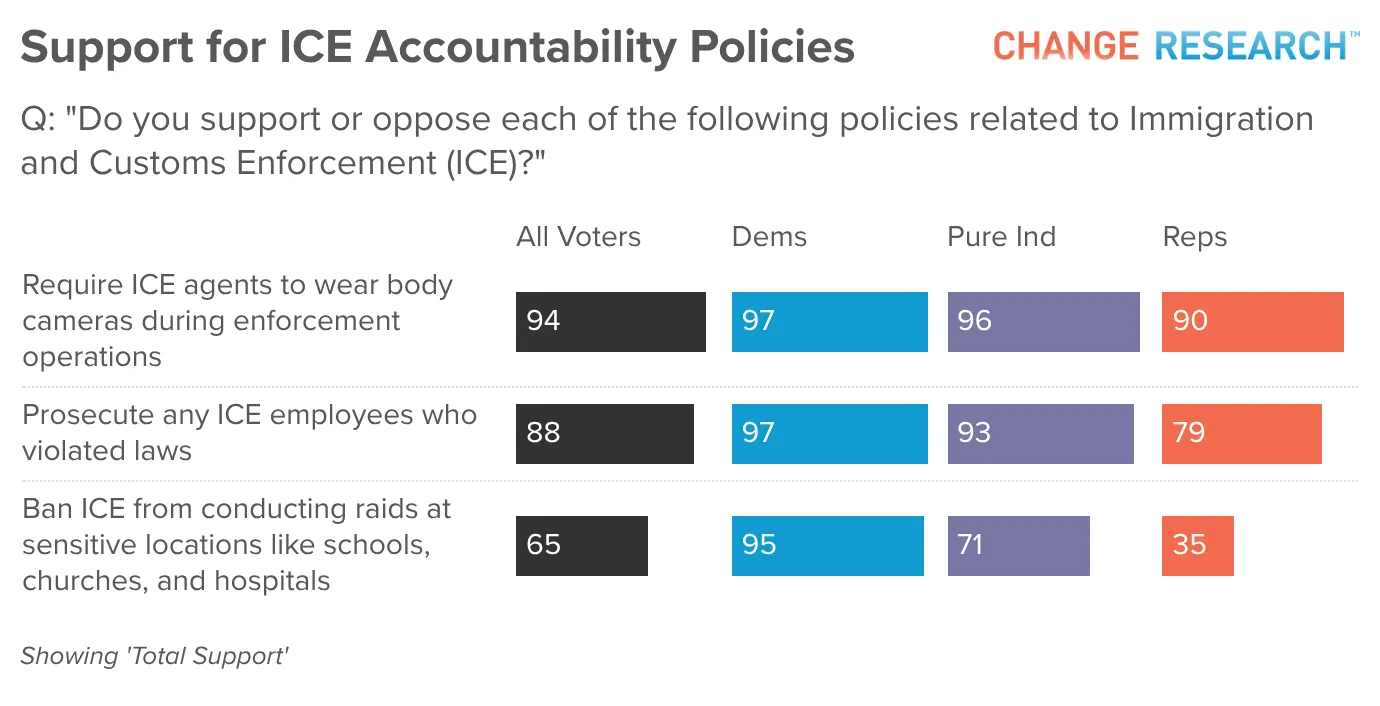
Eighty-eight percent support prosecuting ICE employees who violate laws, with strong majorities across party lines (97% of Democrats, 93% of independents, 79% of Republicans). Eighty-five percent favor requiring more training for ICE officers (93% of Democrats, 86% of independents, 77% of Republicans).
Americans also support limiting where ICE operates. Sixty-five percent back banning ICE from conducting raids at sensitive locations like schools, churches, and hospitals (95% of Democrats, 71% of independents, 35% of Republicans).
The Sticking Points
One of the most contentious issues is requiring ICE agents to obtain warrants signed by a federal judge before detaining someone. Fifty-six percent of Americans support requiring ICE agents to obtain a warrant signed by a federal judge before detaining someone. But the partisan breakdown reveals exactly why negotiations have stalled: 93% of Democrats back the requirement compared to just 19% of Republicans, a 74-point gap. A senior White House official has reportedly called warrant requirements a “particularly challenging aspect” of the negotiations. That might be the understatement of the shutdown.
Similar divides emerge on local control. Fifty-four percent oppose allowing ICE to conduct operations without local government approval, but Republicans support it 82% to 15% while Democrats oppose it 93% to 5%. These aren’t gaps that split the difference.
Fundamental Disagreements About ICE’s Role
The polling exposes deeper disagreements about ICE’s very existence and scope. Thirty-six percent of Americans support abolishing ICE completely, a position backed by 69% of Democrats but only 5% of Republicans. On ICE’s budget, 51% support reducing it while 43% oppose cuts, but these toplines mask an enormous partisan split: 91% of Democrats favor reductions versus 11% of Republicans.
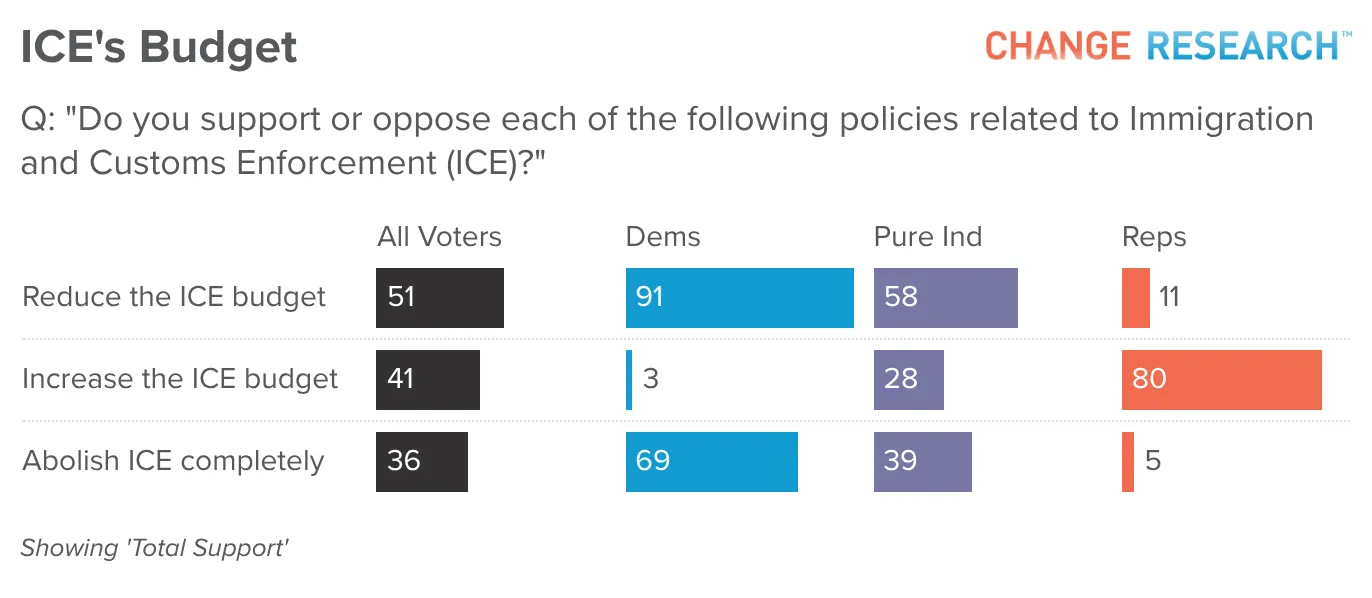
The reverse holds true for expanding ICE. Forty-one percent support increasing ICE’s budget (3% of Democrats, 80% of Republicans), 42% back expanding detention capacity (5% of Democrats, 81% of Republicans), and 43% support hiring more officers (5% of Democrats, 83% of Republicans). Meanwhile, 58% support limiting ICE enforcement to people with criminal convictions (88% of Democrats, 28% of Republicans).
What Americans Consider Acceptable
The survey tested various enforcement scenarios to understand what Americans consider acceptable.
Broadly considered unacceptable:
- 86% say it’s unacceptable to detain someone even after they show documents proving U.S. citizenship (including 95% of Democrats and 77% of Republicans)
- 76% say it’s unacceptable to detain someone without a clear explanation of why (including 96% of Democrats and 53% of Republicans)
- 67% say it’s unacceptable to enter homes without warrants or permission (including 97% of Democrats and 35% of Republicans)
More divided:
- 57% find it unacceptable to detain undocumented immigrants at courthouses, versus 37% who find it acceptable
- 54% find it unacceptable for schools or hospitals to share immigration status information with ICE, while 41% find it acceptable
Broader support:
- 81% consider it acceptable to prioritize removing immigrants convicted of violent crimes over those without criminal records, even if the legal process takes longer (including 76% of Democrats and 88% of Republicans)
Long-Term Residents and Family Ties
Americans face harder choices when considering enforcement against people with deeper ties to the U.S. The public leans against these actions but remains closely divided on some scenarios.
Public leans against:
-
57% find it unacceptable to detain or remove someone with no violent criminal record who has lived in the U.S. for 10+ years, while 38% find it acceptable
-
59% find it unacceptable to detain or remove an immigrant with no violent criminal record who has a U.S.-citizen spouse and/or children, while 33% find it acceptable
-
63% find it unacceptable to detain or remove a person who came to the U.S. illegally as a child and has lived in the U.S. most of their life with no criminal record, while 31% find it acceptable
The longer someone has been here and the more ties they’ve put down, the more uncomfortable Americans get with the idea of removing them.
Force and Protests
Americans reject certain uses of force by ICE. Eighty-five percent say it’s unacceptable to use physical force against people peacefully protesting (including 97% of Democrats and, notably, 72% of Republicans). Eighty-one percent oppose using force against people recording law enforcement from a safe distance. Sixty-six percent say it’s unacceptable to use tear gas without warning and time to leave.
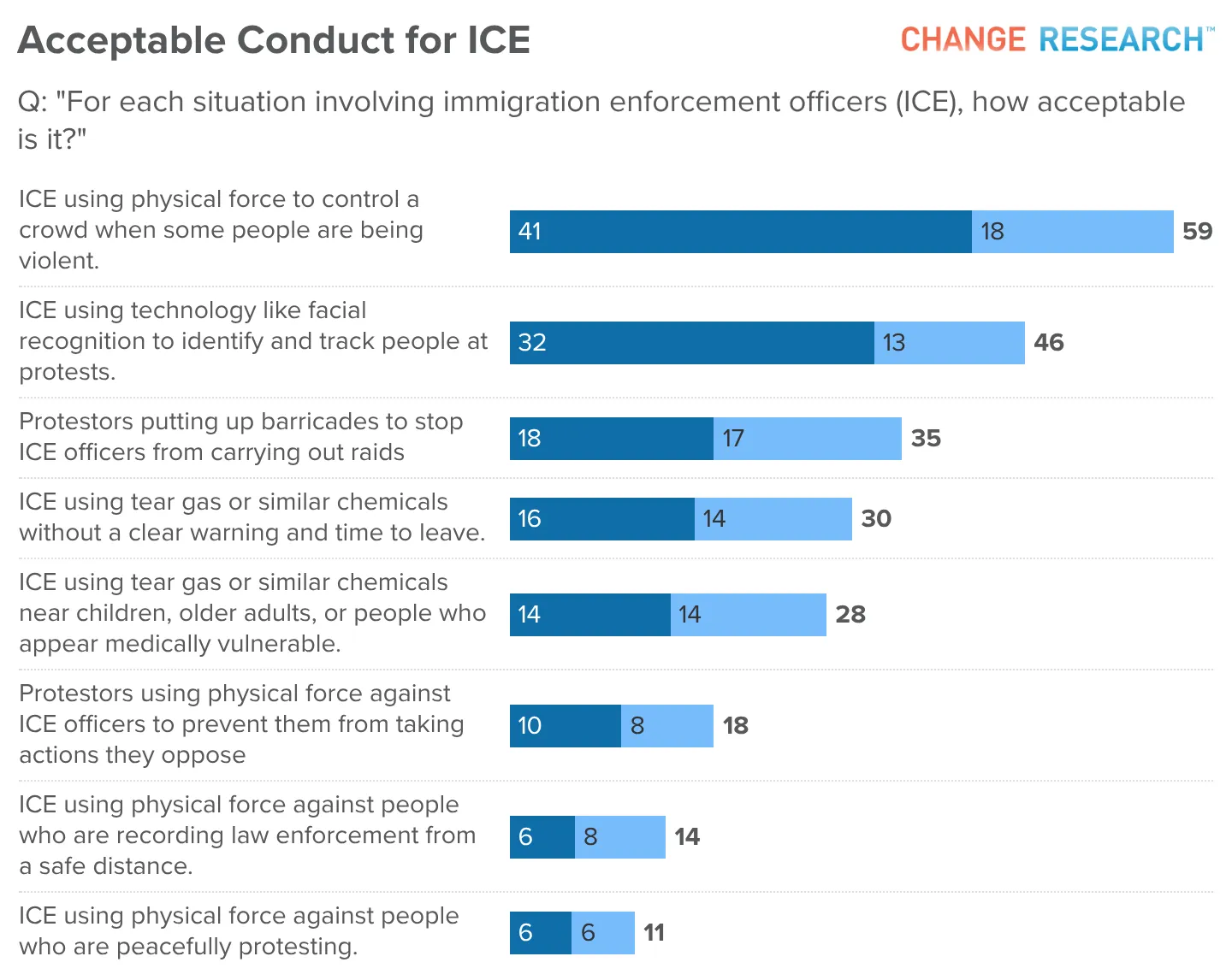
But when violence enters the equation, opinions shift. Fifty-nine percent find it acceptable for ICE to use physical force to control a crowd when some people are being violent (including 25% of Democrats and 93% of Republicans). Americans broadly believe force against peaceful civilians is out of bounds, but that line moves the moment a situation turns violent.
The Underlying Immigration Divide
The polling also reveals how Americans think about immigration more broadly. Seventy-nine percent agree that “everyone deserves to be treated with basic respect, regardless of immigration status” (97% of Democrats, 85% of independents, 61% of Republicans). And 88% agree that “the U.S. has the right to enforce its immigration laws” (78% of Democrats, 86% of independents, 98% of Republicans).
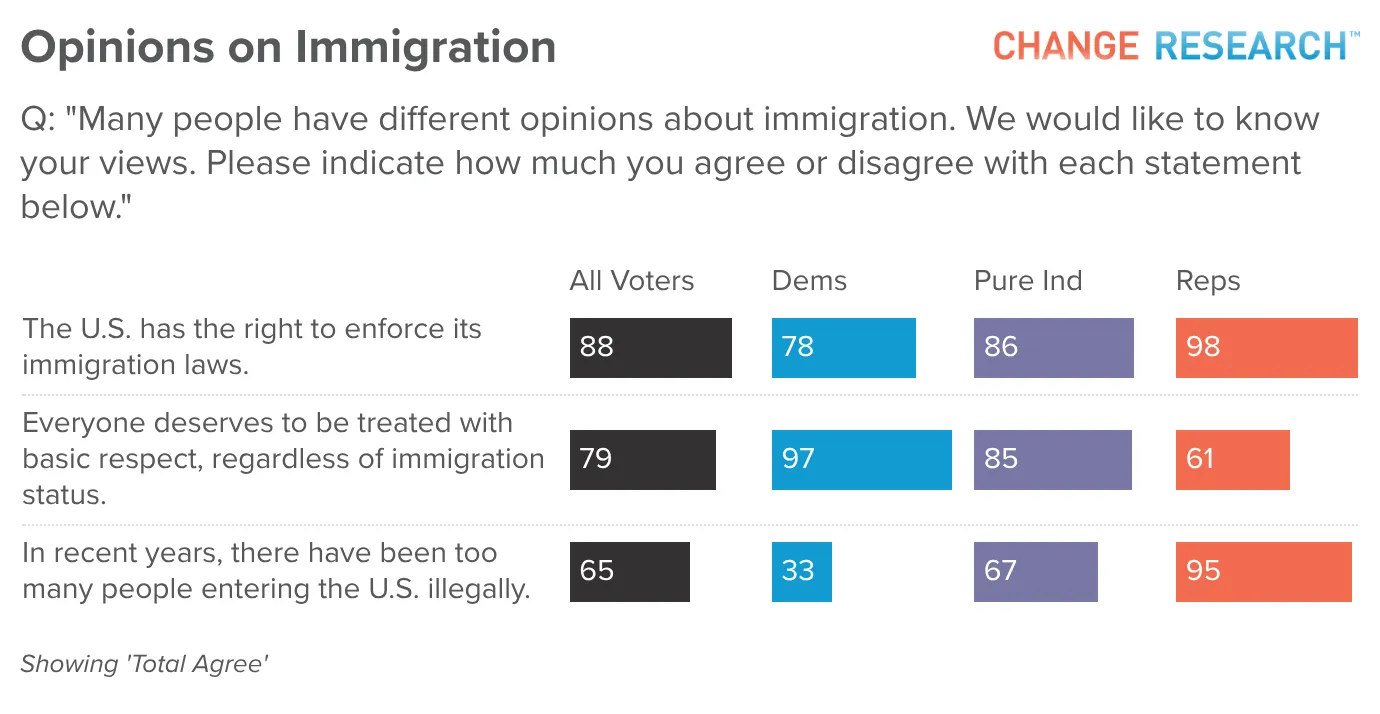
But 65% agree that “in recent years, there have been too many people entering the U.S. illegally,” with massive partisan differences (33% of Democrats, 67% of independents, 95% of Republicans).
The Political Calculation
The data reveals an American public that supports enforcement with humanity, rules with compassion, and borders with dignity, but remains deeply divided on the fundamental question of how aggressive that enforcement should be.
Transparency measures like body cameras, training requirements, and prosecuting agents who break laws enjoy near-universal support. Restrictions on operating near schools and churches command clear majorities.
But once the conversation shifts to questions about ICE’s size, scope, and authority, partisan gaps appear. Democrats and Republicans essentially inhabit different realities on whether ICE should be abolished, expanded, or something in between.
The shutdown fight isn’t just about funding. It’s about which vision of immigration enforcement reflects where American voters actually stand.
Methodology: Change Research conducted this survey of 1,741 registered voters from February 5-18, 2026, with a modeled margin of error of plus or minus 2.5 percentage points.
See the full data behind this poll
Sign up for the award winning Change Research Data Portal to gain insights like these every month with new polling.