
On June 17, the Change Research team hosted the latest installment of the Plus or Minus webinar series, sharing fresh data from our June 2026 Compass Poll on what voters think about mental health and the policies meant to address it.
The Issue Voters Say Leaders Keep Ignoring
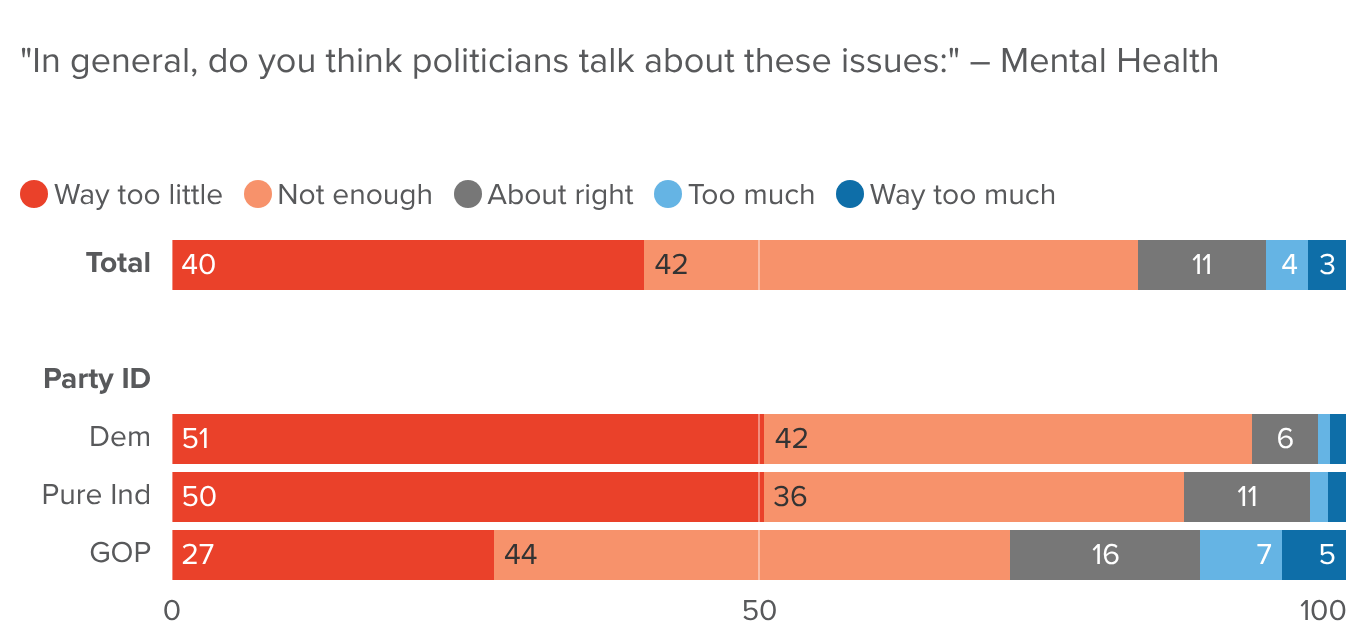
We asked webinar attendees which issue politicians ignore more: mental health or the economy. 82% chose mental health. That number matches the survey data almost exactly: 82% of voters say politicians talk “not enough” or “way too little” about mental health, a view that holds across party lines.
Co-presenter Tyler Fisher, Principal at Trailmark Strategies, framed the challenge this way: Americans now have more access to mental health information, treatment, and insurance coverage than at any prior point in modern history. Stigma has decreased. The conversation has opened up. And yet outcomes have gotten worse across nearly every measure: suicide rates, overdose deaths, teen depression, and loneliness are all trending in the wrong direction.
The Consensus: Access and Affordability
On access to mental health care and insurance, voters are broadly aligned. Insurance coverage ranks as the top overall policy priority, and voters across party lines agree that insurance companies make it difficult to access mental health care coverage.

That consensus extends into primary care. Same-day mental health referrals and screenings in primary care settings both clear 75% support across all party groups, with MAGA Republicans supporting same-day referrals at 81%. Voters are similarly aligned on housing and community services, including affordable housing and expanding community-based support. Overdose- reversal medications like Narcan and requirements that pharmaceutical companies publicly disclose payments they make to addiction treatment centers also draw strong bipartisan support.

Where the Parties Split
Beyond the shared ground on access, the survey reveals sharp divides on some of the most contested parts of the mental health conversation.
Therapy culture: 58% of Republicans say therapy culture has gone too far, compared to 15% of Democrats, a 43-point gap.
Crisis response: Voters broadly support having mental health professionals involved in crisis response, though Democrats and Republicans are 53 points apart on the question. On police co-response (where officers and mental health professionals respond to a call together), the gap widens to 57 points: 95% of Democrats are in support, compared to 38% of Republicans.

Involuntary hospitalization: Only 5% of voters ages 18 to 34 support making it easier to hospitalize someone involuntarily, compared to 74% of seniors. The divide is generational as much as partisan: younger voters favor access, affordability, and school-based solutions, while older voters are more accepting of institutional or coercive approaches.
Red flag laws: Red flag laws, which allow courts to temporarily restrict someone’s access to firearms if they pose a risk to themselves or others, draw 63% support overall, including 63% of non-MAGA Republicans, 82% of women, and 83% of people of color.
Veterans, Law Enforcement, and a Counterintuitive Finding
The survey finds that 97% of Black respondents support law enforcement mental health programs, compared to 92% of white respondents and on par with Democrats overall. Voters ages 18 to 34 are the strongest supporters at 96%, slightly above every other age group. Women are 10 points more likely than men to strongly support these programs (76% vs. 65%), even though total support levels are comparable across gender.

Veterans’ mental health programs draw similarly broad backing. Across both areas, support runs high regardless of party when mental health is framed around a specific population rather than as a broad policy issue.
Addictive Digital Technologies: An Issue Still Up for Grabs
The survey asked voters about a broader range of addictive digital technologies, including social media, pornography sites, gaming platforms, gambling apps, and AI chatbots. Across all of them, the data shows strong support for age restrictions, with a minimum age of 18 drawing the widest backing.

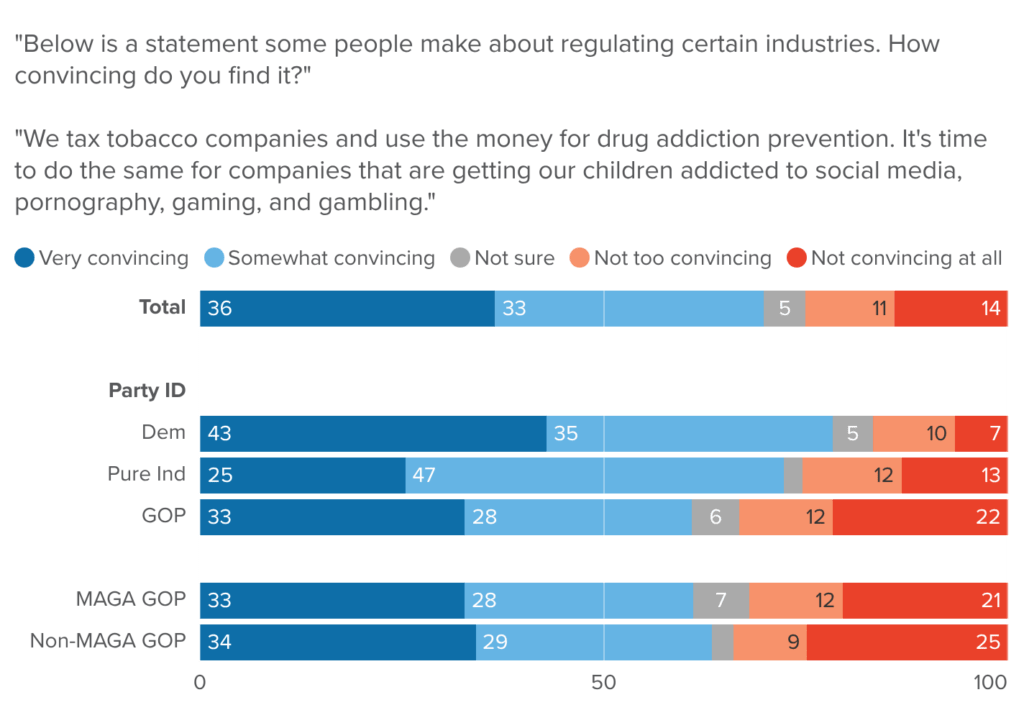
The survey also tested one regulatory argument in particular: should companies that profit from getting users addicted to social media, gaming, gambling, and pornography face the same taxes and regulations as tobacco companies, with that money going toward addiction prevention? Seventy percent of voters find that argument convincing. Democrats and Republicans are 33 points apart (61% vs. 28%), while independents come in at 72%, women at 76%, and men at 63%. The survey also finds majority support for age verification requirements, taxes on social media platforms, and restrictions on AI-based therapy tools marketed to minors.
Stepping back from screens, the survey also asked about nutrition-based mental health policies, specifically proposals to cover nutrition counseling and dietary support as part of mental health treatment. Seventy-two percent of voters support these policies, with Democrats at 85% and Republicans at 59%.
A Low-Risk, High-Reward Issue for Any Campaign
The survey asked voters which party they trust more to handle mental health: 30% chose Democrats, 24% Republicans, and 36% neither. Mental health is contested territory, not a party-owned issue.

During the webinar, our team flagged five political observations from the data:
- Mental health touches every family, which means it reaches every type of voter.
- Young men who have been joining the Republican Party are among the most affected by the mental health crisis, creating a less obvious potential opening.
- The issue’s cross-partisan nature is a feature worth protecting rather than a vulnerability to be exploited.
- Mental health connects directly to the top-priority issues voters care most about, including cost of living and public safety.
- No presidential-level agenda on mental health currently exists — which represents an opening for any candidate willing to claim it.
Every month, Change Research reaches into our Compass Poll data to walk you through what voters are saying and thinking, providing strategic analysis on the issues and attitudes shaping the 2026 midterm cycle. Register here for the next session.
Missed the live session? Catch up with the Briefing Deck and the Webinar Recording.
Want access to the full crosstabs and data? The Change Research Data Portal gives you access to the full results from this survey and our broader research archive. New to the portal? Sign up for access here. Already have an account? Access the mental health poll results directly. Want a quick orientation? Here’s a walkthrough of the portal’s key features.