Americans Turn to Independent Voices as Traditional Media Loses Ground
[difl_advanced_blurb _builder_version=“4.27.4” _module_preset=“default” hover_enabled=“0” global_colors_info=”{}” sticky_enabled=“0”]
New polling by Change Research, conducted as part of the internal Compass Poll that feeds into the Change Research Data Portal, reveals a shift in how Americans place their trust when it comes to news and information. As traditional media institutions face skepticism, independent voices are gaining ground, and the forces shaping news coverage are seen as increasingly driven by corporate and political interests rather than journalistic integrity.
Independent Journalists Lead in Public Trust
According to a national survey conducted from November 19 to December 2, 2025, 34% of Americans say they trust independent or online journalists most to report honestly about their communities and the country. Only 12% say the same for national news organizations, and 10% give their highest trust to local journalists.
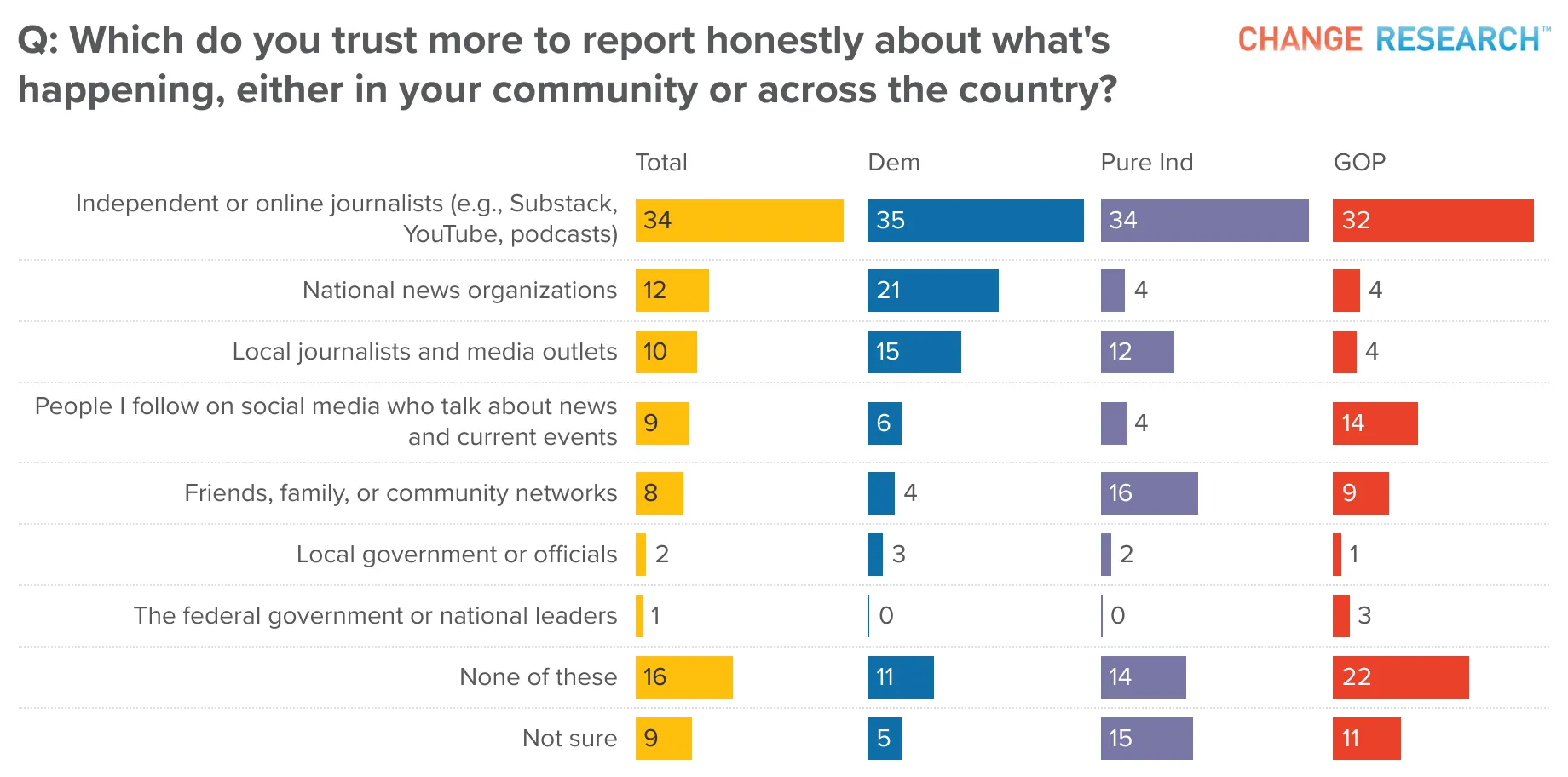
The trend crosses party lines. The preference for independent journalists is shared by 35% of Democrats, 34% of independents, and 32% of Republicans.
Younger Adults Break Even Further From Traditional Media
The gap between younger and older Americans in media trust shows different approaches to information. Among 18 to 34-year-olds, 38% place their highest trust in independent journalists, while only 10% trust national news organizations most. Older Americans show more faith in established media structures, with 14% of those 65 and older trusting national news organizations most, though even this group shows higher trust in independent voices (27%).
How Americans Consume News
When asked where they get local or national news most often, Americans rely on multiple sources:
- 61% turn to digital media (online news websites, apps, podcasts)
- 53% use social media platforms (Facebook, X/Twitter, TikTok, Instagram, YouTube)
- 48% rely on traditional media (TV, radio, newspapers)
- 22% get news from friends, family, or community networks
- 5% use religious or faith-based sources
Among those who get their news from digital and/or social media, consumption patterns vary widely:
- 63% rely on articles from news websites
- 40% turn to short clips or highlights on platforms like YouTube Shorts, TikTok, and Instagram Reels
- 38% watch long-form videos on YouTube
- 33% listen to podcasts or talk shows
- 32% get news from posts, emails, or updates from advocacy groups, campaigns, or issue-based creators
Among those who rely on traditional media, the most common sources are:
- 44% watch news programs via cable TV
- 35% watch news programs via streaming or live TV services (e.g., Hulu Live, YouTube TV)
- 35% listen to radio (AM/FM or satellite like SiriusXM)
- 32% read local newspapers
- 31% read national newspapers (e.g., New York Times, Washington Post)
- 29% watch news programs via antenna or over-the-air TV
When Americans turn to people they know for news, conversations with friends (71%) and family (68%) dominate, far exceeding group chats with people they know in real life (40%) or neighborhood community groups (34%). Religious communities serve as news sources for 19% of Americans, with Republicans (26%) more than twice as likely as Democrats (10%) to rely on their church or faith community for news.
From Active Seeking to Passive Discovery
Beyond where Americans get their news, how they encounter it reveals another shift. While 59% say they mostly find out about news by actively seeking it out through newspapers, social media scrolling, or turning on news programs, 41% report running into news spontaneously while listening to podcasts, watching sports, talking to friends and family, or scrolling social media for entertainment. Among 18 to 34-year-olds, 58% encounter news spontaneously compared to 42% who actively seek it out.
Corporate and Political Influence Seen as Dominant Forces
When asked what forces shape news coverage today, Americans point primarily to corporate and political pressures. One-third (33%) identify corporate interests and advertisers as having the biggest influence on how news gets reported, making it the most frequently cited factor. Political parties and elected officials rank second at 12%, while pressure from the federal government follows at 13%.
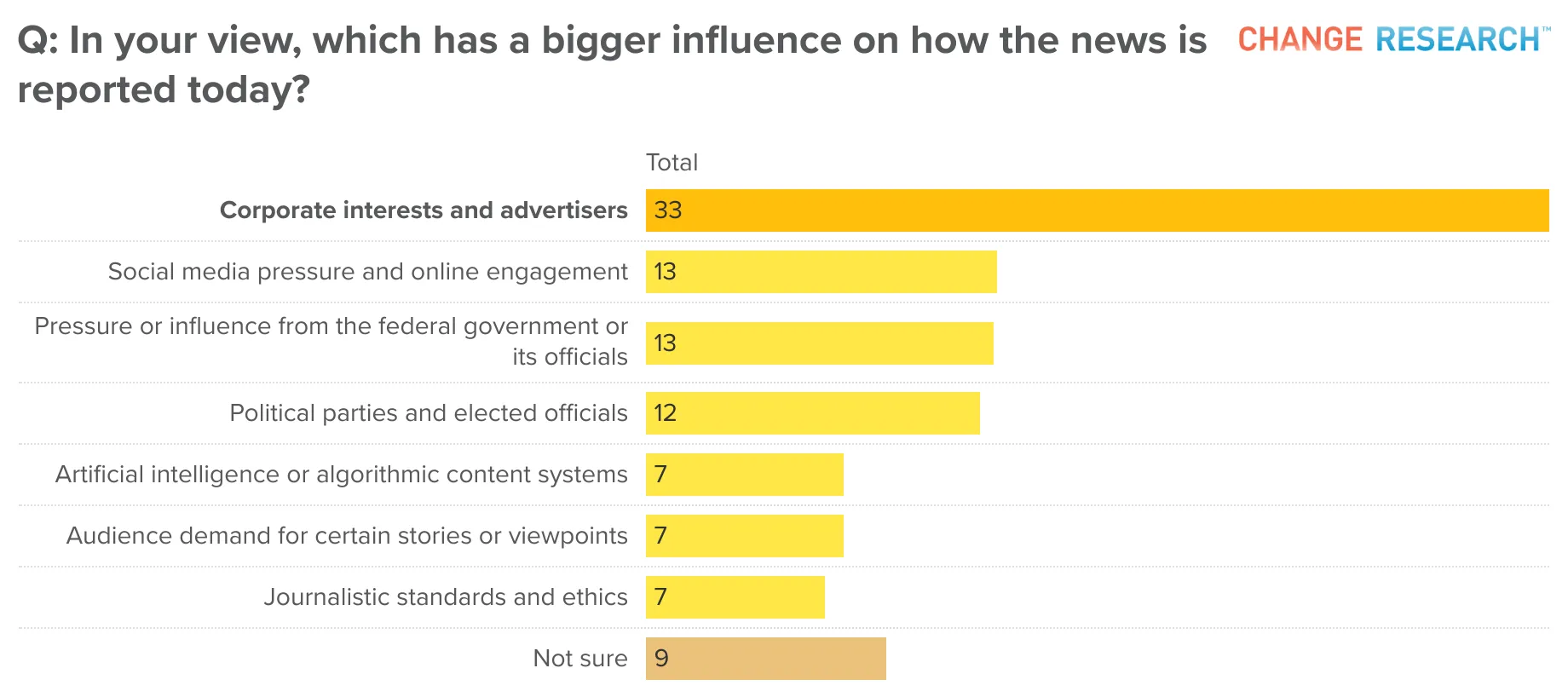
Democrats and Republicans both most frequently cite corporate interests as the primary influence, though Democrats do so at higher rates (38% compared to 23% of Republicans). The partisan differences emerge more clearly in other areas: Republicans are more than twice as likely as Democrats to point to political parties and elected officials (19% versus 8%), and are also more likely to cite social media pressure and online engagement (18% versus 10%). Democrats, meanwhile, are more than three times as likely as Republicans to cite federal government pressure (19% versus 6%).
Social Media’s Growing Role
Social media pressure and online engagement rank as the perceived biggest influence for 13% of Americans overall. Younger voters show particular attention to these dynamics. Among 18 to 34-year-olds, 20% identify social media pressure as the primary influence, more than double the 8% of those 65 and older who share this view.
Broad Support for Press Freedom, Divide on Government Censorship
Despite skepticism about how news is influenced, Americans overwhelmingly agree that a free press is essential for democracy. Ninety-four percent strongly or somewhat agree with this principle. This support cuts across party lines: 99% of Democrats, 92% of independents, and 90% of Republicans.
However, views diverge sharply on government power to limit reporting. When asked whether the government should have the power to restrict what journalists report if it believes national security or public order are at risk, Americans are divided: 44% support restrictions and 53% oppose. The partisan split is stark: 74% of Republicans support such government power compared to just 20% of Democrats. Among independents, 26% agree.
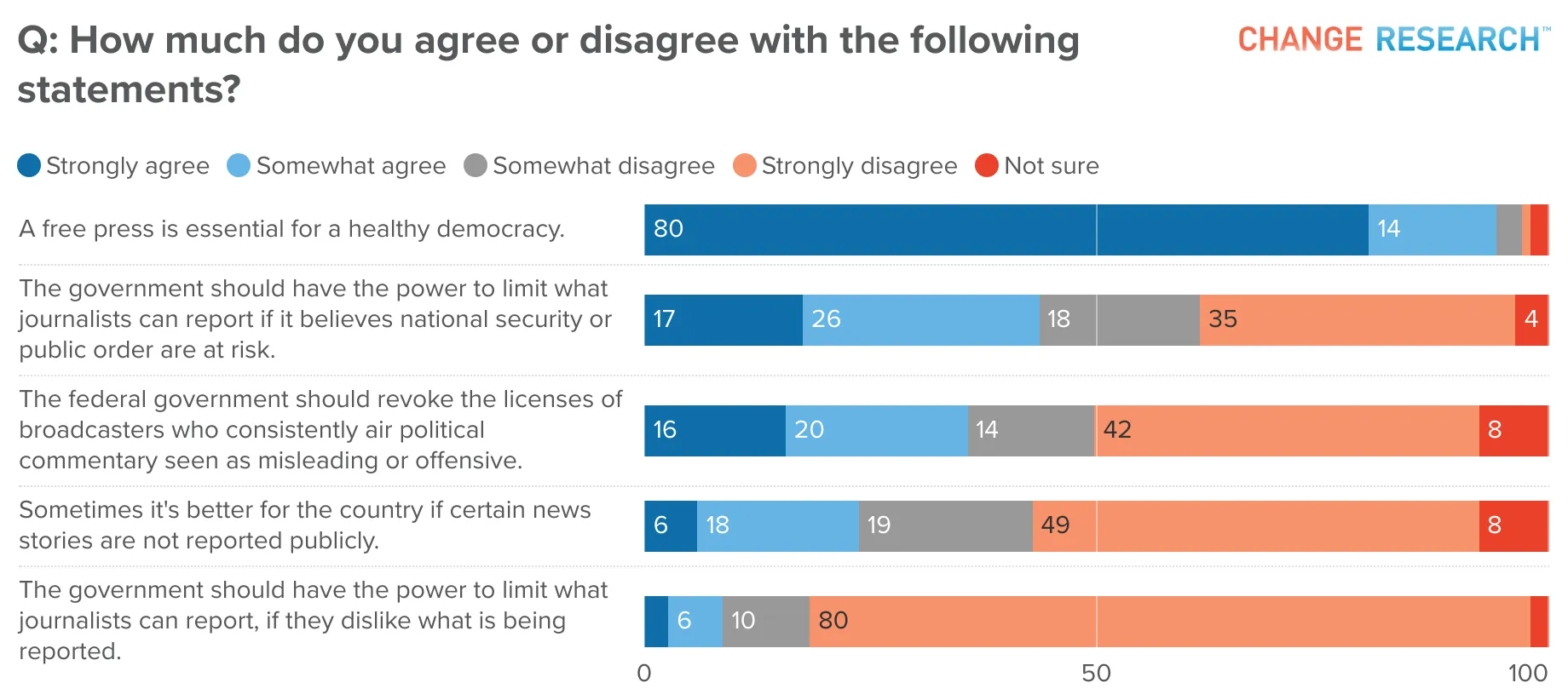
Support for government censorship drops when the national security justification is removed. Only 9% agree that the government should have power to limit reporting based simply on dislike of content, while 81% disagree.
Americans Are Navigating a New Information Landscape
The findings show a public rethinking who they trust and how they get information. Traditional gatekeepers hold less sway. Corporate and political pressures are seen as significant forces shaping the news. Independent voices continue to gain traction across the political spectrum. And Americans remain committed to the idea of a free press even as they disagree sharply about the government’s role in regulating it.
The Change Research Compass Poll surveyed 1,991 registered voters between November 19 and December 2, 2025. The modeled margin of error is 3.0 percentage points.
[/difl_advanced_blurb]
See the full data behind this poll
Sign up for the award winning Change Research Data Portal to gain insights like these every month with new polling.