Americans Split on Olympic Athletes Speaking Out as Politics Dominates Milano Cortina Games
New polling from Change Research, conducted February 5-18 during the 2026 Winter Olympics in Milano Cortina, finds Americans almost evenly divided on whether Olympic athletes should use their platform to speak out on political issues.
Throughout the Games, multiple U.S. athletes made headlines for speaking out on domestic politics, drawing both praise and backlash, and putting the tension between athletic expression and national representation front and center.
The Games will also be remembered for what happened on the ice and snow. Team USA set a record with 11 gold medals, the most ever for the U.S. at a Winter Olympics. Alysa Liu won America’s first women’s figure skating gold in 24 years. And both U.S. hockey teams won gold in dramatic 2-1 overtime victories against Canada, with the men earning their first gold since the 1980 “Miracle on Ice.”
The Partisan Gap on Athlete Expression
Forty-seven percent of Americans say Olympic athletes should speak publicly about political issues if they choose to, while 43% say they should not.
The split falls sharply along party lines. Eighty percent of Democrats support athletes speaking out, compared to just 14% of Republicans, a 66-point partisan gap that underscores how even the Olympics have become contested ground in American politics.
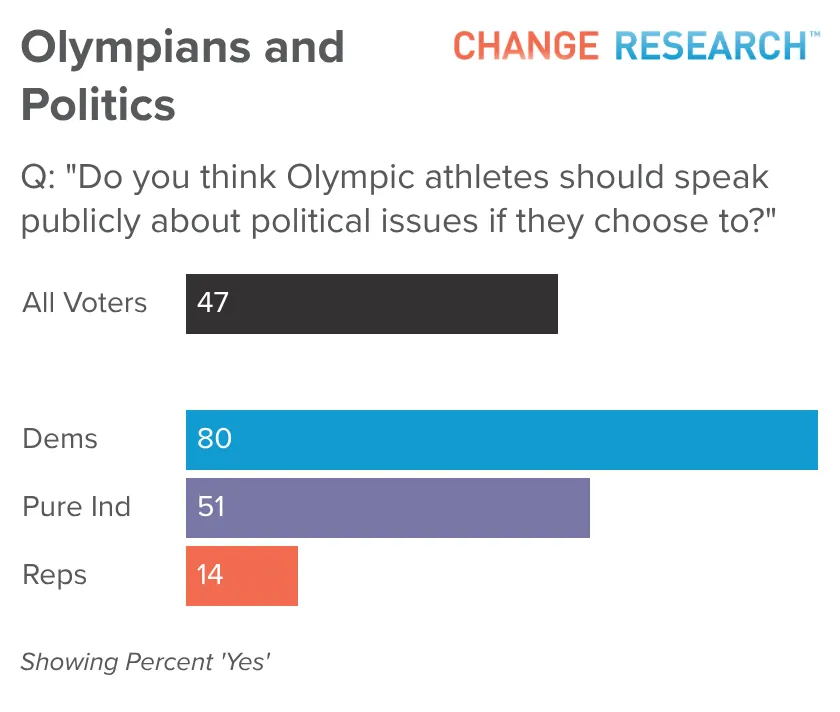
That divide played out in real time. Figure skater Amber Glenn, freeskier Hunter Hess, and snowboarder Chloe Kim all drew headlines for speaking out on issues ranging from LGBTQ rights to immigration, with Hess facing direct criticism from President Trump on Truth Social after saying representing the U.S. brought him “mixed emotions.”
The tensions carried into the post-Games spotlight as well. Trump invited the men’s hockey team to his State of the Union address and announced goaltender Connor Hellebuyck would receive the Presidential Medal of Freedom. The women’s team declined a late-notice invitation, citing scheduling conflicts.
ICE Personnel at Olympics
Perhaps no issue better illustrated the collision of politics and sport at these Games than the deployment of ICE’s Homeland Security Investigations unit to provide security support. The presence sparked protests in Milan well before the opening ceremony, with hundreds gathering to demand U.S. immigration agents leave Italy. Milan Mayor Giuseppe Sala publicly declared ICE “not welcome” in his city. Clashes between protesters and police erupted during the first weekend of competition.
Fifty-one percent disapprove of including ICE personnel to support security for U.S. officials and athletes at the Olympics, while 39% approve.
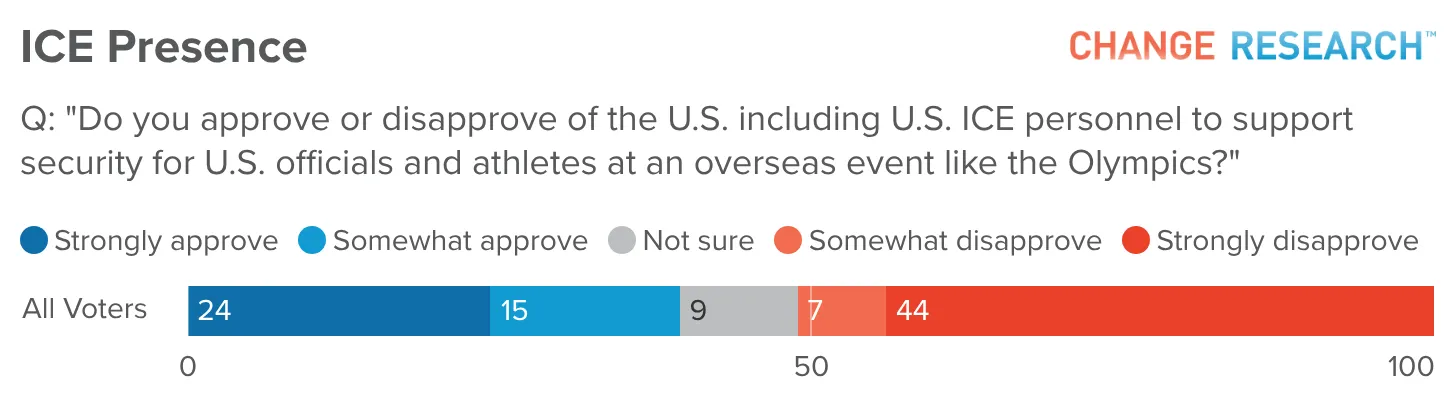
The partisan divide is stark. Eighty-six percent of Democrats disapprove of the ICE presence, while 73% of Republicans approve.
Why Americans Watch
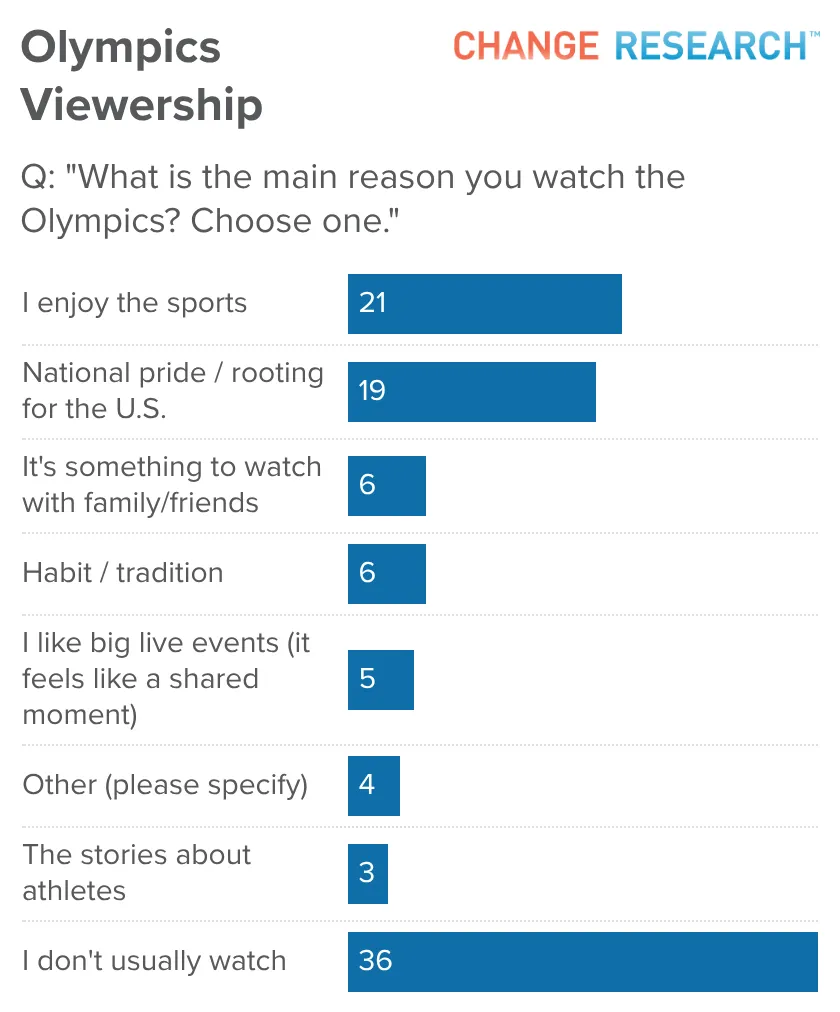
When asked the main reason they watch the Games, responses were scattered. Twenty-one percent say they enjoy the sports, while 19% cite national pride and rooting for the U.S. But notably, 36% say they don’t usually watch at all.
Men were slightly more likely to watch for the sports themselves (23%) compared to women (19%). Older Americans showed stronger interest in national pride as a viewing motivator, with those ages 50-64 most likely to cite this reason (24%), compared to just 15% of those ages 18-34. National pride as a motivator also skewed Republican (27%) versus Democrat (15%).
The polling data, captured as many of these events unfolded, reflects a country where the question is no longer whether politics belongs at the Olympics, but how Americans sort themselves around it when it arrives.
Methodology: Change Research conducted this survey of 1,741 registered voters from February 5-18, 2026, with a modeled margin of error of plus or minus 2.5 percentage points.
See the full data behind this poll
Sign up for the award winning Change Research Data Portal to gain insights like these every month with new polling.