
New Compass Poll Finds Strong Opposition to Military Force Abroad, Even Among Republicans, on Greenland
President Trump capped a week of diplomatic turbulence by announcing a “framework” deal on Greenland, claiming the U.S. will have “total access” to the territory forever. But new polling data suggests Americans are skeptical of his foreign policy approach and oppose using military force to take the Danish territory, even as the administration declares victory.
The poll, conducted January 13-20, 2026, interviewed 1,588 registered voters as part of Change Research’s internal Compass Poll series, which informs the Change Research Data Portal. Trump’s approval on international relations stands at 44% approve versus 53% disapprove, for a net approval rating of -9 points. His handling of the economy fares slightly better at 46% approve to 53% disapprove (net -7).
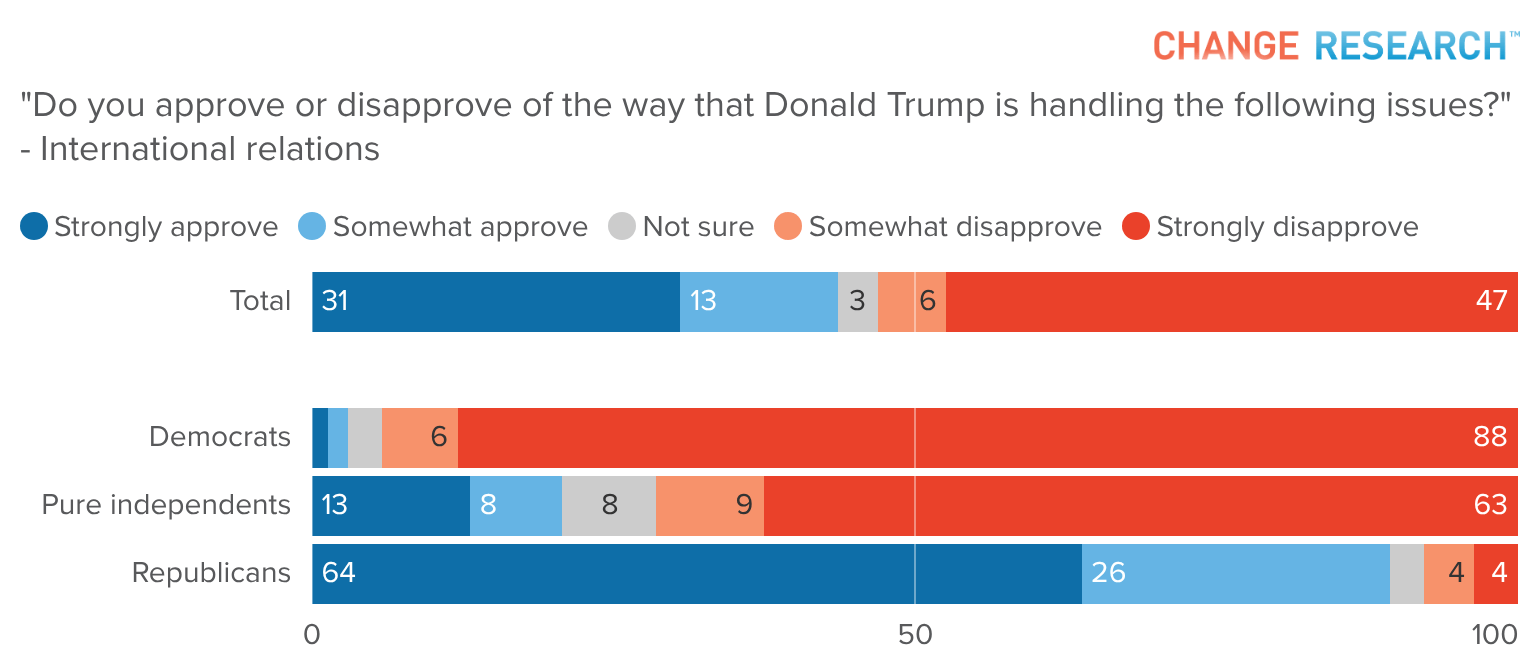
Views are sharply polarized by party. Republicans approve of Trump’s handling of international relations 89% to 8%, while Democrats disapprove 94% to 3%. Pure independents disapprove 71% to 21% (net -50).
The poll was fielded during a period of public disputes with European allies, including tariff threats tied to Greenland and heightened tensions around NATO and Arctic security. After initially threatening tariffs on several European countries, Trump announced a “framework” agreement with NATO Secretary General Mark Rutte that paused the tariff threat. Danish officials said sovereignty was not part of any negotiation.
Strong Opposition to Greenland Military Force
Seven in ten Americans (70%) oppose military force in Greenland, including 60% who strongly oppose it. Just 21% support such action. This makes Greenland the least popular place for the U.S. to engage its military among nine scenarios tested, with a net support of -49 points.
Perhaps most notably, even Republicans are split on military action in Greenland: 42% support versus 44% oppose (net -2). Pure independents oppose Greenland military action 83% to 8%, a net -75. Democrats oppose it 92% to 3%.
The poll also tested a proposal reportedly discussed by the Trump administration to offer direct payments of up to $50,000 per Greenlander to encourage secession from Denmark. When asked specifically about this proposal, Americans oppose it by a wide margin: 67% oppose compared to 24% who support. Among Republicans, only 49% support the payment proposal while 37% oppose.
Other potential military interventions also draw majority opposition:
- Mexico: 34% support, 59% oppose (net -25)
- Colombia: 32% support, 57% oppose (net -25)
- Cuba: 33% support, 58% oppose (net -25)
- Syria: 33% support, 56% oppose (net -23)
- Gaza: 35% support, 56% oppose (net -21)
- Iran: 40% support, 52% oppose (net -12)
- Venezuela: 42% support, 53% oppose (net -11)
- Ukraine: 42% support, 51% oppose (net -9)
Ukraine is an exception in the partisan pattern: Democrats show 47% support and 46% opposition (net +1), while among Republicans 39% support and 53% oppose (net -14). Pure independents oppose 63% to 31%.
Maduro Capture: A Polarized Response
Voters approve of the early January capture of Venezuelan President Nicolás Maduro by a 10-point margin. Fifty-three percent approve of the operation that brought Maduro to the United States to face drug and weapons charges, while 43% disapprove.
Approval is sharply divided by party: Republicans approve of the Maduro capture 95% to 3%, while Democrats disapprove 79% to 15%. Pure independents lean against: 35% approve, 54% disapprove (net -19).
When asked what they believe motivated the Venezuela intervention (they could choose multiple options), voters’ answers split predictably: 85% of Republicans cite “combating drug trafficking,” while 75% of Democrats point to “securing access to oil” and 74% say the operation was meant to “distract from domestic issues.”
Americans Want Congress to Check Presidential Power
Asked what role politicians in Washington should play, Americans favor congressional oversight over giving Trump a free hand on foreign policy.
Forty-five percent want officials to speak up and take a stand against his actions, and 33% want Congress to serve as a check while giving him credit for successes (78% total favor some form of constraint). Just 23% say they want to “allow President Trump to conduct foreign policy however he feels is best.”
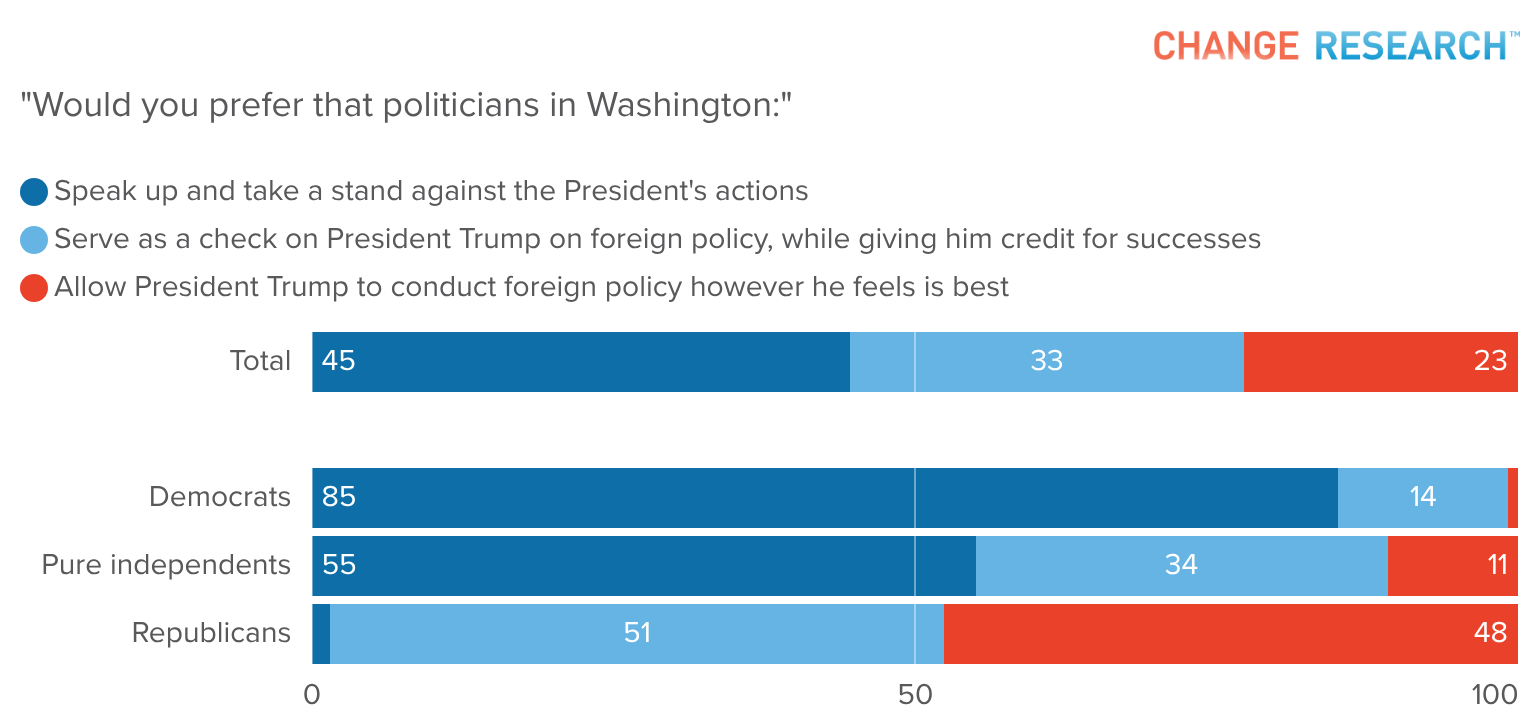
Among Republicans, 48% want Trump to “conduct foreign policy however he feels is best,” while 51% prefer Congress “serve as a check” while giving credit for successes. Among pure independents, 55% want elected officials to “speak up and take a stand against the President’s actions,” with another 34% favoring the check-with-credit approach.
A Challenging Landscape for Diplomatic Ambitions
The polling shows limited public support for a more aggressive push on Greenland. Seven in ten voters (70%) oppose using military force to acquire Greenland, and Republicans are essentially split (42% support, 44% oppose). Voters also reject the idea of direct payments to Greenlanders by a wide margin (67% oppose, 24% support).
This skepticism comes alongside an already negative baseline for Trump’s international standing: 44% approve and 53% disapprove of his handling of international relations (net -9). Pure independents are particularly negative at 21% approve and 71% disapprove (net -50).
Meanwhile, the administration’s “framework” announcement remains unclear. Danish officials have said sovereignty was not negotiated, and NATO has emphasized Arctic security cooperation rather than territorial transfer.