Americans Feel AI's Impact and Worry About the Future
A Change Research national survey of 1,741 voters, conducted from February 5-18, 2026, finds that the transformation of American life by artificial intelligence is well underway for most. A majority of respondents (58%) report that AI has made their life “noticeably different” compared to just a few years ago. This includes 23% who describe the change as “very different” and 36% who say things are “somewhat different.” Conversely, only a little over a third of voters (34%) state that AI has not yet significantly altered their daily experience.
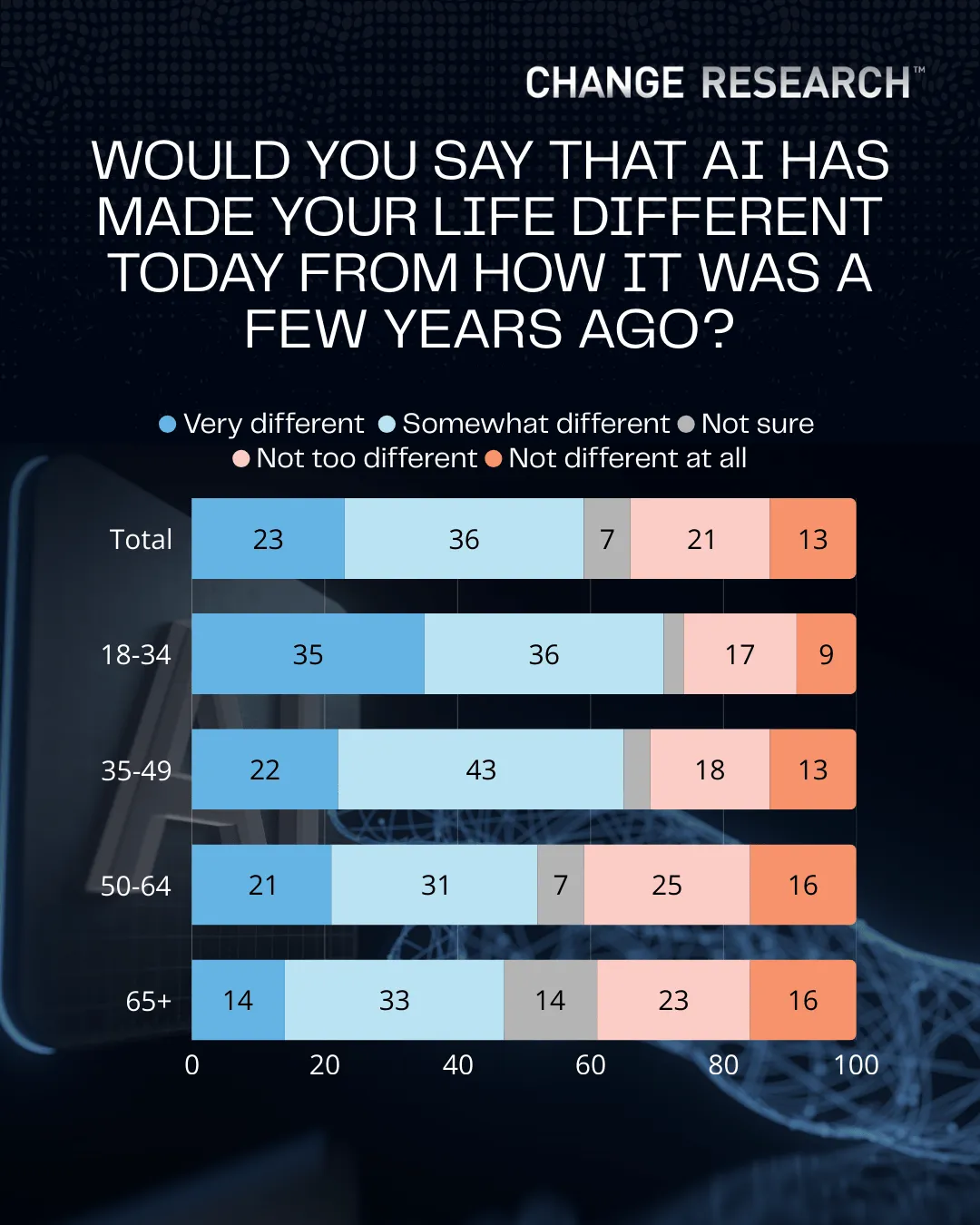
This tracks with broader national trends. As ChatGPT, Claude, and Gemini have grown in both capabilities and usage, AI-related layoffs have been in the news, and the technology has woven itself into search engines, workplaces, and customer service. The question is no longer if Americans feel the impact. It’s how they feel about it.
The answer? Mixed. Among those who say AI has changed their lives, 37% describe that change as mostly negative, compared to just 33% who say it’s been mostly positive. Another 28% land somewhere in the middle. That’s a net-negative sentiment of -4 points among those who say they are feeling AI’s impact.
How Americans Are Actually Using AI
When asked in their own words how they use AI today, the most common use case by far is search and research. Hundreds of respondents describe using AI as an alternative or supplement to traditional search engines, looking up information, answering questions, and conducting research. For many, AI hasn’t replaced Google so much as layered itself on top of it.
“I often use it as a dictation and Google replacement. It feels like a tutor, job counselor, and database rolled into one.”
— Hispanic/Latino Man, 35 to 49, Weak Democrat
The second most common theme is work and professional use. Respondents across industries describe relying on AI for writing emails, generating documents, analyzing data, and streamlining workplace tasks. Close behind that is writing and editing, where AI serves as a drafting partner, grammar checker, and brainstorming tool.
“Brainstorming ideas, improving my skills, small tasks like editing responses before sending.”
— Black/African American Woman, 35 to 49, Independent
Younger respondents and students frequently mention using AI for schoolwork and learning, while a smaller but notable group describes using AI for coding, creative projects like image generation, and health-related research.
The Other Side: Resistance and Resentment
But the usage data tells a two-sided story. A significant share of respondents say they are not using AI at all or actively avoiding it. This group skews older (the largest contingent is 65 and over) and leans Republican, but the resistance cuts across party lines.
A recurring frustration among these respondents: they feel AI is being forced on them whether they want it or not, particularly through search engines and built-in features they didn’t ask for.
“It’s forced upon me. I have no option to not use it, e.g., Google forcing an AI query whenever you search something up.”
— White, Man, 18 to 34, Strong Democrat
“Only in the automatic ways tech companies have foisted on me that I cannot opt out of. I have actively switched some platforms, including search engines and personal email, to avoid mandatory AI implementation.”
— White Woman, 35 to 49, Independent lean Democrat
This sense of involuntary AI exposure shows up across age groups and political affiliations, suggesting that the backlash isn’t just a technophobia problem. For many Americans, the issue isn’t what AI can do. It’s that they weren’t given a choice.
Looking Ahead: More Change, More Fear
If Americans are ambivalent about AI’s current impact, they’re outright uneasy about what’s coming. A full 70% expect their lives to be significantly different five years from now due to AI, including 34% who expect the change to be “very different.” Only 19% think things will stay roughly the same.
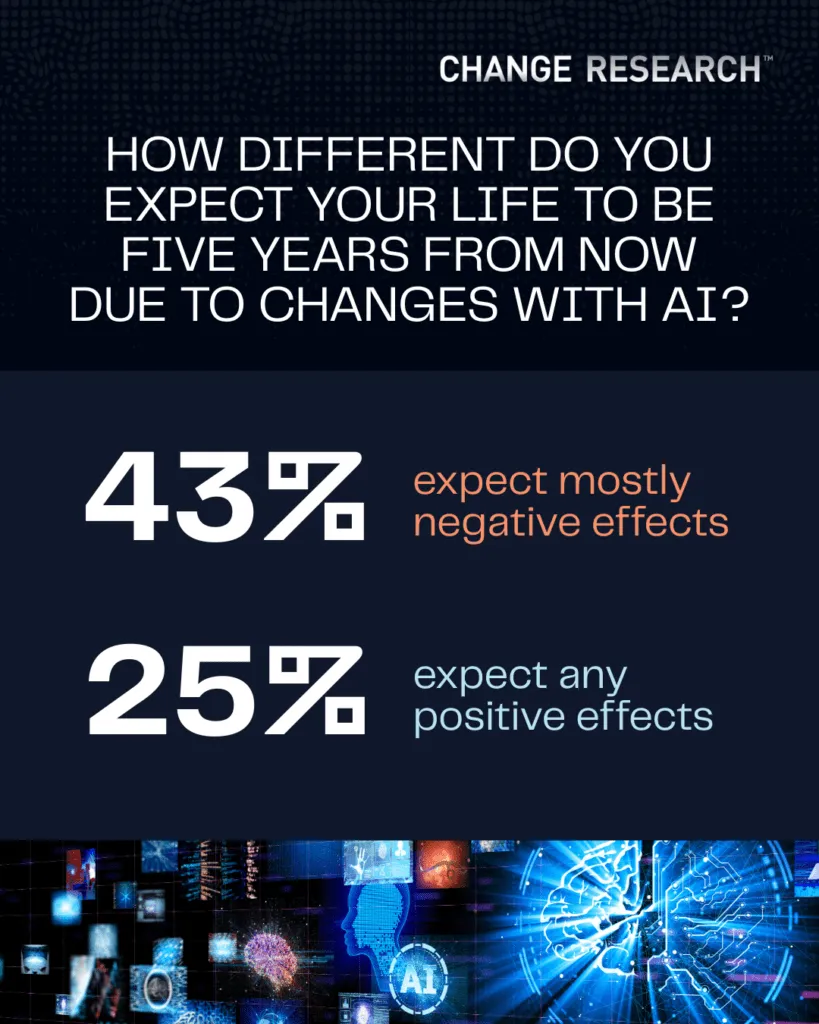
And the pessimism deepens when people look ahead. Among those who expect AI to reshape their future, 43% anticipate mostly negative changes, while just 25% expect those changes to be mostly positive. That’s a net-negative of -18 points on future AI sentiment, considerably more pessimistic than people’s feelings about the changes that have already taken place.
Future AI pessimism outpaces present-day concerns by 14 points, suggesting that fear-driven narratives are widely accepted.
In Their Own Words: What Americans Fear About AI’s Future
When asked in an open-ended format how they expect AI to change things in the next five years, respondents paint a vivid, often negative picture. The dominant theme, by a wide margin, is job loss and economic displacement. Roughly one in five respondents who answered this question raised concerns about AI replacing workers, automating jobs, or concentrating wealth among those who own the technology.
“Attempts to mass automate jobs will have a depressive effect of labor resulting in less jobs and higher profits for capitalists that they are unlikely to share with the remaining increasingly productive workers.”
— White Man, 18 to 34, Weak Democrat
“I think AI is a can of worms we’ve opened that we can’t close. I think there’s going to be massive layoffs. I think we’re gonna have huge unemployment. I think AI is going to lead to the wealthy in increasing their wealth while the bottom half sinks lower.”
— White Woman, 35 to 49, Strong Democrat
Concerns around job loss cross party lines. Republicans, Democrats, and independents all raise it as a top concern. It’s especially pronounced among younger voters, who are both the most likely to use AI and the most likely to worry about its long-term economic impact.
The second major theme is erosion of truth and a rise in misinformation. Respondents frequently express concern about deepfakes, AI-generated disinformation, and the growing difficulty of distinguishing real content from fabricated material. This concern surfaces across all demographics, but it’s particularly common among older voters and women.
“Already can’t believe most of what you see on internet, expect it to get worse.”
— White Man, 50 to 64, Strong Republican
“Make everything visual less likely to be trustworthy.”
— White Man, 65+, Strong Republican
A third recurring theme is the decline of human skills and critical thinking. Many respondents worry that AI dependency will erode people’s ability to think for themselves, solve problems, and develop essential competencies.
“A more dependent, less problem solving society. Increasing mental health issues.”
— White Man, 18 to 34, Strong Republican
“I worry that AI will become too advanced, causing many people to become reliant on such technology. Lack of critical thinking from people. Also, I expect harsher water/electricity regulations at the state/federal level due to AI/data center usage.”
— White Woman, 18 to 34, Weak Democrat
Environmental Anxiety About AI
One of the patterns in the open-ended responses is a rising concern about AI’s environmental footprint. Dozens of respondents, disproportionately younger women, specifically mention water usage, energy consumption, data centers, and the strain on the electrical grid as major concerns about AI’s future.
“AI is destroying our planet. I don’t want to have to fight for water in five years.”
— White Woman, 18 to 34, Strong Republican
“Use too much water. Raise residential utility bills. Take jobs from humans.”
— White Woman, 18 to 34, Independent lean Democrat
“Scarcity of natural resources, different lobbying groups fighting for water likely at the detriment of the average US consumer, likely moving to an international water grab, we need sustainable business operations.”
— Hispanic/Latina, Woman, 35 to 49, Pure independent
This is a theme that spans partisan lines, with both Republican and Democratic respondents raising concerns about water, energy, and data center impacts.
Not All Doom: Where Voters See the Upside
A meaningful subset of respondents see AI’s future through a more hopeful lens, pointing to advances in healthcare and medicine, improvements in research and scientific discovery, and the potential for AI to make everyday tasks more efficient.
“I hope AI can accelerate health/disease research”
— White Woman, 65+, Strong Democrat
“I believe AI will change things for the better and I hope it’ll all help our world thrive and be more positive letting us fulfill our goals and dreams easier and quicker too with the help from AI!”
— Hispanic/Latino, Man, 18 to 34, Pure independent
Among some optimists, responses include caveats. The most common sentiment among those with positive views could be summed up as: this could be great, but only if the right guardrails are in place. Many express a conditional optimism that hinges on regulation, corporate responsibility, or distribution of AI’s benefits.
“I think AI will negatively impact the world without strict regulations. I would love to see AI used in the medical sector for cancer detection and research purposes but am worried about the implications of attempting to use AI to replace doctors and other skilled workers.”
— White Woman, 18 to 34, Weak Democrat
Who Uses AI Most: Age, Race, and the Digital Divide
AI’s impact doesn’t land equally. Young Americans are by far the most likely to say AI has already changed their lives: 71% of voters aged 18 to 34 report their lives are different because of AI, compared to just 47% of voters 65 and older. The 35-to-49 age group falls close behind at 66%.
The racial divide is also notable. 67% of Hispanic voters and 67% of AAPI voters say AI has made their lives different, compared to 61% of Black voters and 55% of white voters. Across all voters of color, the figure is 64%, nine points higher than among white voters.
Women are slightly more likely than men to say they feel the change (61% vs. 56%), and college-educated voters report very similar levels of impact to non-college voters (58% vs. 59%).
The sentiment divide is where things get interesting. Among those who say AI has changed their lives, men are more likely to view the change positively (37% positive vs. 29% among women), and AAPI voters stand out dramatically as the most optimistic group: 51% of AAPI voters who feel AI’s impact say that change has been mostly positive, compared to 31% of white voters and 31% of Black voters.
Looking ahead, the future-pessimism gap persists across nearly every group. But voters 65 and older are the most negative about what’s coming: among those who expect AI-driven change, 44% anticipate mostly negative effects. Democrats (47%) and white voters (47%) also lean heavily negative on AI’s future trajectory.
The Tech Company Report Card: Google and Amazon Strong, OpenAI Not So Much
In the race for public approval, not all tech companies are created equal. Google stands alone as the most favorably viewed tech entity in the poll with a net favorability of +13 (38% favorable, 25% unfavorable). Apple comes in at +3 net favorable (31% favorable, 28% unfavorable), and Amazon lands at +6 (38% favorable, 32% unfavorable).
LinkedIn is the only social media platform with a positive net favorability at +3 (22% favorable, 19% unfavorable). Every other social platform is underwater, with TikTok (-31) and X/Twitter (-23) faring the worst. Facebook sits at -10 and Instagram at -5.
But AI-specific companies were – at the time of this survey in February – either relatively unpopular or not very well known.
OpenAI as a company carried a net favorability of -31 (15% favorable, 46% unfavorable), making it one of the least popular entities in the entire survey. Its consumer product, ChatGPT, fared better at -11 net favorable (23% favorable, 34% unfavorable): the brand name carries more goodwill than the company behind it. ChatGPT’s favorability was sharply divided by age: 28% of 18-to-34-year-olds viewed it favorably compared to just 13% of voters 65 and older.
Other AI companies barely registered. Anthropic (maker of the AI assistant Claude) had a 63% “never heard of them” rate, with just 4% holding a favorable view. Claude itself sat at 68% unknown. Palantir has better name recognition (54% unknown) but carries a -24 net favorability among those with an opinion. Voters of color consistently view tech companies more favorably than white voters: Google’s net favorability among Black voters is +33, compared to +9 among white voters.
The Bottom Line
Americans are increasingly aware of AI. A clear majority already feel its presence in their daily lives, and an even larger share expects the pace of change to accelerate. But the national mood is decidedly cautious. More people describe AI’s impact as negative than positive, and that pessimism only grows when people look to the future.
The open-ended responses add texture to the quantitative data. Job loss dominates the conversation, but concerns about misinformation, the erosion of critical thinking, and AI’s environmental footprint create a web of concerns that go beyond economics. The conditional optimism that does exist tends to come with heavy caveats about regulation and fairness.
Several of the biggest tech companies – Google, Amazon, and Apple – are far more popular than many other large American institutions. Still, the numbers around AI show that some companies building AI are struggling to win public trust. OpenAI, the most recognizable name in the AI space, is deeply unfavorable. (This poll was fielded before recent well-reported stories connecting Anthropic, the Department of War, and OpenAI.)
The demographic fault lines matter for anyone thinking about AI politics and policy. Young voters and voters of color feel AI’s impact most acutely, and they’re also the groups most likely to see the upside. Older voters and white voters skew toward pessimism. As AI companies put money into 2026 midterm campaigns and we see the reshaping of the labor market in real time, these attitudes are poised to change quickly.
Methodology
Change Research conducted this survey of 1,741 respondents nationally from February 5-18, 2026. The modeled margin of error is ±2.5 percentage points.
See the full data behind this poll
Sign up for the award winning Change Research Data Portal to gain insights like these every month with new polling.