
Last week, the Change Research team hosted the latest installment of our Plus or Minus webinar series, walking attendees through fresh data from our May 2026 Compass Poll on one of the defining issues of the midterm cycle: the economy. Head of Polling Stephen Clermont and Head of Analyst Team Melanie Phillips led the session, drawing on a survey of 2,244 registered voters conducted May 5-10, 2026, with a modeled margin of error of ±2.4%.
Consumer Confidence Is in Uncharted Territory
The University of Michigan’s consumer sentiment index sits at 48.2, a reading lower than any point recorded over the past 50 years – lower than during the recessions of the late 1970s and early 1980s, lower than the depths of the Great Recession in 2008, lower than COVID, and lower than the inflation peaks of the Biden years. No second-term president in modern history has faced a drop this steep, and the data makes clear that voters are noticing it.
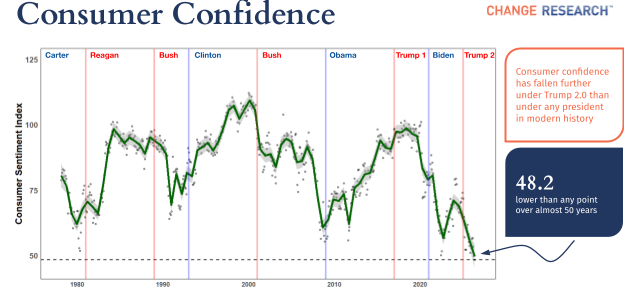
During Trump’s first term, personal disposable income (also known as take-home pay) grew faster than inflation, a dynamic that drove his strong economic approval heading into 2024. That dynamic has reversed in the second term. Inflation has been outpacing growth in personal disposable income, which has largely stayed flat. 65% of middle-income Americans say their income is falling behind the cost of living. That share has held at roughly two-thirds for several quarters.
The Unstable Electorate
For this poll, we divided voters into a ‘Brick Wall’ group (49% of respondents) whose vote choice is fixed, and five overlapping persuadable groups that together make up the other 51%.
Brick Wall voters are decided on their House race, rate their motivation to vote as a 10/10, are 35 or older, and clearly identify as either Democrats or Republicans. That group tilts Republican 54% to 46%.
The other 51% look very different. They skew younger, are more racially diverse, and are less educated on average. They are also experiencing the economy in a fundamentally different way than Brick Wall voters: more financially precarious, more pessimistic about the future, and far less insulated from the gap between what things cost and what they take home. That shared economic anxiety, cutting across Movables, Pure Independents, younger voters, and 2024 non-voters, is what makes this group worth understanding together.
Economic Pain Is Not Partisan
Among Movable voters (those who are undecided in the House race, unfavorable toward both parties, or who somewhat disapprove of Trump’s job), 71% say the United States is already in a recession. 73% of Pure Independents say the same. 72% of Gen Z respondents say yes, we’re already in a recession, the highest of any generation.
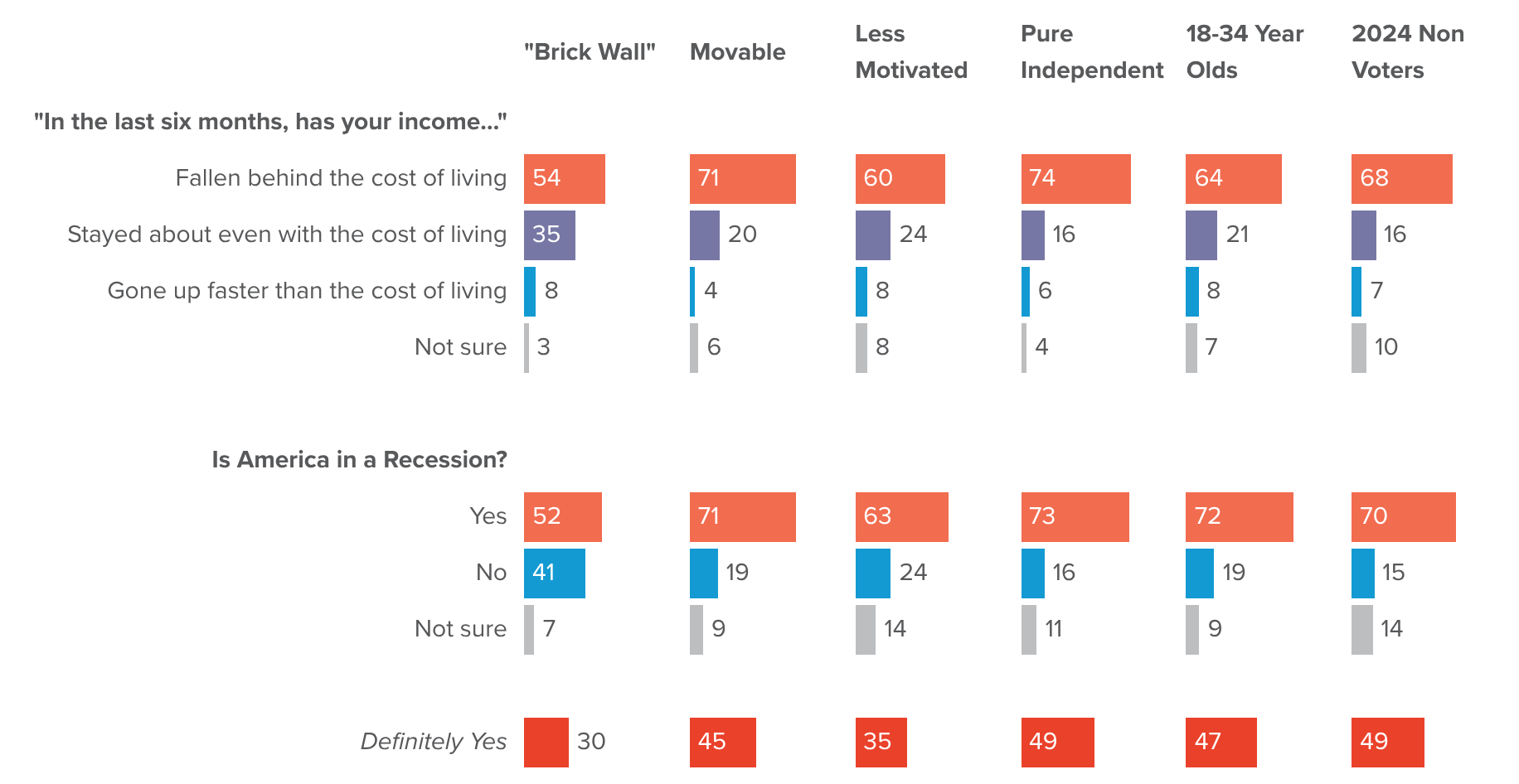
69% of Movable voters say they cannot save enough for retirement. 69% say they are behind where they expected to be financially at this stage of their lives. Nearly half of persuadable voters do not have an emergency fund to cover a $1,000 expense.
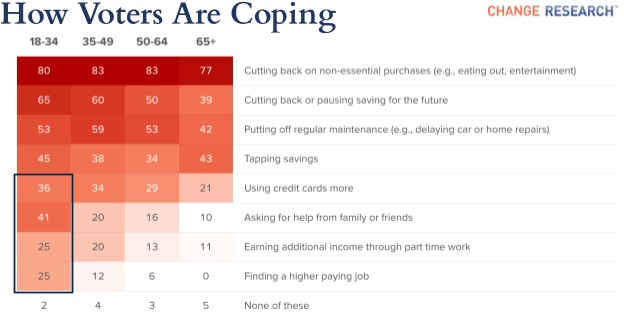
When asked how they are coping with the gap between income and costs, voters across the board report cutting back on non-essential spending. Younger voters, 18 to 34 year olds especially, are more likely to be taking on extra work, using credit cards, or asking family and friends for help. These patterns are notably less common among Brick Wall voters, who have emergency savings and a generally positive assessment of their personal finances.
The Political Divide

Outside the Brick Wall, pessimism about the economic future is widespread. Among Movable voters, approximately two-thirds believe the U.S. economy will be worse a year from now. Similar majorities expect the prices of everyday goods to keep rising.
Trump is underwater with every group outside his firm base. 73% of Movable voters and 73% of Pure Independents view him unfavorably. His net approval on inflation among Movable voters is -65; among Pure Independents, it is -66.
On the generic House ballot, Democrats lead among every persuadable group. Among Movable voters, the split is 37% Democrat, 18% Republican, and 45% not sure. That undecided chunk represents the primary persuasion and battleground for voter turnout for both parties.
Neither party is viewed favorably by persuadable voters: 78% of Movables rate Democrats unfavorably, and 73% rate Republicans unfavorably.
What Voters Say Matters
Government corruption is the number one issue across all voter segments, including Brick Wall, Movable, Less Motivated, younger, and 2024 nonvoters. Among Pure Independents, 56% name it as a top priority. Inflation and the high cost of goods ranks second among Movables, Less Motivated voters, and 2024 Non-Voters.

On the least important end: 41% of Movable voters and 45% of Pure Independents say fighting wokeness and DEI are a low priority.
What We’re Watching
The pool of persuadable voters is bigger than past cycles would suggest, and frustration with current economic conditions is real and growing across nearly every non-Brick Wall segment. The data points toward competing in more places geographically and among more voter groups than 2022 and 2024 results might indicate, with costs and government corruption as the through-line issues.
Brick Wall voters are largely insulated from financial instability, but they are a shrinking share of the overall electorate. Millennials and Gen Z already make up a significant portion of the voting-age population, and both groups show higher rates of economic anxiety, financial precarity, and pessimism about the future than older voters. Change Research will be tracking how those attitudes shift as the midterms approach.
Every month, Change Research reaches into our depth of Compass Poll data to walk you through what voters are saying and feeling and providing our strategic analysis. In this live briefing, our team breaks down the freshest findings from the Change Research Data Portal, covering the issues, attitudes, and shifts that matter most heading into the 2026 midterm election. Because in a cycle this close, the plus or minus is everything. Register here for the next session.
Missed the live session? Catch up with the Briefing Deck and the Webinar Recording.