
A Change Research national survey of 2,702 registered voters, conducted April 3-7, 2026, finds that opposition to data center construction has grown substantially over the past year. Fewer than four in ten voters support building data centers nationally, and support collapses further when voters are asked about construction in their own communities or on property near their homes. The findings are the latest in a series of Change Research surveys tracking how public attitudes toward data centers have shifted as construction activity has accelerated and awareness of energy and infrastructure impacts has increased.
The survey comes as the Trump administration has made AI infrastructure expansion a top priority, with billions of dollars in announced investments in data center construction across the country. Federal and state officials have fast-tracked permitting in several states, even as local opposition has intensified in communities where facilities are planned or under construction.
National Support Has Declined
In early 2025, most voters said they had heard little or nothing about data centers being built in their local communities. By mid-2025, awareness of the issue had grown broadly, with a separate Embold Research national survey finding roughly two-thirds of voters had heard at least “some” about data centers. That shift coincided with a period in which large-scale construction projects from Meta, Google, Microsoft, Amazon, and companies linked to Elon Musk became visible in communities across the country, and public hearings and local government debates brought the issue into mainstream conversation.
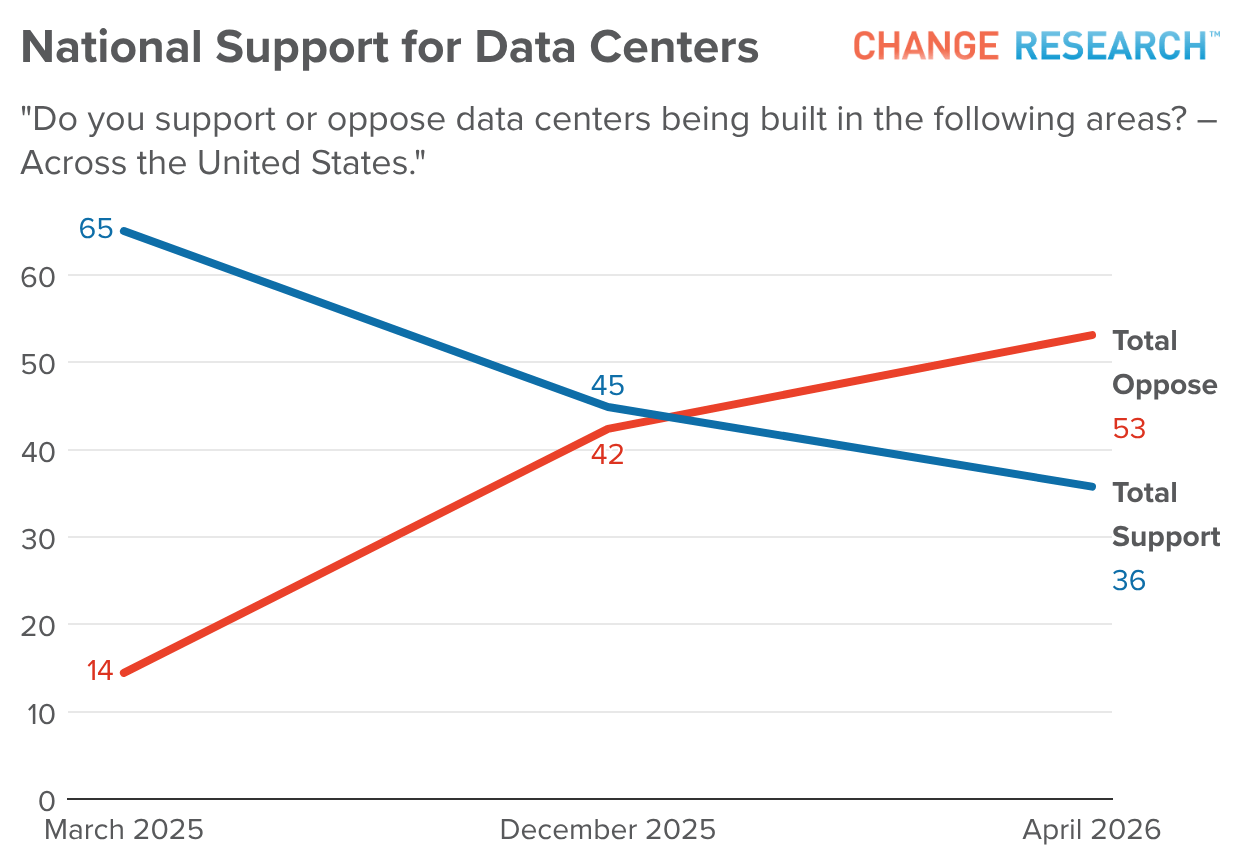
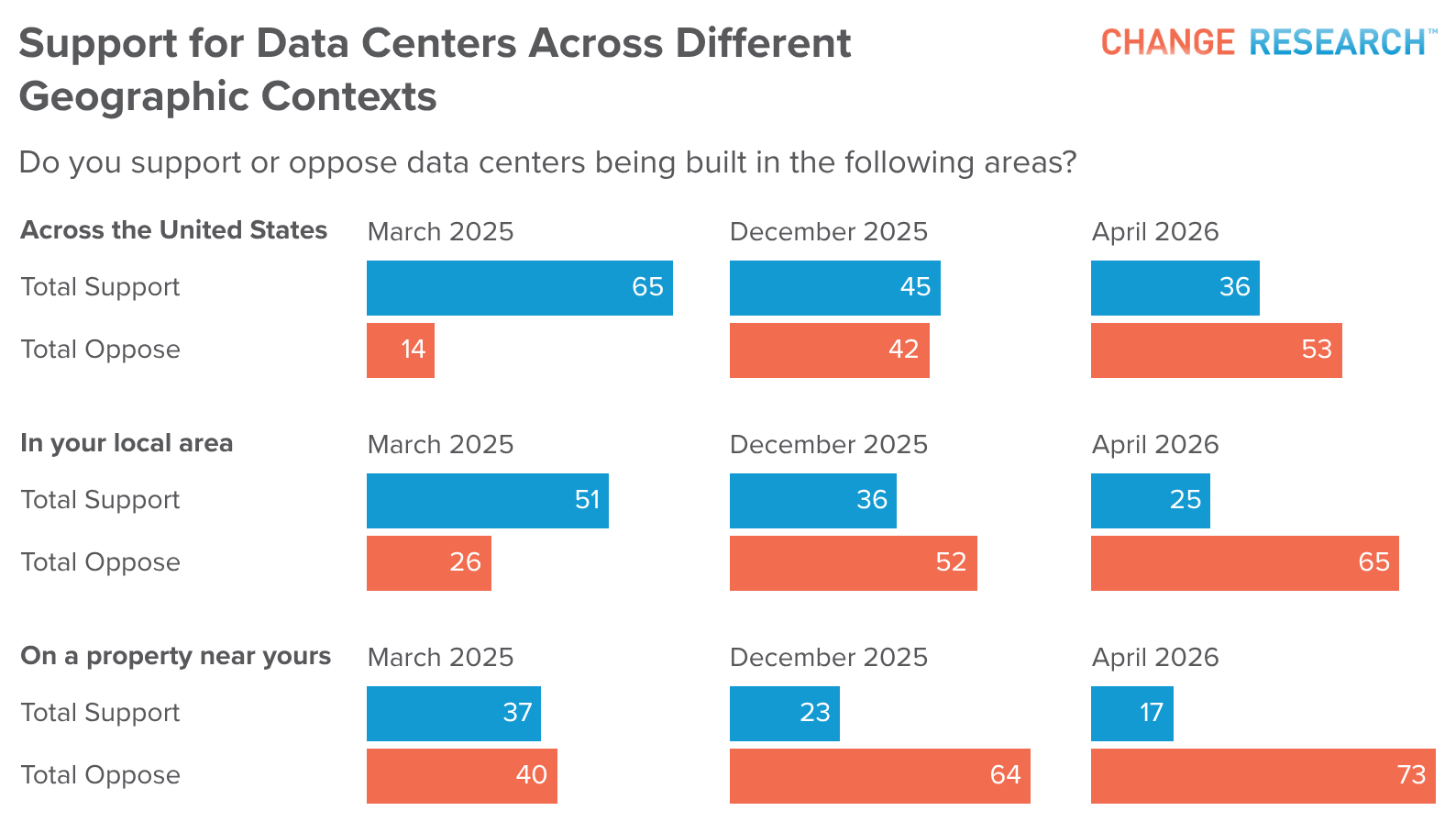
The polling numbers followed that arc. In March 2025, 65% of voters supported building data centers across the United States, with just 14% opposed. By December 2025, national support had fallen to 45%, and national opposition had risen to 42%, nearly reversing the picture from nine months earlier. In April 2026, roughly 36% of voters support national data center construction, with 53% opposed.
The April 2026 survey tested two versions of a question about data centers. One version specified that data centers power technologies “such as artificial intelligence (AI).” The other described them as facilities that “store information and process data” without mentioning AI. Nationally, support was slightly lower in the version that mentioned AI (35% support, 55% oppose) compared to the version that did not (37% support, 51% oppose), though the differences at the local and nearby-property levels were minimal.
Local Opposition Is the Sharpest
The surveys consistently show a geographic gradient: voters are more willing to accept data centers in the abstract nationally than in their own communities, and far less accepting of construction on property near their own homes.
In March 2025, 51% of voters supported building data centers in their local area, compared to 26% opposed. By December 2025, local support had fallen to 36% with 52% opposed, a net swing of more than 40 percentage points in nine months. In April 2026, just 25-26% of voters support local construction, with 65% opposed.
Opposition to construction on property near respondents’ own homes is the most pronounced. In March 2025, opinions were roughly split, with 37% supporting and 40% opposing nearby construction. By December 2025, only 23% supported and 64% opposed. In April 2026, just 17-18% support nearby data center construction, with 73-74% opposed.
Partisan Patterns
In December 2025, Republican-leaning voters were more supportive of data center construction than Democratic-leaning voters across all three geographic contexts. Nationally, 56% of Republican-aligned voters supported construction, compared to 33% of Democratic-aligned voters. Locally, 47% of Republican-aligned voters supported construction versus 24% of Democratic-aligned voters.
In April 2026, the partisan split persists, but both groups have grown more opposed. 47-52% of Republican voters support national data center construction, compared to 23-24% of Democrats, with pure independents at 29-30% support. Locally, the numbers are tighter on the opposition side: 53-55% of Republicans oppose local construction, while 73-76% of Democrats oppose it.

Energy and Infrastructure Concerns
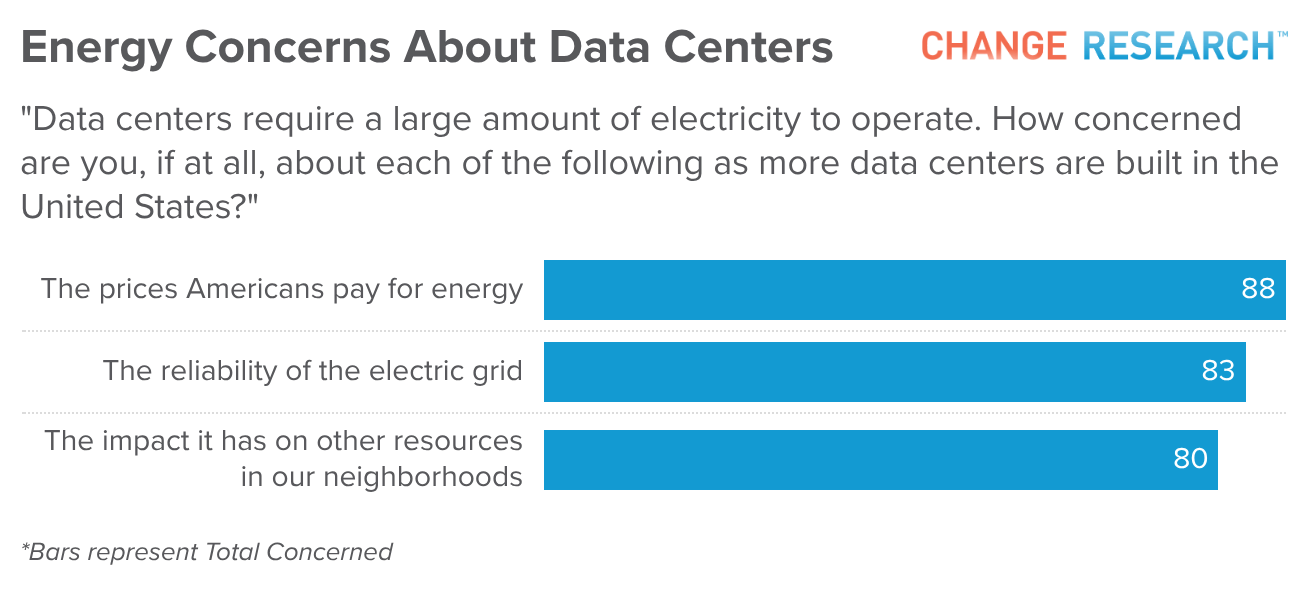
The December 2025 survey asked voters about specific concerns related to data center energy consumption. Among the concerns tested, energy prices drew the most alarm: 65% of voters said they were “very concerned” about the impact of data center electricity use on the prices Americans pay for energy, with another 23% “somewhat concerned.” Combined, 88% expressed some level of concern about energy prices.
Concern about grid reliability was also high, with 55% “very concerned” and 83% expressing some level of concern overall. On the question of impacts on other local resources such as water and land, 51% were “very concerned” and 80% expressed some concern overall.
The August 2025 Embold Research survey asked a related question about who should bear responsibility when rising energy demand exceeds grid capacity. A plurality, 40%, said the federal government should be responsible, followed by 28% pointing to utility companies and 18% to state governments. The question pointed to a broader public expectation that oversight of data center energy burdens should fall on public institutions, not just the private sector.
What Voters Are Saying
Open-ended responses from the March 2025 survey offered an early window into how voters were processing data center construction before opposition had hardened. Energy demand was the most recurring concern across political lines, appearing in nearly a third of all substantive responses. Respondents described local utility strain, grid fragility, and water consumption as their primary worries, often without prompting on any specific tradeoff.
A number of responses reflected firsthand awareness of local projects. Several respondents named specific corporate construction activity in their communities, including projects by Google, Meta, Microsoft, Amazon, and companies linked to Elon Musk, particularly in Memphis and West Tennessee.
Among the responses:
“Data centers require very large electrical power feeds. We do not have enough generation capacity to support them. Several centers have resorted to high pollution solutions.” – White Man, 50 to 64, Independent
“Feels like they’re popping up everywhere and they are a huge strain on water resources in an area.” – Hispanic/Latina Woman, 18 to 34, Democrat
“I know electrical engineers who design them for Meta. They are a huge energy drain on the grid and a massive heat source that no one is really talking about.” – White Man, 35 to 49, Independent
“In Texas, data centers are hogging electricity and energy sources where our grid is already fragile.” – White Woman, 35 to 49, Democrat
“Concerns about noise, but important part of the emerging economy.” – White Man, 50 to 64, Republican
“Elon Musk has chosen my city (Memphis, TN) as the location for the world’s largest artificial intelligence supercomputer. This has been a hot topic here for the last several months.” – White Woman, 35 to 49, Democrat
Methodology
Change Research conducted this survey of 2,702 registered voters from April 3-7, 2026. The modeled margin of error is ±2.0 percentage points. The March 2025 survey was conducted among registered voters in the same national sample frame. The August 2025 survey was conducted by Embold Research, Change Research’s nonpartisan research arm, among a national sample of registered voters. The December 2025 survey was conducted among 1,520 registered voters from December 5-10, 2025, with a modeled margin of error of ±2.7 percentage points. All surveys used online polling methodology with sample balancing on age, gender, race/ethnicity, education, and 2024 presidential vote.
Want access to the full crosstabs and data? Sign up for the Change Research Data Portal here. Already have a Data Portal account? Sign in here.